What Is Samyang (Rokinon)? A Complete Guide to the Korean Lens Maker(2)
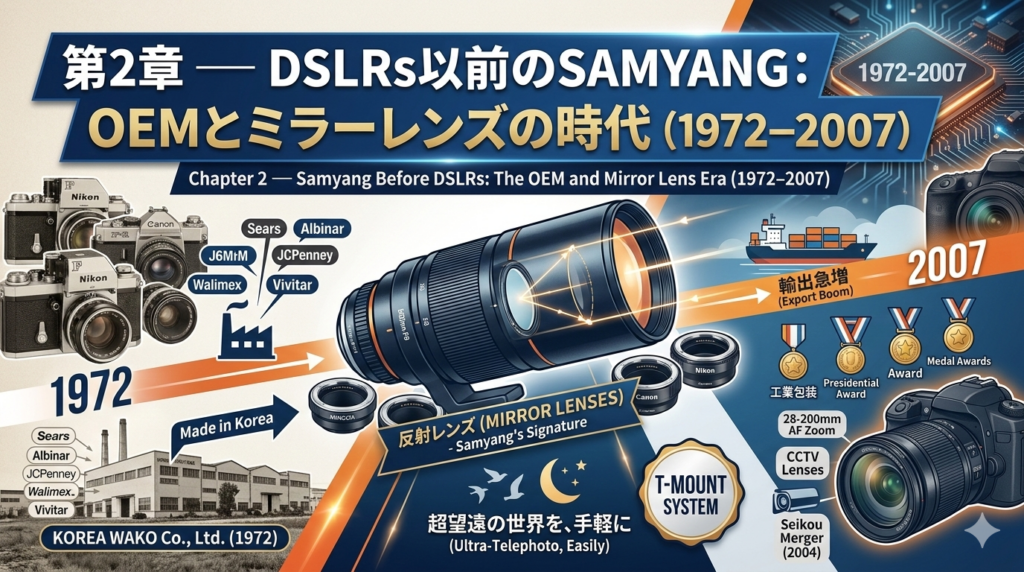
1972. The year after Nikon launched the F2 in Japan and Canon made its serious push into the professional market with the F-1. In Masan, Gyeongsang Province, South Korea, an entrepreneur founded a company called Korea WAKO Co., Ltd. This was the origin of Samyang.
The Founding — Korea WAKO (1972)
Samyang’s predecessor, Korea WAKO Co., Ltd., was established on September 6, 1972. Little is officially known about the “WAKO” in the company name, though it’s widely assumed to reference a business tie with a Japanese optics firm — a common arrangement in Korean manufacturing at the time, when technology transfer and OEM partnerships with Japanese companies were standard practice.
From the very beginning, the company manufactured interchangeable lenses for SLR cameras. However, during this early period, the Samyang name was virtually unknown to consumers. The reason was simple: the company’s entire business model was built on OEM (Original Equipment Manufacturing) — making lenses that would be sold under other companies’ brands.
The OEM Era — “Made in Korea” Lenses for the World
From the 1970s through the early 2000s, Samyang manufactured lenses for a remarkably wide range of brands. The list of OEM clients reads like a who’s who of the retail lens market:
Key OEM Clients and Brands
- Sears: The major American department store chain. Sears-branded lenses marked “Made in Korea” were all manufactured by Samyang
- Albinar: A camera accessories brand sold through Best Products retail stores in the US. Albinar lenses from the early 1980s were made by Samyang in Korea
- JCPenney: Another major American department store that received Samyang-made lenses
- Walimex: The brand of Germany’s Foto Walser GmbH. “Walimex, made in Korea” meant Samyang-made
- POLAR: Samyang’s own brand for the Korean domestic market during the 1980s. POLAR lenses were popular in Korea for their strong price-to-performance ratio
In addition, Samyang-manufactured lenses were sold under the Vivitar, Phoenix, and Quantaray brand names.
Mirror Lenses — Samyang’s Signature Product
No account of this era would be complete without mentioning Samyang’s mirror lenses (catadioptric or reflex telephoto lenses).
The T-mount 500mm F8 mirror lens, in particular, was shipped worldwide under a dizzying array of brand names. If you encountered a “Made in Korea” mirror telephoto lens during this period, the odds were overwhelming that it was a Samyang product. The mirror lens lineup included the standard 500mm F8, an ED-glass version (500mm F6.3 DX), and an 800mm F8. Samyang also offered a conventional (non-mirror) T-mount super-telephoto zoom, the 650-1300mm F8-16.
Mirror lenses offered a compelling value proposition: they were dramatically more compact and lightweight than equivalent refractive telephoto lenses, making ultra-telephoto photography accessible to hobbyists on a budget. While optical quality couldn’t match conventional telephoto lenses, the extreme affordability made them popular entry points for astrophotography and bird photography enthusiasts.
The T-mount system was key to the business logic. Because T-mount lenses attach via a simple adapter, Samyang didn’t need to design separate lens mounts for each camera system — it only needed to supply different adapters. This made T-mount lenses ideal for OEM production at scale.
1979 — The Birth of “Samyang”
Seven years after its founding, Korea WAKO changed its name to Samyang Optical Co., Ltd. in 1979. This marked the birth of the “Samyang” brand.
A note for those unfamiliar with Korean business: several unrelated Korean companies share the “Samyang” name. Samyang Foods, famous for its Buldak fire noodles, the textile-and-chemical conglomerate Samyang Corporation (三養社), and GS Group’s Samyang Trading are all entirely separate entities from LK Samyang.
Riding the Export Wave — Korea’s Economic Boom
The 1970s and 1980s were an era of rapid industrial expansion in South Korea, driven by President Park Chung-hee’s “Export Nation” policy that prioritized manufacturing exports as a matter of national strategy. Samyang rode this wave, steadily expanding its overseas sales:
- 1981: Exports exceeded $10 million (commended by the Korea Foreign Trade Association)
- 1984: Established an in-house R&D laboratory. Exports exceeded $20 million (awarded the “Industrial Packaging and $20 Million Export Tower” by KFTA)
- 1989: Received the Bronze Tower Order of Industrial Service Merit
- 1993: Received the Presidential Award (Korea Science and Technology Promotion Association)
For a small-to-medium enterprise of roughly 130 employees, these were impressive milestones — and a microcosm of Korea’s broader manufacturing success story during this period.
The AF Challenge — Autofocus and Camera Bodies
From the late 1980s through the 1990s, SLR cameras rapidly transitioned to autofocus. Samyang adapted by manufacturing AF zoom lenses for Minolta/Sony A-mount, Nikon AF, Canon EOS, and Pentax KAF systems.
Key AF zoom lenses from this period:
- AF 28-70mm F3.5-4.5
- AF 28-200mm F4-5.6
- AF 35-70mm F3.5-4.5
- AF 35-135mm F3.5-4.5
- AF 70-210mm F4-5.6
These were budget zoom lenses supplied primarily to OEM clients rather than sold under the Samyang brand. During this era, Samyang remained firmly in the role of a behind-the-scenes manufacturer, and few of these products earned notable praise for optical quality.
According to NamuWiki, Samyang also produced auto-compact cameras, binoculars, and polarizing microscopes during the 1980s. The company was less a specialist lens maker and more a general-purpose optical manufacturer.
CCTV Lenses and the Merger with Seikou
Entering the 2000s, Samyang expanded into the growing CCTV (security camera) lens market:
- 2001: Launched CCTV lens lines (550, 2810, 358 series)
- 2002: Obtained ISO 9001 certification. Built new headquarters and factory. Renamed the company to Samyang Optics Co., Ltd. Received the Precision Technology Promotion Award (Ministry of Commerce, Industry and Energy)
- 2003: Certified as a specialized parts and materials company
- 2004: Merged with Seikou, a Japanese CCTV optics manufacturer
- 2005: Obtained ISO 14001 (environmental management) certification
- 2006: Launched CCTV megapixel lenses, hybrid aspherical lenses, and plastic aspherical lenses
During this period, Samyang operated on two pillars: OEM production of SLR lenses and CCTV optics. However, in the SLR market, Japanese third-party manufacturers like Tamron and Sigma dominated so thoroughly that Samyang had little room to build its own brand presence.
Crisis — Delisting and a Fresh Start
In the early 2010s, Samyang faced a serious corporate crisis.
According to NamuWiki, in October 2011, trading of the company’s stock was suspended due to failure to disclose financial loans to related companies. Even after trading resumed, the stock was placed under administrative supervision for continued non-compliance with disclosure regulations. The company eventually underwent a paid-in capital increase followed by a paid-in capital reduction.
At the time, Samyang Optics had diversified into businesses beyond optical lenses, including logistics. Amid this turmoil, the core optical lens division was spun off as a new legal entity, while the old corporation (SY Corporation) voluntarily delisted.
In August 2013, the spun-off company — the new “Samyang Optics” — was acquired by VIG Partners (Bogo Fund), a private equity firm. This acquisition would prove to be one of the most important turning points in Samyang’s history.
Looking Back at This Era
Over the roughly 35 years from 1972 to 2007, Samyang built its business on OEM manufacturing and budget lens supply. Many photographers from this period will have used a Samyang-made product without ever knowing it. The Sears lens, the Albinar lens, the Walimex lens — all of them came from the same factory in Masan, South Korea.
But it was precisely this long OEM era — and the optical design and manufacturing expertise accumulated during it — that laid the foundation for the “Samyang Renaissance” that began in 2008, as we’ll explore in the next chapter.
What Is Samyang (Rokinon)? A Complete Guide to the Korean Lens Maker
- What Is Samyang (Rokinon)? A Complete Guide to the Korean Lens Maker
- Samyang Before DSLRs: The OEM and Mirror Lens Era (1972–2007)
- Samyang’s DSLR Renaissance: The 85mm F1.4 That Changed Everything (2008–2015)
- Samyang in the Mirrorless Era: AF Lenses and the Schneider-Kreuznach Partnership (2016–Present)
- Samyang vs. Chinese Lens Makers: The Path Samyang Paved and the New Challengers
- Samyang’s Global Presence: Rokinon, Walimex, and the Road to Brand Unity
- Why Does Korea Have So Few Camera Companies?
Sources
- LK Samyang Official Website — History (https://www.lksamyang.com/en/about/history.php)
- Wikipedia — “LK Samyang” (https://en.wikipedia.org/wiki/LK_Samyang)
- NamuWiki — “LK삼양” (https://en.namu.wiki/w/LK삼양)
- Camera-wiki.org — “Samyang” (https://camera-wiki.org/wiki/Samyang)
- Camerapedia — “Samyang” (https://camerapedia.fandom.com/wiki/Samyang)
- ePHOTOzine — “A Golden Anniversary – 50 Years Of Samyang” (https://www.ephotozine.com/article/a-golden-anniversary—50-years-of-samyang-36151)
- Scott Bradford — “JCPenney, Polar, Samyang, Oh My” (https://www.scottbradford.us/2025/03/02/jcpenney-polar-samyang-oh-my/)
- Popular Photography, November 9, 1994 (Samyang AF zoom lenses reference via Wikipedia)
- dyxum.com — Samyang 28-70mm F3.5-4.5 AF / Samyang 70-210mm F4-5.6 AF (via Wikipedia)
- Hankyoreh — Samyang POLAR brand article (https://www.hani.co.kr/arti/specialsection/esc_section/459719.html)