The Chinese Camera Equipment Chronicle — THE COMPLETE SERIES — Vol. 01
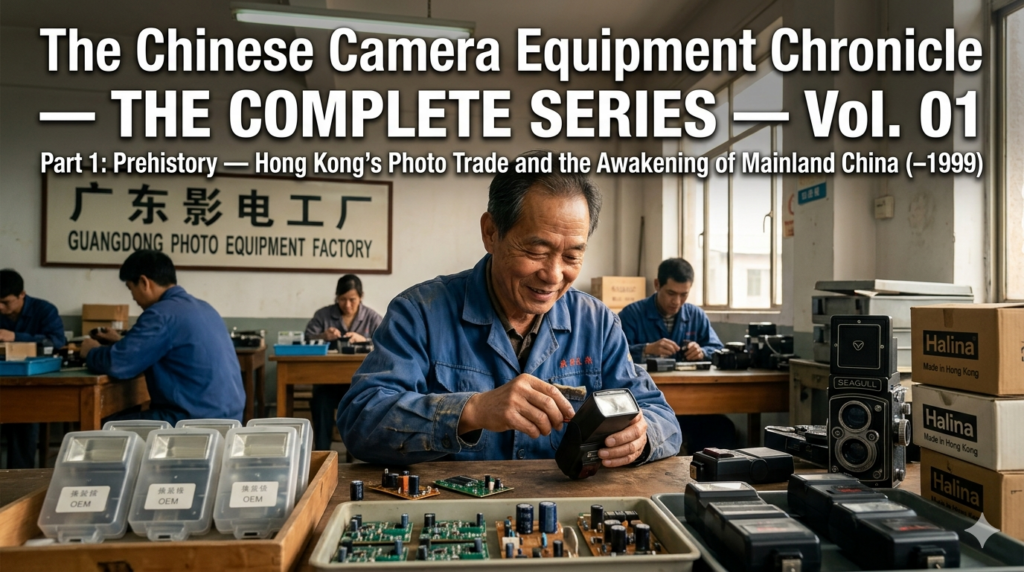
When people talk about China’s camera equipment industry, most focus only on the explosive growth of the 2000s onward — the era when Godox and Aputure swept the global market.
But that explosion had a long prehistory.
The arrival of photography in the mid-nineteenth century, Hong Kong’s unique development as a free-trade port, Shanghai’s photographic culture, and the industrial clustering in Guangdong Province after Reform and Opening Up — to understand the “Chinese camera equipment” of the twenty-first century, you first need to understand this backstory.
Hong Kong — The “Gateway” of Camera Equipment
The Arrival of Photography and Hong Kong’s Special Position
The history of photography in China is closely tied to the opening of Hong Kong following the Treaty of Nanking in 1842.
By the 1840s, Western photographers had already arrived in Hong Kong and opened commercial portrait studios. American photographer George R. West is recorded as having operated one of the earliest commercial photography studios in Hong Kong in the mid-1840s.
What proved decisive for Hong Kong’s photography industry was its status as a duty-free port (freeport). With no import tariffs, cameras from around the world — Germany’s Leica and Rolleiflex, Japan’s Nikon and Canon, America’s Kodak — could be purchased in Hong Kong for less than in their home countries. From the 1950s onward, Hong Kong became Asia’s largest hub for camera equipment distribution.
Haking — “Made in Hong Kong” Cameras
Hong Kong was not merely a trading waypoint. It had its own history as a manufacturing base.
The emblematic example is Haking (Haking Enterprises). Founded by industrialist Haking Wong (黄克競), the company began producing cameras under the Halina brand in the 1950s, exporting them to the United Kingdom and other European markets. The Halina 35X was a cost-effective 35mm film camera, and throughout the 1960s it became many British families’ “first camera.”
An intriguing detail: Hong Kong–made products of this era were labeled “Empire Made” (manufactured within the British Empire), in contrast to Japanese products, which were labeled “Foreign.” Hong Kong’s status as a British colony gave its products a distinct advantage in accessing Western markets.
Haking later grew into an OEM/ODM manufacturer, supplying products to camera brands worldwide. This dual model of “own brand + OEM” would be inherited by mainland Chinese manufacturers in the decades to come.
Hong Kong’s Photographic Culture — Salon Photography and Art Photography
A brief aside from equipment: Hong Kong’s photographic culture also deserves mention.
The Photographic Society of Hong Kong (PSHK) was established in 1937, and during the 1950s–1960s, participation in international salon photography exhibitions flourished. Photographer Fan Ho (何藩, 1931–2016) captured the rapid urbanization of postwar Hong Kong with his Rolleiflex twin-lens reflex, earning international acclaim.
This maturation of photographic culture demonstrated that Hong Kong was not merely a “transit point for cameras” but a region with its own photographic sensibility. This cultural foundation cultivated an eye for quality and a demanding standard for equipment — qualities that would later serve as a “quality filter” when mainland Chinese products entered global markets via Hong Kong.
Shanghai — China’s Other Center of Photographic Culture
Photography Studios in the Concession Era
From the late nineteenth century to the early twentieth century, Shanghai was China’s other major center of photographic culture.
Shanghai’s numerous foreign concessions attracted Western photographers early on, and by the 1860s multiple commercial photography studios were in operation. Chinese photographers began opening their own studios in the latter half of the nineteenth century, producing portrait and landscape photography.
Shanghai’s photography industry intersects with the history of lighting equipment through studio lighting. In the early twentieth century, Shanghai studios transitioned from natural-light photography to magnesium flash powder and later to electric bulb lighting. All of this equipment was imported; domestic production capacity was virtually nonexistent.
The Film Industry and Lighting Technology
Shanghai was also the birthplace of China’s film industry. During the 1920s–1930s, Shanghai’s film world was so vibrant it was called the “Hollywood of the East,” and filmmaking required large-scale lighting setups.
All film lighting was imported from the West — primarily Germany and the United States. Records show that equipment from Arri (Arnold & Richter, founded 1917) and Mole-Richardson (founded 1927) was used in Shanghai’s studios.
This pattern — “a thriving film industry, but all lighting equipment imported” — would persist long after the founding of the People’s Republic. It would take more than half a century before China could design and manufacture its own lighting equipment.
Macau — Another Starting Point in the History of Photography
Macau is often overlooked in the story of photography’s arrival in China, but it played a historically significant role.
As a Portuguese colony since the sixteenth century, Macau had long been a point of contact between the West and China. Some research suggests that the earliest daguerreotypes (silver-plate photographs) entered China via Macau in the 1840s. Daguerreotypes taken by French customs official Jules Itier (1802–1877) in Macau and Guangzhou in 1844 are considered among the oldest surviving photographs from China.
Macau’s photographic history does not directly connect to the industrial history of lighting and video equipment, but as one of the “earliest pathways through which photography entered China,” it forms part of this prehistory.
The Founding of the People’s Republic and the State Factory Era (1949–1978)
The Optical Equipment Industry Under a Planned Economy — The Absence of Lighting Equipment
After the founding of the People’s Republic of China in 1949, Chinese industry was reorganized under a planned economy. Cameras and optical instruments were not classified as “heavy industry” and received low priority, although state-owned factories did produce cameras.
However, no specialized lighting equipment manufacturers existed.
For camera bodies, state-owned factories such as the Shanghai Camera Factory (上海照相机厂, established 1958) produced cameras under the Seagull (海鸥) brand — twin-lens reflexes and 35mm cameras that accumulated over 20 million units produced, making Seagull China’s largest camera manufacturer. But the expertise these factories developed — optical design and precision machining — was fundamentally different from the electronic circuit design and high-voltage power control required for lighting equipment.
Photographic flash units (strobes) were dominated globally by Sunpak (Japan), Metz (Germany), and Vivitar (USA) during the 1950s–1960s, but these imports barely circulated within China. Only state-run media and military photography operations had access to a limited supply purchased with scarce foreign currency.
Film lighting followed the same pattern: state-run film studios (Beijing Film Studio, Shanghai Film Studio, etc.) primarily used Soviet-made equipment, and during the Cultural Revolution (1966–1976), film production itself was severely curtailed.
During this entire era, China accumulated virtually no expertise in designing or manufacturing lighting equipment. This stands in stark contrast to the tripod industry (covered in a separate series), where state-owned factories built up metalworking skills. This absence of foundational knowledge is crucial for understanding why China’s lighting equipment industry would later have to start essentially from zero.
Reform and Opening Up, and Industrial Clustering in Guangdong (1978–1999)
Special Economic Zones and the Influx of Foreign Capital
In 1978, Deng Xiaoping launched the Reform and Opening Up policy.
The Special Economic Zones established in 1980 — Shenzhen, Zhuhai, Shantou, and Xiamen — became gateways for foreign capital and technology. Shenzhen in particular absorbed massive investment from neighboring Hong Kong and rapidly transformed into an industrial city.
During this period, Hong Kong companies accelerated the relocation of their manufacturing bases to Shenzhen and the Pearl River Delta. Hong Kong firms like the aforementioned Haking expanded production in mainland China, where labor costs were dramatically lower.
The Clustering of Electronic Components — The Soil for Lighting Equipment
Throughout the 1990s, the Pearl River Delta region — centered on Shenzhen, Dongguan, and Zhongshan — saw an enormous concentration of electronic component factories. These facilities produced capacitors, transistors, LED elements, and injection-molded plastic parts: the building blocks of all electronic devices.
This electronic components cluster would later become the foundation of the lighting equipment industry. Strobes require high-voltage capacitors and flash tubes. LED lights require LED elements and driver circuits. Wireless triggers require radio communication modules. The ability to source all of these components locally created what was, in the Pearl River Delta, an ecosystem for lighting equipment manufacturing unmatched anywhere else in the world.
Nanguang (南冠, 1992) — One of the Earliest Lighting Equipment Makers
Among the earliest specialized manufacturers of photographic and video lighting equipment in mainland China was Nanguang (南冠, later Nanlite).
In 1992, Lin BiGuang (林碧光) founded Guangdong Nanguang Photo & Video Systems Co., Ltd. (广东南冠影视器材有限公司) in Shantou, Guangdong Province.
In its early years, Nanguang manufactured fluorescent and halogen lighting for photography and video. Its full-scale entry into LED lighting would not come until the 2000s, but it is noteworthy that as early as 1992, a company was already operating as a “dedicated manufacturer of photographic and video lighting equipment.”
Shantou was one of the Special Economic Zones, with an established base for electronic component production. From the outset, Nanguang pursued export-oriented operations and took on overseas OEM contracts. By the 2020s, the company had grown to over 900 employees with a factory floor of 44,000 square meters, operating under its own brands: “Nanlite” for prosumer products and “Nanlux” for cinema-grade equipment.
Godox (神牛, 1993) — Another Origin Point
The year after Nanguang’s founding, in 1993, Godox (神牛, officially GODOX Photo Equipment Co., Ltd.) was established in Shenzhen.
The story of Godox’s founding is recounted on the website of its Dutch distributor. Founder Eugene Zeng (曾祥宜) was driven by a mission to deliver high-quality yet affordable photography and video equipment to the market. In 1993, he acquired a small, struggling factory and began building what would become the Godox brand.
During the 1990s, Godox primarily manufactured studio flash units (monoblock strobes). In 1998, it launched the Mini Master series, reportedly sparking a boom in compact studio flashes. In 1999, it released the professional-grade F-series and M-series studio flash units.
But in the 1990s, Godox was still a small-scale manufacturer serving the domestic market and OEM clients. It would not be until the late 2000s that Godox began fundamentally transforming the global lighting equipment market.
OEM — The “Shadow School” of Technical Expertise
What Chinese Factories Learned by Making Other Brands’ Products
The most critical technical education that Chinese lighting equipment makers received in the 1990s Pearl River Delta came through OEM (Original Equipment Manufacturing) — producing products under foreign brands’ names.
Western and Japanese lighting equipment brands began outsourcing their manufacturing to Chinese factories. In order to meet the quality standards demanded by their clients, these factories were forced to develop expertise in circuit design, power management, thermal design, and quality control.
This process is perfectly parallel to the tripod industry, where factories in Zhongshan accumulated CNC machining skills through OEM work for Gitzo and Manfrotto. The difference is that lighting equipment OEM added expertise in electronic circuit design and software control. Flash output control, LED color temperature regulation, wireless communication protocol implementation — these belong to the domain of electronic engineering, a skillset that could be most efficiently acquired within the Pearl River Delta’s electronic components cluster.
The Seeds of the “Copycat” Problem
OEM manufacturing was simultaneously a pathway for technology transfer and a breeding ground for copycat products.
Factories that had gained intimate knowledge of other companies’ product designs through OEM work began selling near-identical products under their own brands. This problem was already emerging by the late 1990s. Designs and circuit layouts from Western and Japanese flash manufacturers appeared in subtly modified form under Chinese brand names, a trend that would accelerate through the 2000s.
This issue became most prominent with the arrival of Yongnuo (永诺) in the 2000s and the controversy surrounding Canon and Nikon speedlite “compatibles.” That story is told in detail in Part 2.
1999 — The Eve of Transformation
As of 1999, the landscape of China’s camera equipment industry looked like this:
| Category | China’s Status (1999) | Global Market Leaders |
|---|---|---|
| Clip-on Speedlites | No in-house design capability. OEM orders only | Canon, Nikon, Metz, Sunpak, Nissin |
| Studio Flash | Godox and others selling low-end units domestically. Limited exports | Profoto, Broncolor, Elinchrom, Bowens, Comet |
| Video Lighting | Nanguang manufacturing fluorescent/halogen lights. LED in its infancy | Arri, Kino Flo, Mole-Richardson, LTM |
| Camera Bags | Textile industry OEM work. No Chinese brands | Lowepro (est. 1967), Domke (est. 1976), Tenba, Tamrac |
| Camera Rigs & Accessories | The concept itself was not yet mainstream | Zacuto, Redrock Micro (would emerge in the 2000s) |
| Gimbals / Stabilizers | Did not exist | Steadicam (mechanical, invented 1974) |
Across every category, Chinese manufacturers were either “nonexistent” or “OEM subcontractors.”
Yet within the Pearl River Delta’s factories, two decades of accumulated electronic component manufacturing infrastructure, quality management know-how gained through OEM work, and a growing ambition to “build our own brands for the global market” were quietly taking root.
In the 2000s, all of that accumulation would burst to the surface.
Next time, we examine how “Chinese flash” — led by Godox’s global strategy and Yongnuo’s controversial copycats — fundamentally transformed the worldwide strobe market.
Coming next: Part 2 — The Flash Revolution: How Godox and Yongnuo Democratized the Speedlite (2000–2012)
The Chinese Camera Equipment Chronicle — THE COMPLETE SERIES (Main Series Hub)
- Prehistory — Hong Kong’s Photo Trade and the Awakening of Mainland China (–1999)
- The Flash Revolution — How Godox and Yongnuo Democratized the Speedlite (2000–2012)
- The LED Lighting Conquest — How Nanlite, Aputure & Godox Rewrote the Rules of Production Lighting (2012–Present)
- Conquering the World of Video Accessories — How Chinese Gear Transformed the Film Set (2007–Present)
- Conclusion — How “Chinese Gear” Redefined the Standards of Production
Sources and References
- Terry Bennett — History of Photography in China: Western Photographers 1861–1879 (Quaritch, 2010). A primary-source study detailing the earliest Western photographers active in China. https://www.quaritch.com/books/bennett-terry/history-of-photography-in-china/U51/
- Gwulo: Old Hong Kong — “Western photographers in Hong Kong, 1861–1879” and “Chinese photographers in Hong Kong, 1844–1879.” Archival site documenting the history of photography studios in Hong Kong. https://gwulo.com/node/35363 | https://gwulo.com/node/31857
- Asia Art Archive — “Resurfacing Hong Kong in Southeast Asia: Circulations of Photography from the 1930s to the Handover.” Academic paper covering the establishment of the PSHK and the development of photographic culture. https://aaa.org.hk/en/grants/the-robert-h-n-ho-family-foundation-greater-china-research-grant-papers/resurfacing-hong-kong-in-southeast-asia-circulations-of-photography-from-the-1930s-to-the-handover
- South China Morning Post — “Inside the evolution of travel photography in Hong Kong.” Coverage of Haking/Halina cameras and Hong Kong’s role as a duty-free camera equipment market. https://www.scmp.com/postmag/culture/article/3290320/inside-evolution-travel-photography-hong-kong
- 35mmc — “Made in Hong Kong” (November 2025). Detailed article on Haking cameras and the “Empire Made” label. https://www.35mmc.com/12/11/2025/made-in-hong-kong/
- The Classic Photo Magazine — “History of Photography in China: New Discoveries and Research” (2021). Research on Jules Itier’s 1844 daguerreotypes in Macau and Guangzhou. https://theclassicphotomag.com/history-of-photography-in-china-new-discoveries-and-research/
- Nanguang (南冠) official site — Company profile and history. Founded 1992, 900+ employees, 270+ patents. https://www.nanguang.cn/introduce.html
- Lighting & Sound America — “NanGuang Celebrating 30th Anniversary.” Details on Nanguang’s 30th anniversary, 900+ employees, and 270+ patents. http://www.lightingandsoundamerica.com/news/story.asp?ID=AJHHIF
- Godox official site — “Why Godox” and “History” pages. Product milestones from 1993 onward. https://www.godox.com/why-godox/ | https://www.godox.com/history/
- Godox Netherlands — “About us: How it all started.” The story of founder Eugene Zeng (曾祥宜). https://www.godox.nl/about-us-1
- Crunchbase — “GODOX Photo Equipment Co. Ltd.” Founded 1993, Shenzhen, 1,001–5,000 employees. https://www.crunchbase.com/organization/godox-photo-equipment-co-ltd
- Hong Kong Memory (香港記憶) — “Classic Camera Brands and Products.” Archival resource on the history of film cameras and photography equipment in Hong Kong. https://www.hkmemory.hk/en/collections-archival_camera_collection-wave_of_amateur_filmmaking-classic_camera_brands_and_products.html