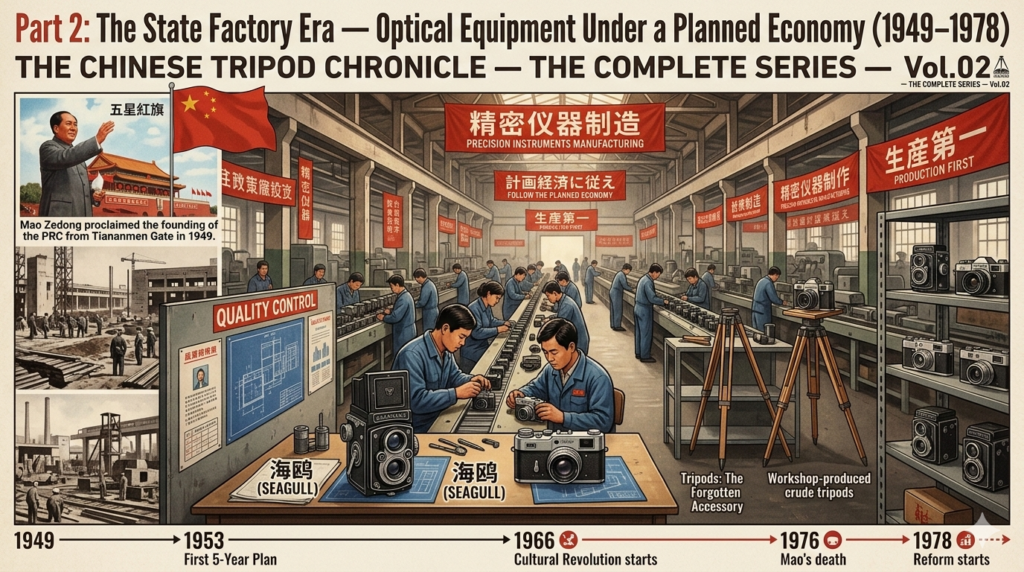
The Chinese Tripod Chronicle — THE COMPLETE SERIES — Vol.02
On October 1, 1949, Mao Zedong proclaimed the founding of the People’s Republic of China from the Gate of Heavenly Peace in Beijing. A new state was born — and with it, a radically different approach to industrial development.
As we saw in Part 1, China in 1949 had essentially zero domestic capacity for manufacturing photographic equipment. Cameras, lenses, film, and tripods were all imported. The new government, modeled on the Soviet Union, set out to build an industrial base from scratch — under central planning.
This second installment covers the three decades from 1949 to 1978, a period during which China built its first optical equipment factories, produced its first domestically made cameras, and yet left tripod manufacturing as an afterthought — a low-priority accessory in a system focused on heavier industrial goals.
Building an Industrial Base from Zero
The Soviet Model
The early People’s Republic of China adopted the Soviet model of economic development wholesale. This meant centralized planning, state ownership of all significant enterprises, and a strong emphasis on heavy industry — steel, machinery, chemicals, and military equipment.
The optical instruments sector fell under this industrial framework. Cameras and lenses were classified as “precision instruments” (精密仪器), a category that also included microscopes, surveying equipment, and military optics (binoculars, rangefinders, gun sights). Within this category, consumer cameras were given relatively low priority compared to military and scientific applications.
The First Five-Year Plan (1953–1957)
During China’s First Five-Year Plan, several optical equipment factories were established or expanded with Soviet technical assistance. The most significant of these was the state-owned optical factory system, which laid the groundwork for China’s domestic camera production.
Key facilities included:
- Tianjin Camera Factory (天津照相机厂): One of the earliest producers of domestic cameras.
- Shanghai Camera Factory (上海照相机厂): Located in China’s most industrially advanced city, this factory became one of the most important camera producers.
- Nanjing Optical Instruments Factory and others in the Yangtze River Delta region.
These factories were established primarily through technology transfer from the Soviet Union and, to a lesser extent, from East Germany. Soviet advisors provided blueprints, training, and equipment. The cameras produced were often direct copies or close derivatives of Soviet models, which were themselves based on pre-war German designs (the Leica-derived FED and Zorki, the Contax-derived Kiev, etc.).
Camera Production: Copies of Copies
The “Seagull” and Other Domestic Cameras
China’s first domestically produced cameras began to appear in the late 1950s and early 1960s. The most famous of these was the Seagull (海鸥) brand, produced by the Shanghai Camera Factory.
The Seagull cameras were modeled on foreign designs:
- The Seagull 4 series (a twin-lens reflex camera) was based on the Rolleiflex/Rolleicord design.
- Various 35mm rangefinder models were derived from Leica and Soviet copies of Leica designs.
Production numbers were modest by international standards, and quality control was inconsistent. These cameras were primarily intended for professional use — press photographers, government documentation, and scientific recording — rather than for consumer sale. In the planned economy, cameras were allocated to work units (单位), not sold freely on the open market.
Other notable domestic camera brands of this era included:
- Red Flag (红旗): A prestige brand for high-end cameras
- Pearl River (珠江): Produced in Guangzhou
- Great Wall (长城): Another Shanghai-produced brand
- Phoenix (凤凰): Produced by the Jiangxi Optical Instruments Factory
Quality Challenges
It is important to be honest about the quality of these early Chinese cameras. While they represented a genuine achievement — building precision instruments in a country that had no such manufacturing tradition — they were generally considered inferior to their Japanese, German, and even Soviet counterparts.
Common issues included:
- Inconsistent shutter speed accuracy
- Imprecise film transport mechanisms
- Lower-quality lens coatings
- Unreliable light meters (when present)
These quality challenges stemmed from broader systemic issues in the planned economy: the absence of market competition, limited access to advanced materials and components, and a focus on meeting production quotas rather than quality standards.
Tripods: The Forgotten Accessory
Why Tripods Were Not a Priority
Within this state-run camera manufacturing system, tripods occupied the lowest rung of the priority ladder.
The logic was straightforward. In the planned economy’s hierarchy of needs:
- Military optics (binoculars, rangefinders, gun sights) — highest priority
- Scientific instruments (microscopes, surveying equipment) — high priority
- Cameras (for professional and government use) — medium priority
- Accessories (including tripods, filters, flash units) — low priority
Tripods were seen as simple mechanical devices — far less technically demanding than cameras or lenses. They did not require optical glass, precision shutters, or film transport mechanisms. In the eyes of central planners, they were not worth dedicating significant resources to.
What Tripods Existed?
During this period, the tripods used in China came from three sources:
- Imported tripods: Pre-1949 stock of foreign-made tripods (European and Japanese) continued to be used. New imports were limited due to foreign exchange constraints.
- Soviet-supplied tripods: Some tripods entered China as part of Soviet technical aid packages, particularly for military and surveying applications.
- Workshop-produced tripods: Small workshops attached to camera factories or photographic supply cooperatives produced simple wooden or steel-tube tripods. These were crude by international standards — heavy, with imprecise leg-locking mechanisms — but functional for the basic needs of studio photographers and government documentation teams.
There was no dedicated tripod factory, no tripod brand, and no systematic effort to develop tripod manufacturing capabilities. The tripod remained an afterthought.
The Cultural Revolution (1966–1976): A Decade Lost
Impact on Industrial Development
The Great Proletarian Cultural Revolution, launched by Mao Zedong in 1966, had devastating effects on China’s industrial development, including the precision instruments sector.
During the most chaotic years (1966–1969), many factories were disrupted by political campaigns. Engineers and technicians were “sent down” to the countryside for re-education. Research and development activities were curtailed. International technical exchanges — already limited after the Sino-Soviet split of the early 1960s — ceased almost entirely.
Camera production continued during the Cultural Revolution, but innovation stagnated. The cameras produced in the early 1970s were essentially the same designs as those from the early 1960s, while Japanese manufacturers (Canon, Nikon, Minolta, Pentax) were rapidly advancing with auto-exposure systems, motor drives, and increasingly sophisticated electronics.
The Growing Technology Gap
By the mid-1970s, the technology gap between Chinese and Japanese cameras had widened dramatically. Japan’s camera industry was producing the Canon AE-1 (1976), one of the first microprocessor-controlled cameras and a massive global bestseller. China’s camera factories were still producing manual-everything designs based on 1950s-era technology.
This gap was not limited to cameras. It extended across the entire photographic equipment chain — including, implicitly, the infrastructure and expertise needed to produce high-quality tripods. While Italy’s Manfrotto (founded 1972 from Lino Manfrotto’s earlier business) was innovating in tripod design for the European market, China had no comparable enterprise, no tripod-specific R&D, and no path to creating one under the existing economic system.
The State of Affairs in 1978
When Deng Xiaoping initiated the “Reform and Opening Up” policy (改革开放) in December 1978 at the Third Plenum of the 11th Central Committee, China’s photographic equipment industry was in the following condition:
| Category | Status in 1978 |
|---|---|
| Camera manufacturing | Exists (state-owned). Seagull, Phoenix, Pearl River, etc. Quality far below Japanese standards |
| Lens manufacturing | Exists (state-owned). Basic designs, poor coating technology |
| Tripod manufacturing | Virtually nonexistent as a distinct industry. Workshop-level production only |
| Technology level | 15–20 years behind Japan and Germany |
| Market structure | Planned economy. No consumer market. Equipment allocated by the state |
| International presence | Zero. No exports of photographic equipment |
The planned economy had succeeded in building a basic camera manufacturing capability from nothing — a genuine achievement that should not be dismissed. But it had failed to create an industry that could compete internationally or innovate independently. And within that system, tripods had received almost no attention at all.
Everything was about to change. The “Reform and Opening Up” policy would unleash market forces that would transform China’s manufacturing landscape — and create the conditions for a tripod industry that would eventually dominate the world.
The Chinese Tripod Chronicle — THE COMPLETE SERIES
- Series overview
- Part 1: The Arrival of Photography — When Cameras and Tripods Came to China (–1949)
- Part 2: The State Factory Era — Optical Equipment Under a Planned Economy (1949–1978)
- Part 3: Reform, Opening Up, and OEM — How Tripod Factories Gathered in Guangdong (1978–1999)
- Part 4: The Rise of Private Brands — Benro, Sirui, and Fotopro Enter the Stage (2000–2009)
- Part 5: Conquering the World Market — Redefining “Chinese Tripods” (2010–Present)
References
- Douglas Kerr — The Camera as Witness: A Social History of Chinese Photography (various essays and lectures). Covers the state-owned camera factory era.
- Gu Di (顾棣) — Studies on the development of the Chinese photographic equipment industry, 1949–1978.
- Shanghai Camera Factory / Seagull Group — Corporate history and archival materials on camera production volumes and models.
- Jiangxi Optical Instruments Factory — Historical records of Phoenix brand camera production.
- Ezra Vogel — Deng Xiaoping and the Transformation of China (Harvard University Press, 2011). Essential context on the economic system and its reform.
- Barry Naughton — The Chinese Economy: Adaptation and Growth (MIT Press, 2nd ed., 2018). Detailed analysis of China’s planned economy period and the transition to reform.