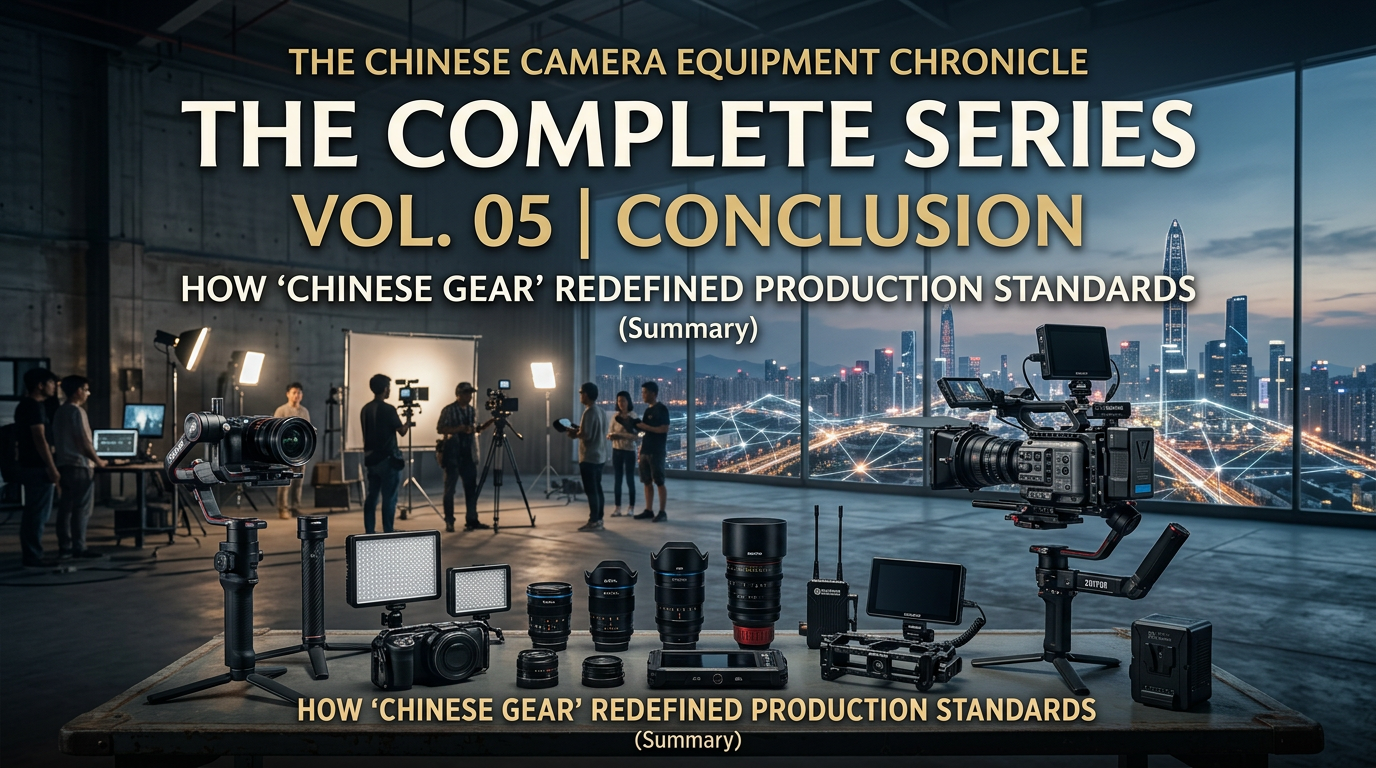
The Chinese Camera Equipment Chronicle — THE COMPLETE SERIES — Vol. 05
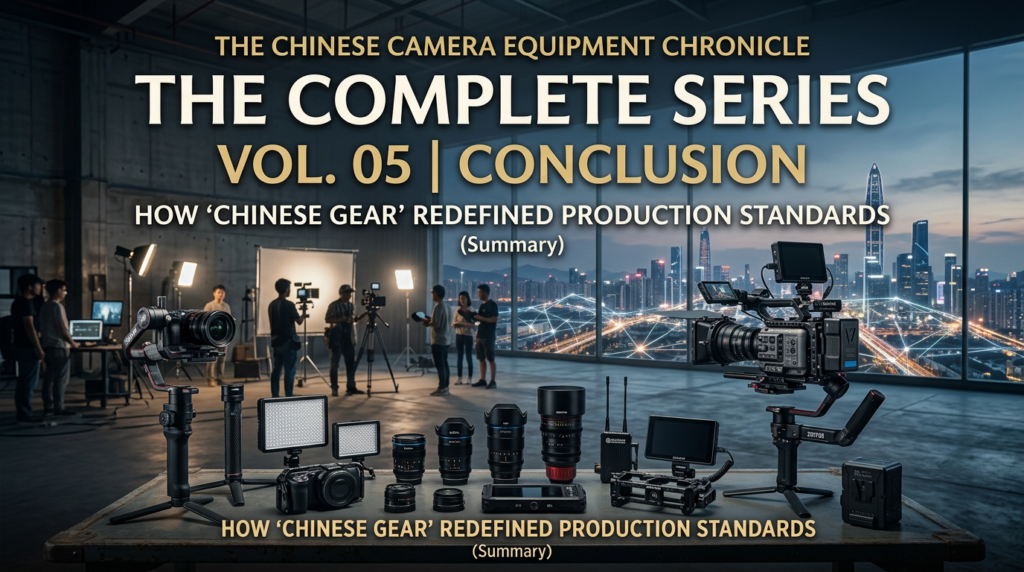
Chinese gear did not simply become cheaper. It became normal.
That normalization is the real ending of this series: a structural shift in how film and photo equipment is designed, manufactured, branded, and trusted. In the 2000s, Chinese-made accessories were often framed as “alternatives.” In the 2010s, they became “good value.” By the 2020s, in many categories, they became the default layer of the global production stack.
This conclusion is not a victory lap, nor a cautionary tale. It is an attempt to name the mechanisms that produced this outcome—because the same mechanisms will shape whatever comes next.
- 1) The new baseline: when Chinese gear becomes infrastructure
- 2) How OEM learning turned into brand power
- 3) Industrial clustering: Guangdong as a production operating system
- 4) Ecosystems beat hero products
- 5) The “good enough” trap—and why it became a ladder
- 6) What was lost: the decline of older industrial centers
- 7) The next question: can the same model break its own limits?
- 8) What this series tried to prove
- Sources and references (to be expanded)
1) The new baseline: when Chinese gear becomes infrastructure
Walk onto a contemporary set and count the “invisible” items that make production possible: LED fixtures, modifiers, light stands, cages, handles, V-mount batteries, power distribution, monitors, video transmitters, gimbals, microphones, cables, cases.
The most important change is not that Chinese brands entered these categories. It is that they saturated them.
When a supplier becomes infrastructure, three things happen:
- The conversation shifts from “Should we trust it?” to “Which model fits this job?”
- Compatibility becomes a selling point: mounts, quick releases, control apps, wireless protocols, battery ecosystems.
- Upgrade cycles accelerate, because incremental improvements become affordable and widely adopted.
In other words, the competitive battlefield moved away from “price only” and toward ecosystems, iteration speed, and category breadth.
2) How OEM learning turned into brand power
A recurring pattern across this series is the OEM-to-brand transition.
OEM work did more than provide cashflow. It trained factories and engineers in the language of the market:
- tolerances and reliability standards,
- how to hit a price point without collapsing QA,
- what features Western and Japanese users actually pay for,
- how products fail in real-world use.
Once that learning is internalized, brand-building is no longer a leap. It is a graduation.
The brands that succeeded did not simply copy. They:
- built product roadmaps instead of one-off items,
- invested in industrial design and user experience,
- created after-sales networks (even imperfect ones),
- made YouTube and creator communities part of distribution.
This is why “copycat stigma” weakened over time. Not because memory faded, but because the products stopped behaving like copies.
3) Industrial clustering: Guangdong as a production operating system
The Pearl River Delta is not just a location. It functions like a production operating system.
Clusters reduce friction:
- Components, machining, plastics, PCB assembly, packaging, logistics—within short travel distance.
- Skilled labor that can move between firms and transfer tacit knowledge.
- Vendors and subcontractors that can scale up or down with demand.
This cluster advantage matters most in categories where iteration is frequent:
- LED lighting (rapid improvements in COB efficiency, thermal design, control, and optics),
- rigs and cages (constant camera-body refreshes),
- wireless video (protocol stability + RF engineering + packaging).
When iteration is the game, the supply chain that iterates fastest wins.
4) Ecosystems beat hero products
One reason Chinese brands became “standards” is that they built ecosystems, sometimes deliberately and sometimes by accident.
Examples of ecosystem logic:
- Mount standards and adapters (Bowens, V-mount, NATO rails, Arca-style plates).
- Modular accessories that interlock across products (cages, handles, rails, baseplates).
- Shared power and charging solutions.
- Firmware that unifies control across product lines.
A hero product can win a year.
An ecosystem can win a decade.
Legacy brands often defended margins with fragmentation: proprietary modifiers, proprietary mounts, premium service differentiation.
Chinese challengers frequently did the opposite: they made compatibility cheap, and then sold breadth.
5) The “good enough” trap—and why it became a ladder
It is true that many categories began with “good enough” products.
But “good enough” can be a ladder, if a company reinvests:
- quality control,
- reliability testing,
- thermal engineering,
- RF stability,
- support and repair logistics,
- documentation.
The market then rewards the brand with:
- word-of-mouth adoption,
- rentals adding it to inventory,
- studios standardizing on it,
- creators building tutorials around it.
This is how low-end access became mainstream legitimacy.
6) What was lost: the decline of older industrial centers
A realistic ending must include what the shift displaced.
When Chinese brands captured the accessory layer, older centers lost more than unit sales:
- they lost early visibility into what users were doing,
- they lost the chance to define accessory standards,
- they lost bargaining power in distribution.
Some companies survived by moving upmarket. Others survived by exiting. Some became niche.
It is tempting to frame this as a simple story of “innovation” beating “tradition.” That is not accurate.
It is a story of industrial structure: clustering, speed, and scale.
7) The next question: can the same model break its own limits?
If Chinese gear has become the baseline, the next phase is not about entering categories. It is about overcoming constraints.
Three constraints appear repeatedly in interviews, user reports, and market behavior:
- Long-term durability and professional service networks (especially outside China).
- Software quality and workflow integration (apps, color management, metadata, remote control).
- Trust at the highest-stakes tiers (broadcast, high-end cinema, large studios) where downtime is more expensive than gear.
Some brands are actively trying to solve these constraints. If they do, the distinction between “legacy” and “challenger” will dissolve further.
8) What this series tried to prove
This series began with a simple observation: you cannot understand modern film and photo production by looking only at cameras and lenses.
The accessory layer is where workflows are built.
China’s camera equipment industry—especially lighting and video accessories—did not rise because the world suddenly wanted cheaper products.
It rose because an industrial ecosystem learned faster than incumbents could adapt, then used compatibility, breadth, and iteration to turn “alternatives” into standards.
The phrase “Chinese gear” once implied a warning label.
Today, it increasingly describes the default toolkit.
Sources and references (to be expanded)
- Company press releases and official histories (Godox, Aputure, Nanlite, SmallRig, DJI, Hollyland, Deity)
- Distributor catalogs and rental house inventories
- Trade media interviews and product teardowns
- Manufacturing and export data where available
The Chinese Camera Equipment Chronicle — THE COMPLETE SERIES (Main Series Hub)
- Prehistory — Hong Kong’s Photo Trade and the Awakening of Mainland China (–1999)
- The Flash Revolution — How Godox and Yongnuo Democratized the Speedlite (2000–2012)
- The LED Lighting Conquest — How Nanlite, Aputure & Godox Rewrote the Rules of Production Lighting (2012–Present)
- Conquering the World of Video Accessories — How Chinese Gear Transformed the Film Set (2007–Present)
- Conclusion — How “Chinese Gear” Redefined the Standards of Production