The Chinese Tripod Chronicle — THE COMPLETE SERIES — Vol.04
The 2000s were a turning point for China’s tripod industry.
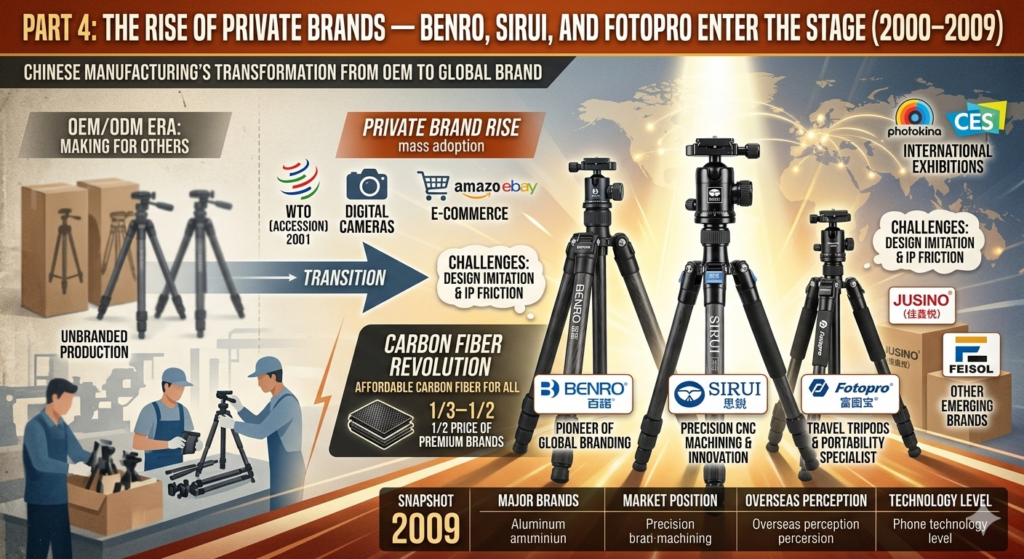
As we have seen in previous installments, the 1990s were dominated by OEM and ODM — “making products under someone else’s brand name.” The industrial cluster centered on Zhongshan, Guangdong Province, had steadily built up its manufacturing expertise and cost competitiveness.
But in the 2000s, a handful of companies made a decisive leap: they launched their own brands.
From OEM factory to brand-name manufacturer. This transformation is one of the most important themes in the history of Chinese manufacturing — and the tripod industry is one of its clearest success stories.
Why Branding Began in the 2000s
The shift toward proprietary brands accelerated in the 2000s due to several structural factors.
1. WTO Accession (2001) and a New Export Landscape
In December 2001, China formally joined the World Trade Organization (WTO).
WTO membership had two major implications for Chinese export industries. First, tariff reductions and the removal of trade barriers made it easier to sell Chinese products abroad. Second, intellectual property protections were — at least on paper — strengthened, giving legal legitimacy to brand ownership.
For OEM-only factories, WTO accession posed a stark question: Do we keep making products for others, or do we sell directly to the world under our own name?
2. The Digital Camera Explosion
The early 2000s saw a rapid transition from film to digital photography.
As DSLR (Digital Single-Lens Reflex) prices dropped, the population of photography enthusiasts grew worldwide. Tripod demand rose in tandem. Amateur photographers, in particular, were looking for alternatives cheaper than Gitzo (ranging from several hundred to over a thousand dollars) and Manfrotto (typically several hundred dollars) — and that opened the door for Chinese brands to step in.
3. The Rise of E-Commerce
eBay, Amazon, and later AliExpress gave small and medium Chinese manufacturers a way to sell directly to overseas consumers — bypassing the traditional distribution chain of importers, wholesalers, and retailers.
Building a brand the old-fashioned way required enormous investment: setting up sales agents in every country, attending trade shows, printing catalogs. The internet dramatically lowered these barriers to entry.
4. Technical Know-How Accumulated Through OEM/ODM
As discussed in Part 3, Chinese tripod factories had already accumulated substantial manufacturing expertise through their years of OEM/ODM work. Factories that had been building products to the exacting standards of Japanese and Italian brands naturally thought: If we can make products this good for them, why can’t we do it under our own name?
The Major Brands Are Born
Among the Chinese tripod brands born in the 2000s, three stand out as especially significant.
Benro (百諾) — Founded 2002
Benro (百諾, pronounced “Ben-ro”) is the pioneer of Chinese tripod brands and remains one of the most internationally recognized Chinese tripod manufacturers to this day.
Benro’s predecessor company was established in 1995 (some sources say 1996) in Guangdong Province as a cooperative-style tripod manufacturing company. After accumulating expertise through OEM/ODM work, the company launched its own brand — “Benro” — in 2002, headquartered in Zhongshan. The Chinese name “百諾” means “a hundred promises,” chosen to symbolize a commitment to quality.
Benro’s strategy was clear from the start:
- Aggressive presence at international trade shows: Exhibiting at Photokina (Cologne, Germany) and CES (Las Vegas, USA) to build brand awareness in the global photography community.
- Competing on quality, not just price: Positioning itself as offering Gitzo- and Manfrotto-level quality at significantly lower prices.
- Early adoption of carbon fiber: Benro was among the first Chinese manufacturers to bring carbon fiber tripods to market, signaling technical ambition.
By the late 2000s, Benro had established a distributor network across Europe, North America, and Asia, becoming the first Chinese tripod brand to achieve genuine global recognition.
Sirui (思鋭) — Founded 2001
Sirui (思鋭, pronounced “Sih-rway”) is, alongside Benro, a pioneer of the Chinese tripod industry.
Sirui was founded in 2001 in Zhongshan by Li Jie (李傑), an industry veteran who leveraged OEM/ODM experience to build a proprietary brand.
Sirui’s defining characteristic is an intense focus on precision machining. The company invested heavily in CNC (Computer Numerical Control) lathes, pursuing industry-leading accuracy in the machining of leg tubes, locking mechanisms, and ball heads.
Sirui earned particular acclaim in the ball head segment. In a market dominated by Gitzo and Markins (South Korea), Sirui introduced ball heads offering comparable precision and load capacity at less than half the price. These products received enthusiastic reviews on English-language camera forums such as DPReview and Fred Miranda.
Fotopro (富図宝) — Founded 2004
Fotopro (富図宝) was founded in 2004 in Zhongshan (officially Zhongshan Nigao Precision Industry Co., Ltd.).
Drawing on the tripod manufacturing expertise accumulated in Guangdong through the 1990s and 2000s, Fotopro distinguished itself by focusing early on travel tripods — lightweight, compact tripods designed for portability. From the mid-2000s onward, airline-carry-on-friendly compact tripods became the core of Fotopro’s product line, targeting travelers and backpackers.
Other Notable Brands
Numerous other Chinese tripod brands emerged during the 2000s beyond these three:
| Brand | Founded (approx.) | Key characteristics |
|---|---|---|
| Jusino (佳鑫悦) | Early 2000s | Value-focused. Strong presence in Southeast Asian markets |
| Beike (贝壳) / QZSD | Mid-2000s | Broad lineup across low to mid price ranges. Active on Amazon |
| Feisol | Early 2000s | Taiwanese. Carbon-fiber specialist. Niche but high-end oriented |
| Kingjoy (勁捷) | Mid-2000s | Expanded into video tripods and gimbals. Focused on filmmaking market |
The Carbon Fiber Revolution: How a Material Changed the Game
The most important technological shift in the 2000s tripod industry was the widespread adoption of carbon fiber.
A Brief History of Carbon Fiber Tripods
The first company to bring a carbon fiber tripod to market was France’s Gitzo. Gitzo introduced carbon fiber tripods in the mid-1990s, revolutionizing the concept of what a tripod could be.
The advantages of carbon fiber were clear:
- Lightweight: Approximately 60% the weight of an equivalent aluminum alloy tripod
- High rigidity: Excellent vibration damping characteristics
- Corrosion resistance: Resistant to salt damage, ideal for coastal photography
However, Gitzo’s carbon fiber tripods were expensive. Even the most affordable models cost over $500, and flagship models exceeded $1,000. For many amateur photographers, this was out of reach.
Chinese Manufacturers Bring Carbon Fiber to the Masses
From the mid-2000s onward, Benro and Sirui began bringing carbon fiber tripods to market at dramatically lower prices.
Three factors allowed Chinese manufacturers to offer carbon fiber tripods affordably:
1. Domestic carbon fiber sourcing
Gitzo sourced high-quality carbon prepreg (carbon fiber pre-impregnated with resin) from Japanese manufacturers like Toray, then formed the tubes in-house. Chinese manufacturers sourced from domestic Chinese carbon fiber producers, significantly reducing raw material costs.
In terms of quality, early Chinese carbon tubes were considered somewhat inferior to Gitzo’s premium “6X Carbon” and similar offerings, but they were more than adequate for practical use.
2. Low-cost CNC machining
Metal components for tripods (leg connectors, locking mechanisms, center columns) are produced by CNC machining. CNC machining costs in China were a fraction of those in Italy or Japan.
3. Labor cost advantages
Final tripod assembly still involves many manual processes — paint finishing, torque adjustment of screws, final inspection. China’s labor cost advantage in these hand-assembly steps was substantial.
The Price Shock
Benro and Sirui carbon fiber tripods hit the market at one-third to one-half the price of equivalent Gitzo models.
This sent shockwaves through the global photography community. On English-language camera forums such as DPReview, Fred Miranda, and Photography on the Net, threads titled “Is Benro/Sirui as good as Gitzo?” proliferated, sparking vigorous debate.
The general consensus among user reviews was: “If Gitzo is 95 out of 100, Benro/Sirui is 85–90. Whether that difference is worth the price gap is a personal judgment.”
From OEM Factory to Brand: The Challenges of the Transition
Launching a brand required far more than manufacturing prowess. Building a brand demanded capabilities that OEM factories had never needed: product development, marketing, after-sales service, and distribution network construction.
Design and Identity
For OEM factories, “designing products under your own brand” was uncharted territory.
It is an undeniable fact that the early products of Chinese tripod brands bore a strong resemblance to existing Gitzo and Manfrotto designs — leg tube shapes, locking mechanism designs, ball head aesthetics all showed clear influence. This “design borrowing” became the single biggest point of criticism against Chinese tripod brands. On overseas camera forums, accusations of “copying” and “knockoffs” were frequent.
However, by the late 2000s, both Benro and Sirui had begun establishing their own design languages. Benro explored design approaches distinct from the Vitec Group aesthetic, while Sirui pursued a minimalist, precision-oriented look.
The After-Sales Challenge
Tripods are durable goods that people often use for over a decade. Loose screws, worn locking mechanisms, dented leg tubes — after-sales service for long-term wear and tear is critical to brand credibility.
Gitzo and Manfrotto had repair and parts supply networks worldwide. Building an equivalent service infrastructure was a major challenge for emerging Chinese brands. Benro established repair services through its distributor network relatively early, though service quality varied. Sirui pursued similar efforts, gradually building out its support system.
Intellectual Property Friction
Throughout the 2000s, there was ongoing tension between Chinese tripod brands and established European and Japanese brands over patents and design rights.
Vitec Group, Gitzo’s parent company, held multiple patents related to tripod locking mechanisms and carbon fiber molding techniques, and some Chinese products were suspected of infringing on these. This issue was not clearly resolved by the end of the 2000s, but as Chinese brands accelerated their own R&D, the situation would shift considerably in the 2010s.
2009: The End of the Beginning
Here is a snapshot of the Chinese tripod industry at the end of 2009:
| Category | 1999 | 2009 |
|---|---|---|
| Major Chinese brands | Virtually none | Benro, Sirui, Fotopro, Feisol, and numerous smaller brands |
| Market position | OEM/ODM only | Own brands growing, though OEM/ODM continues in parallel |
| Product range | Aluminum tripods (low to mid-range) | Aluminum + carbon fiber. Low to upper-mid price range |
| Overseas perception | Unrecognized | Known as “high-value alternatives.” Some “copycat” criticism persists |
| Proprietary technology | Virtually none | ODM capabilities established. Proprietary patents still few |
| Sales channels | OEM clients only | Overseas distributors + eBay/Amazon and other e-commerce platforms |
The 2000s were a transitional period — from “taxiing” to “takeoff.” Benro, Sirui, and their peers had made steady progress in product quality, brand awareness, and distribution, but it was still too early to say they had “reshaped the global tripod market.”
That would change dramatically in the 2010s. The rise of social media, the mirrorless camera revolution, and the emergence of a new generation of brands led by Leofoto would fundamentally rewrite the image of “Chinese tripods.”
The Chinese Tripod Chronicle — THE COMPLETE SERIES
- Series overview
- Part 1: The Arrival of Photography — When Cameras and Tripods Came to China (–1949)
- Part 2: The State Factory Era — Optical Equipment Under a Planned Economy (1949–1978)
- Part 3: Reform, Opening Up, and OEM — How Tripod Factories Gathered in Guangdong (1978–1999)
- Part 4: The Rise of Private Brands — Benro, Sirui, and Fotopro Enter the Stage (2000–2009)
- Part 5: Conquering the World Market — Redefining “Chinese Tripods” (2010–Present)
References
- Benro (百諾撮影器材有限公司) — Official website. Company history including the 2002 founding. https://www.benro.com/
- Sirui (中山市思鋭光学股份有限公司) — Official website and IPO prospectus (招股説明書). The company filed for an IPO but ultimately withdrew the application. https://www.sirui.com/brief.html
- Fotopro — Official website. Brand overview and history. https://www.fotopro.com/
- Vitec Group plc (now Videndum plc) — Annual Reports (various years). Information on Gitzo and Manfrotto’s carbon fiber strategy and competitive landscape. https://videndum.com/investors/results-reports-and-presentations/
- DPReview — Forum threads (2005–2009). Early user reviews and discussions of Benro and Sirui products. Acquired by Gear Patrol after Amazon announced closure in 2023. https://www.dpreview.com/
- Fred Miranda Photography Forum — Tripod and ball head review threads (2006–2009). Includes measured data in multiple user reviews of Chinese-made tripods. https://www.fredmiranda.com/forum/
- WTO — China accession documents. December 2001 accession terms, including intellectual property provisions. https://www.wto.org/english/thewto_e/countries_e/china_e.htm
- Toray Industries — Public materials on carbon fiber business. Global market trends and applications. https://www.toray.co.jp/products/carbon_fiber/
- China Camera Industry Association (中国照相机械行業協会) — Annual reports with production and export statistics for photographic equipment including tripods.
- Marukawa Tomoo (丸川知雄) — The Chinese Economy (Yuhikaku, 2013). Overview of Chinese industrial development and brand building, including the impact of WTO accession.
- Gitzo — Official website. Brand history, including the development of the first carbon fiber Mountaineer tripod (1994). https://www.gitzo.com/uk-en/gitzo-history/