2008. The year Canon released the EOS 5D Mark II and ignited a revolution in DSLR video. That same year, a single lens shipped from a factory in Masan, South Korea would change the trajectory of a company. The 85mm F1.4 — Samyang’s first serious DSLR lens under its own brand name.
- The 85mm F1.4 — Birth of the “Sam-Zeiss” Legend
- Expanding into Wide-Angle and Fisheye Territory
- The VIG Partners Acquisition and Corporate Overhaul (2013)
- The XEEN Shock — Entering the Cinema Lens Market (2015)
- The XP Series — Premium Manual Focus Lenses
- New Factory and “World Class 300” Recognition
- Looking Back at This Era
- Sources
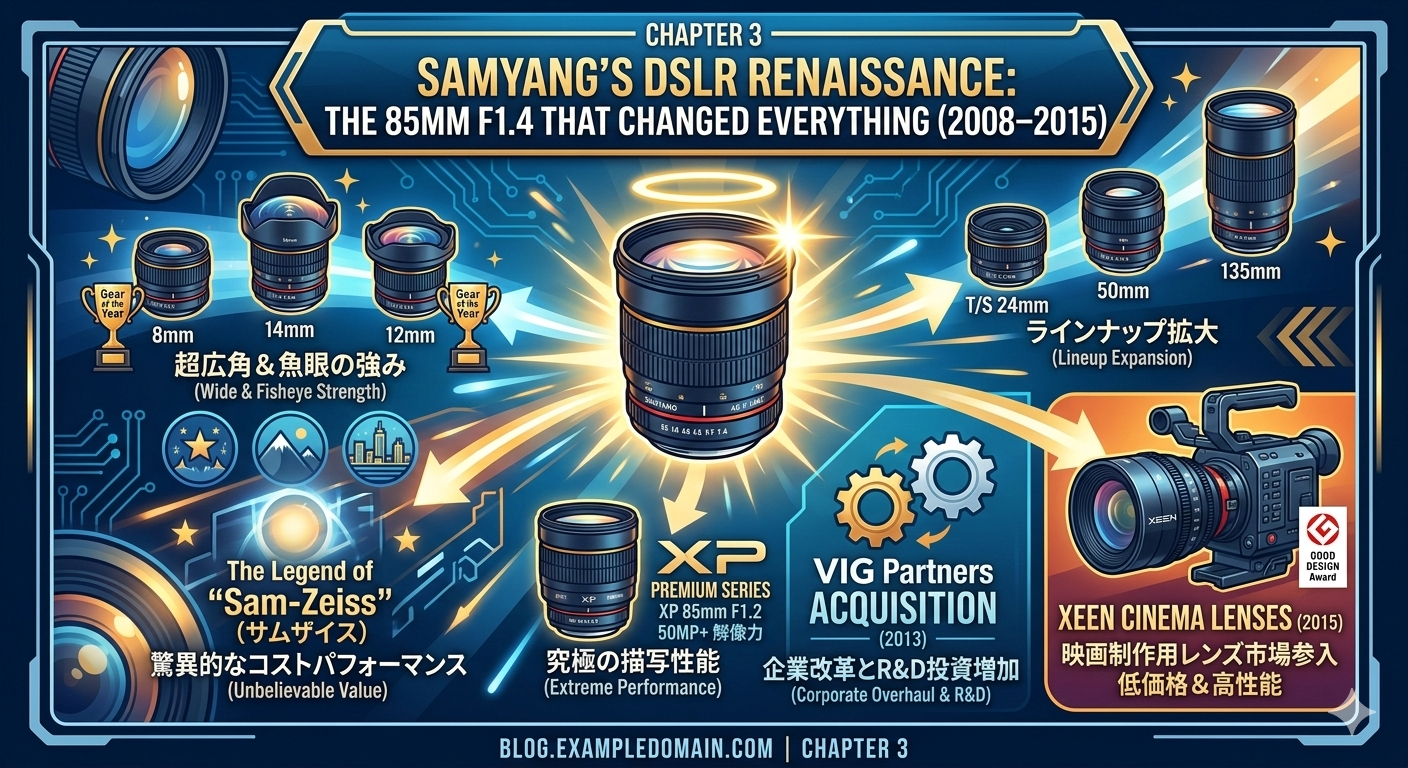
The 85mm F1.4 — Birth of the “Sam-Zeiss” Legend
In 2008, Samyang released the 85mm F1.4 AS IF UMC. For the company, this was far more than a new product launch — it represented a fundamental pivot in its business model.
Until that point, Samyang had been a behind-the-scenes player, supplying cheap OEM zoom lenses and mirror lenses for other brands. The 85mm F1.4, by contrast, was a lens the company put its own name on — and one it was genuinely proud of.
The reason it turned heads was simple: the optical performance wildly exceeded expectations for the price.
An 85mm F1.4 lens was traditionally the domain of premium offerings like the Canon EF 85mm F1.2L II USM or the Nikon AF-S 85mm F1.4G, both priced in the $1,500–$2,000 range at the time. Samyang’s version was manual focus only, but at roughly $300, it delivered image quality that reviewers across multiple countries called “unbelievable for the money.”
The UK’s Digital Photo magazine and Practical Photography both awarded this lens “Gear of the Year — Best Budget Lens.” The simultaneously released 8mm F3.5 Fish-Eye also picked up an award from Poland’s Film Video Foto magazine. Samyang’s own-brand products were beginning to earn international recognition.
Expanding into Wide-Angle and Fisheye Territory
Emboldened by the success of the 85mm F1.4, Samyang rapidly expanded its lineup into wide-angle and fisheye lenses.
Key Product Timeline (2008–2015)
| Year | Key Products | Notes |
|---|---|---|
| 2008 | 85mm F1.4 AS IF UMC | First serious own-brand DSLR lens. Multiple “Best Budget Lens” awards |
| 2009 | 8mm F3.5 Fish-Eye | Diagonal fisheye. Became popular for astrophotography and landscapes |
| 2010 | 14mm F2.8 ED AS IF UMC | Ultra-wide-angle. Full-frame compatible. Aspherical and ED glass elements |
| 2011 | 7.5mm F3.5 Fish-Eye | Micro Four Thirds mount |
| 2012 | 24mm F1.4 ED AS IF UMC / 8mm F2.8 Fish-Eye | Exports exceeded $30 million |
| 2013 | T/S 24mm F3.5 / 16mm F2.0 / 300mm F6.3 | Even a tilt-shift lens developed in-house. VIG Partners acquisition |
| 2014 | 50mm F1.4 / 10mm F2.8 / 12mm F2.0 | VIP ASIA Awards (50mm T1.5 cine version) |
| 2015 | 135mm F2.0 / 100mm F2.8 Macro / XEEN series launch | Cinema lens brand “XEEN” established. GOOD DESIGN Award |
What’s particularly notable is that Samyang’s sweet spot turned out to be wide-angle and ultra-wide-angle fast primes. The 14mm F2.8, 12mm F2.0, 10mm F2.8, and 8mm F3.5 Fish-Eye became favorites among astrophotographers, architecture photographers, and landscape shooters.
These focal lengths hit a strategic sweet spot: they’re expensive in first-party lineups and, crucially, manual focus is far less of a handicap at ultra-wide angles. Samyang had found its niche — the intersection of “expensive if you buy first-party” and “MF is perfectly usable.”
The VIG Partners Acquisition and Corporate Overhaul (2013)
Following the corporate crisis described in the previous chapter, Samyang was acquired by VIG Partners (Bogo Fund) in August 2013. Under new CEO Hwang Chung-hyun, the company underwent a radical restructuring.
NamuWiki describes the transformation as follows:
“After the acquisition by VIG Partners, Hwang Chung-hyun became CEO and successfully restructured the business by winding down OEM production and the CCTV lens division, and refocusing on cinema lenses (XEEN) and AF lens development.”
The specific measures included:
- Exit from OEM production: Ceased manufacturing budget lenses for other brands, concentrating resources on the Samyang brand
- Exit from CCTV lenses: Abandoned the low-margin surveillance camera lens business
- Major R&D investment increase: Expanded the MF lens group from 15 models to 40 by 2017
- Launch of the XEEN cinema lens brand: A serious entry into the professional filmmaking market
- AF lens development: Initiated autofocus lens R&D as the next growth engine
This was a clear strategic pivot: quality over quantity, own-brand over OEM, and stills-plus-cinema over stills-only. The revenue mix, which had been 100% MF lenses, shifted to “54% MF lenses, with the remainder split between AF and cinema lenses” by 2017.
The XEEN Shock — Entering the Cinema Lens Market (2015)
In 2015, Samyang launched XEEN, its professional cinema lens brand.
In the filmmaking world, cinema lenses must meet exacting requirements: unified barrel dimensions for easy lens swaps, precision focus gears for follow-focus systems, declicked aperture rings for smooth iris pulls, T-stop (transmission) markings rather than F-stops, and minimal focus breathing. Lenses meeting these specifications — Canon’s CN Cinema series, Sony’s CineAlta, Zeiss CP.2, and others — typically command prices from several thousand to well over ten thousand dollars.
XEEN entered with a lineup of eight lenses, from 14mm T3.1 to 135mm T2.2, priced dramatically lower than existing cinema lens options. For independent filmmakers and creators shooting video on DSLRs and mirrorless cameras, XEEN was a game-changer — offering production-quality cinema glass at a fraction of the established price.
XEEN won a GOOD DESIGN Award in 2015, and the following year the XP 85mm earned ePHOTOzine’s “Gear of the Year” distinction. Samyang was stacking up international awards at an impressive pace.
The XP Series — Premium Manual Focus Lenses
Starting in 2016, Samyang introduced the “XP (eXtreme Performance)” series as a new premium line:
- XP 85mm F1.2 (2016)
- XP 14mm F2.4 (2016/2017)
- XP 35mm F1.2 (2018)
- XP 50mm F1.2
- XP 10mm F3.5 (2019)
The XP series was designed to resolve at 50 megapixels and above, positioning these lenses in a higher price bracket than Samyang’s standard offerings. The XP 85mm F1.2, in particular, won ePHOTOzine’s “Gear of the Year 2016” — a clear signal that Samyang was shedding the “cheap and cheerful” reputation.
New Factory and “World Class 300” Recognition
In January 2016, Samyang built a new production facility in Masan, replacing the aging original factory. This wasn’t just about increasing capacity — it was a statement about quality control.
That same year, Samsung Electronics exited the camera market entirely, discontinuing the NX series. This made Samyang Optics the only company in South Korea capable of designing and manufacturing interchangeable camera lenses — a symbolic milestone for the Korean optical industry.
In 2017, the Korean government designated Samyang as a “World Class 300 Enterprise” — a distinction given to mid-sized Korean companies with proven global competitiveness. The company also listed on KOSDAQ (the Korean over-the-counter market) and received an iF Design Award that year.
Looking Back at This Era
The years from 2008 to 2015 were, in many ways, a “second founding” for Samyang.
What began with a single lens — the 85mm F1.4 — expanded at remarkable speed into fisheye, ultra-wide-angle, tilt-shift, macro, and cinema lenses. The VIG Partners acquisition and CEO Hwang’s restructuring accelerated the transformation from anonymous OEM subcontractor to recognized lens brand.
But this was still fundamentally a manual focus story. As digital cameras shifted to mirrorless and autofocus became the baseline expectation, Samyang couldn’t survive on MF lenses alone. The next evolution — the leap into autofocus — is the subject of the next chapter.
Sources
- LK Samyang Official Website — History (https://www.lksamyang.com/en/about/history.php)
- Wikipedia — “LK Samyang” (https://en.wikipedia.org/wiki/LK_Samyang)
- NamuWiki — “LK삼양” (https://en.namu.wiki/w/LK삼양)
- ePHOTOzine — “A Golden Anniversary – 50 Years Of Samyang” (https://www.ephotozine.com/article/a-golden-anniversary—50-years-of-samyang-36151)
- PetaPixel — “A Guide to Third-Party Chinese Lens Brands” (https://petapixel.com/chinese-lens-brands/)
- LensTip.com — Samyang AF 50 mm f/1.4 FE II Review (https://www.lenstip.com/653.0-Lens_review-Samyang_AF_50_mm_f_1.4_FE_II_.html)
- Maeil Business Newspaper — “Samsung Electronics, which was leading the K-optical industry” (https://www.mk.co.kr/en/business/11181079)