
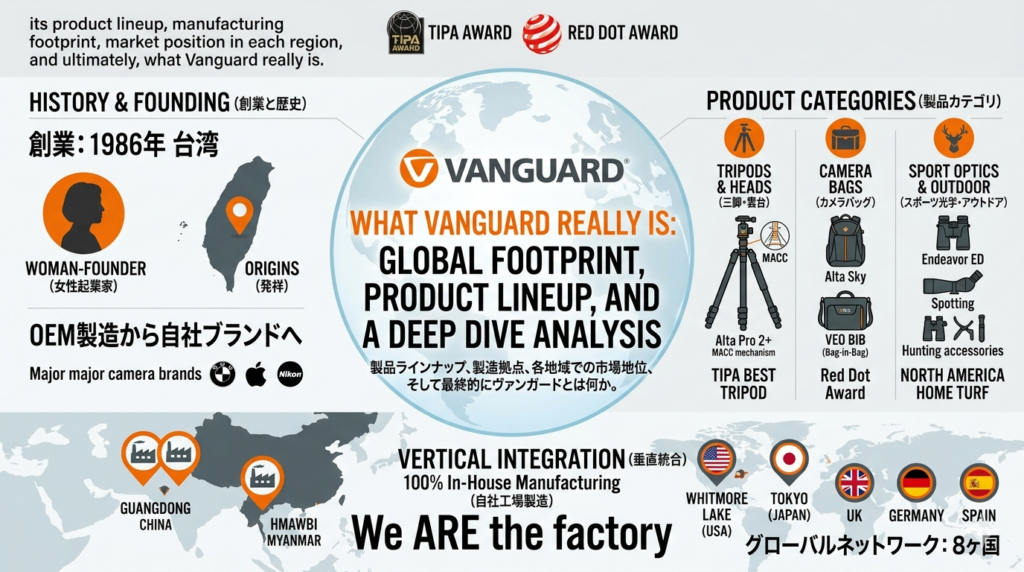
There are countless tripod manufacturers in the world. But surprisingly few can clearly answer all of these questions: Who founded it? Where are the products actually made? And why does it offer this level of quality at this price? Vanguard is one of those rare exceptions. Born in Taiwan in 1986, the brand started as an OEM manufacturer before pivoting to its own brand, building a global presence across three pillars: tripods, camera bags, and sport optics. In this series, we trace Vanguard’s journey from its founding to the present — its product lineup, manufacturing footprint, market position in each region, and ultimately, what Vanguard really is.
- Chapter 1: The Founding — A Woman Entrepreneur’s Tripod Factory in 1986 Taiwan
- Early 1990s: Opening an Office in Michigan
- Mid-to-Late 1990s: Beyond Tripods
- 2000s: Entering the Optics Market
- Taiwanese Origins, Manufacturing in Guangdong, China
- What “100% In-House Manufacturing” Means
- “Made in China” vs. “Chinese Brand”
- 1990s–Early 2000s: Building Expertise Through OEM
- 2009: The Alta Pro and the First TIPA Award
- 2017: Alta Pro 2+ — TIPA and Red Dot Double Winner
- 2021: VEO 3GO — The New Standard in Travel Tripods
- 1. Tripods, Monopods & Heads
- 2. Camera Bags & Cases
- 3. Sport Optics
- 4. Hunting & Outdoor
- Japan: The Invisible Contender
- Camera Bags in Japan
- North America: Home Turf
- Europe: Subsidiaries in Germany, the UK, and Spain
- China & Asia: A Complicated Position
- Strengths
- Weaknesses
- Supplement: Where to Buy Vanguard — Retail Availability in Five Key Markets
Chapter 1: The Founding — A Woman Entrepreneur’s Tripod Factory in 1986 Taiwan
Vanguard’s history begins in 1986. Its founder is Anne Lee, a Taiwanese woman entrepreneur.
The company she established was called Guardforce Group, and its initial business was OEM manufacturing of camera tripods. OEM — Original Equipment Manufacturer — refers to a business model in which a company manufactures products under other companies’ brand names. Guardforce produced tripods for major brands, including Sony.
1986 was still firmly in the film camera era. 35mm SLRs were the dominant format, and the tripod market was controlled by established players: Manfrotto and Gitzo from Italy and France, and Slik and Velbon from Japan. A small Taiwanese factory entering this crowded field with just a handful of tripod models was not considered a strong bet. As Vanguard’s own brand presentation materials put it: “The company’s odds for success in a crowded market were slim.”
But Anne Lee’s instincts proved correct. By taking on OEM contracts for major manufacturers, Guardforce was able to learn their quality standards firsthand while accumulating expertise in manufacturing technology and quality control. This strategy would later become the solid foundation upon which Vanguard launched its own brand on the world stage.
The fact that the founder is a woman is unusual in the camera accessories industry. Vanguard continues to officially identify itself as a “woman-owned company” to this day, and as of the late 2010s, Anne Lee was confirmed to still be at the helm of the group.
Chapter 2: Entering North America and the Shift to a Proprietary Brand (1990s–2000s)
Early 1990s: Opening an Office in Michigan
A few years after its founding, Vanguard made its formal entry into the North American market in the early 1990s. The first U.S. office was established in Dexter, Michigan. According to company accounts, the location was chosen because a colleague of Anne Lee had personal ties to nearby Ann Arbor. From this base, Vanguard began supplying tripods — both under the Vanguard brand and as private-label products — to major retailers across North America, Europe, and Asia.
The office later relocated to Whitmore Lake, a small town in southeastern Michigan, where Vanguard USA’s headquarters remains to this day. As of around 2010, approximately 21 staff members were reported at the location.
Mid-to-Late 1990s: Beyond Tripods
By the mid-1990s, Vanguard’s tripod distribution network had expanded considerably, and the brand was establishing a reputation for “affordable tripods with features you can’t find elsewhere.” Around the same time, the company expanded its manufacturing facilities and began producing camera bags and cases — an unusual move for a tripod manufacturer at the time.
During this period, Anne Lee was keenly reading shifts in the market: the acceleration of globalization, the digitization of photo and video equipment, and the rapid growth of manufacturing in mainland China. In response, the Guardforce Group underwent a major strategic pivot: a shift from an OEM-centric business model to a brand strategy that positioned “Vanguard” as a mid-to-premium brand.
2000s: Entering the Optics Market
In the 2000s, Vanguard invested millions of dollars in building a state-of-the-art optical instrument manufacturing facility and began developing binoculars and spotting scopes. The result was the Endeavor collection.
This move signaled a transformation from “camera tripod maker” to “comprehensive photo, video, and outdoor accessories brand.” Vanguard didn’t just expand its product categories — it made a full-scale entry into outdoor markets such as hunting and birdwatching. The formal entry into the sport optics market — with the release of Endeavor binoculars around 2010 — was a natural extension of this trajectory.
Chapter 3: Where Does Vanguard Actually Make Its Products? — The Truth Behind “Made in China”
One of the most common questions about Vanguard is: “Are Vanguard products made in China?” The answer is both yes and no.
Taiwanese Origins, Manufacturing in Guangdong, China
Vanguard’s roots are in Taiwan. The Guardforce Group was established there, and early manufacturing took place in Taiwan as well. However, the company’s current manufacturing base has moved to Foshan Nanhai District, Guangdong Province, China, where Vanguard operates its own factory under the entity Foshan Nanhai Chevan Optical Electronics Co., Ltd.
In addition, Vanguard’s brand presentation materials explicitly state: “2015: Vanguard invests heavily in our manufacturing facilities by creating a purpose-built, state-of-the-art new facility in Myanmar.” The official “About Us” page designates Myanmar as the company’s “design and manufacturing headquarters,” while offices in other countries — including China (Guangzhou) — are listed as “distribution, sales, marketing and administrative branches.” Furthermore, product registration records for the Indian market list the manufacturer as “Guardforce Group, Hmawbi T/S Yangon, Myanmar” with the country of origin recorded as “Myanmar.”
The reality of Vanguard’s current manufacturing setup is best described as a dual-facility system: the existing factory in Foshan, Guangdong, and a newer facility built in Myanmar from 2015 onward. While the official website positions Myanmar as the “design and manufacturing headquarters,” the Foshan Nanhai entity remains listed in the global address directory, making it difficult to conclude that manufacturing has fully migrated. At least for products shipped to India, Myanmar-based production has been confirmed.
What “100% In-House Manufacturing” Means

Vanguard’s key message is: “We ARE the factory.”
The official website states:
“There are no third-party factories, development or design companies, or outsourcing of any kind in our process. Over 1,000 Vanguard employees create the products and drive the brand. Every step is executed by Vanguard’s in-house R&D, production, management, marketing, and sales teams, in facilities owned and managed by Vanguard.”
This is a distinctive feature in the tripod and camera bag industry, where many brands outsource manufacturing to OEM factories in China. Vanguard maintains a vertically integrated model — designing, manufacturing, and selling its own products. According to Vanguard, this structure eliminates intermediary margins, resulting in better value for consumers and healthier margins for retailers.
“Made in China” vs. “Chinese Brand”
There’s an important distinction to be made here. While Vanguard products are indeed manufactured in China (and Myanmar), Vanguard is fundamentally different in origin from Chinese-born brands such as Benro, Sirui, and Leofoto.
Founded in Taiwan and run by a Taiwanese entrepreneur through the Guardforce Group, Vanguard is more accurately described as a “Taiwanese brand, China-manufactured” company. That said, the question of corporate nationality is not entirely clear-cut — some global market research reports classify Vanguard under “Taiwan,” while others list it under “China.”
Regardless of classification, Vanguard makes its products in its own factories, designed by its own engineers. Who makes it, and under what quality standards, matters more than where it’s made — that is Vanguard’s position, and one this author agrees with.
Chapter 4: A Global Network Spanning Eight Countries
Vanguard operates out of eight countries worldwide, anchored by its manufacturing bases in Myanmar and Guangdong, China.
| Country/Region | Entity Name | Location | Primary Function |
|---|---|---|---|
| Myanmar | Guardforce Group (Vanguard Myanmar) | Hmawbi, near Yangon | Design & manufacturing HQ (per official site) |
| China | Foshan Nanhai Chevan Optical Electronics Co., Ltd | Nanhai District, Foshan, Guangdong | R&D, manufacturing, administration |
| United States | VANGUARD USA INC. | Whitmore Lake, Michigan | North American sales & marketing |
| Japan | GUARDFORCE JAPAN LTD. | Iwamotocho, Chiyoda-ku, Tokyo | Japanese market sales |
| United Kingdom | Vanguard World UK Ltd | Christchurch | UK sales |
| Germany | Vanguard Deutschland GmbH | Bergheim | German-speaking market sales |
| Spain | GUARDFORCE ACCESORIOS SL | Near Barcelona | Southern European sales (incl. Italy) |
| Luxembourg | Vanguard World Luxembourg SARL | Stadtbredimus | European operations HQ |
A noteworthy detail is that Vanguard has its own subsidiary in Japan (GUARDFORCE JAPAN LTD.) rather than relying on a third-party distributor. This is a clear signal that Vanguard takes the Japanese market seriously — a market known for its demanding consumers and strong domestic brands.
Chapter 5: The Hit Products — From Alta Pro to VEO
Vanguard’s product history is defined by several clear turning points.
1990s–Early 2000s: Building Expertise Through OEM
In its early years, Vanguard did sell tripods under its own brand, but the lineup was limited. The general consensus was “affordable but nothing special” — products that rarely made it onto the shortlists of professionals or serious enthusiasts.
However, the quality standards learned from OEM clients and the manufacturing know-how accumulated in its own factories during this period would make later breakthroughs possible.
2009: The Alta Pro and the First TIPA Award
Vanguard’s breakthrough came with the Alta Pro series, launched in 2009.
The Alta Pro featured a proprietary mechanism called the Multi-Angle Center Column (MACC). On a conventional tripod, the center column moves only vertically. The Alta Pro allowed the center column to tilt to virtually any angle, including horizontal — dramatically improving versatility for macro photography and overhead shooting.
The Alta Pro won the TIPA (Technical Image Press Association) “Best Accessory” award in its launch year. TIPA is an international industry body composed of editors from photography and imaging magazines worldwide, and its awards represent an objective validation of product quality and innovation. This recognition helped Vanguard shed its image as a “budget tripod maker” and established it as an innovative, mid-range tripod brand.
<!– Affiliate insertion point 2: Vanguard Alta Pro 2+ tripod (Amazon) –>
2017: Alta Pro 2+ — TIPA and Red Dot Double Winner
The Alta Pro 2+, launched in 2017 as the true successor to the Alta Pro, is arguably the most acclaimed tripod in Vanguard’s history.
Alongside an improved MACC system, the leg lock mechanisms and overall build quality saw major upgrades. The refined design earned it both the TIPA “Best Tripod” award and a Red Dot Design Award. The following year (2018), it won the TIPA “Best Tripod” award again — back-to-back — and Vanguard also received a TIPA award in the camera bag category that same year.
The Alta Pro 2+ was offered in both carbon fiber and aluminum models, priced at roughly $180–$350 USD. This put it in direct competition with comparable Manfrotto products, while differentiating itself through the unique MACC mechanism.
2021: VEO 3GO — The New Standard in Travel Tripods
From the late 2010s, the rise of mirrorless cameras drove a surge in demand for lightweight, compact, travel-friendly tripods. Photographers increasingly wanted tripods small enough for carry-on luggage, rather than the bulky legs designed for heavy DSLRs.
Vanguard responded with the VEO series. The VEO 3GO series in particular earned high praise as a travel tripod that delivered the brand’s technical strengths in a lightweight carbon fiber package. It won the TIPA “Best Tripod” award in 2021.
The VEO 3GO comes in two sizes: the compact 235 model (folded length ~33 cm / 13″, weight ~1.0–1.2 kg / 2.2–2.6 lbs, max load ~4 kg / 8.8 lbs) and the larger 265 model (~41 cm / 16″ folded, ~1.4 kg / 3.1 lbs, max load ~10 kg / 22 lbs). Both comfortably support mirrorless camera and lens combinations. Priced at roughly $130–$280 USD, the VEO 3GO competes with the Peak Design Travel Tripod and Manfrotto’s Befree series.
Chapter 6: The Current Product Lineup — It’s Not Just Tripods
Vanguard’s product ecosystem in the 2020s spans four major categories.
1. Tripods, Monopods & Heads
Vanguard’s tripod lineup is segmented by use case and price point.
Alta Pro 2+ / Alta Pro 3VL
The flagship line for users who demand professional-grade rigidity. Features the MACC system. The Alta Pro 3VL series incorporates a built-in leveling base, making it suitable for video work as well. Maximum load capacity is around 13 kg (28.6 lbs), supporting telephoto lenses and larger cinema camera rigs.
VEO 3+ / VEO 3GO / VEO 2
The travel-to-midrange tripod family. The VEO series is Vanguard’s current flagship line, primarily targeting mirrorless camera users. Available in both carbon fiber and aluminum models, offering a wide range of options.
Vesta
The entry-level, budget-friendly line. Priced around $70 USD, it targets first-time tripod buyers.
Heads
Vanguard offers PH series (3-way heads), BH series (ball heads), ALTA GH series (pistol grip heads), and VEO PV series (pan & tilt video heads). An increasing number of models feature Arca-Swiss compatible quick release systems.
2. Camera Bags & Cases
Camera bags are Vanguard’s second-largest product pillar.
Alta Sky
A pro-oriented, high-capacity backpack. Features rear access, drone storage compatibility, and an included rain cover — all designed with functionality in mind. Winner of the Red Dot Design Award. Note that the 2018 TIPA “Best Photo Bag” award was given to a different product in the same Alta collection: the Alta Fly 55T, a roller-style backpack.
VEO Active
An outdoor-oriented backpack designed for hiking and nature photography, featuring weather-resistant materials.
VEO Range / VEO Select
Compact messenger and shoulder bags optimized for mirrorless cameras. Designed for urban use with a refined aesthetic.
VEO City
An everyday 3-in-1 bag with a detachable front tech pouch, allowing users to switch between daily carry and photo configurations.
VEO BIB (Bag-in-Bag)
An “inner bag” system designed to fit inside existing backpacks or suitcases. A practical approach to travel photography that integrates seamlessly with your existing luggage — and one that has earned strong user reviews.
3. Sport Optics
Endeavor ED Series (Binoculars)
Binoculars featuring ED (Extra-low Dispersion) glass. Well-suited for birdwatching and hunting, with a solid following in the North American market.
Endeavor HD Series (Spotting Scopes)
Field scopes for long-range observation. Positioned as entry-level instruments for birdwatching and stargazing.
4. Hunting & Outdoor
Vanguard also offers hunting-related products for the North American market, including shooting sticks, gun cases, and bow cases. While these products see virtually no distribution in markets like Japan or Europe, they contribute significantly to brand recognition in North America.
Chapter 7: Vanguard’s Market Position by Region
Vanguard describes itself as a “global brand,” but its presence varies dramatically by region. Here’s a closer look at each major market.
Japan: The Invisible Contender
To put it bluntly, Vanguard is not a major player in the Japanese tripod market.
The BCN AWARD — one of the few publicly available datasets on Japan’s tripod and monopod market, based on POS sales data from electronics retailers and online shops — shows the top three spots consistently held by Hakuba Photo Industry (~25–30%), Slik (~12–15%), and Videndum Media Solutions (formerly Vitec Group, parent company of Manfrotto and Gitzo, ~14–15%). Vanguard does not appear in the top three.
| Year (BCN AWARD) | #1 | #2 | #3 |
|---|---|---|---|
| 2026 | Hakuba (25.2%) | Videndum (13.9%) | Slik (12.8%) |
| 2025 | Hakuba (28.8%) | Slik (14.8%) | Videndum (14.4%) |
| 2024 | Hakuba (29.6%) | Videndum (14.2%) | Slik (14.2%) |
Source: BCN AWARD, Tripod & Monopod category
Several factors explain Vanguard’s struggles in Japan:
First, Japan has powerful domestic brands. Hakuba Photo Industry acquired Velbon’s camera tripod business (product planning, design, and development) in August 2020, expanding its market share to around 30% from 2021 to 2023. However, the share has been declining recently, falling to 25.2% in the BCN AWARD 2026 (based on 2025 sales data). Slik also maintains a loyal following. Japanese consumers tend to place strong trust in domestic brands, especially for long-term-use products like tripods.
Second, Manfrotto dominates the foreign brand space. Manfrotto (under Videndum, formerly Vitec Group) enjoys heavy coverage in Japanese photography magazines and prominent placement in camera retail stores. For many Japanese photography enthusiasts, “foreign tripod brand” essentially means “Manfrotto.” Vanguard would have to overcome this deeply entrenched perception to compete in the same price bracket.
Third, the rise of Chinese brands has created yet another competitive front. Since the 2010s, Chinese brands such as Benro, Sirui, Leofoto, and K&F Concept have rapidly gained traction. Leofoto in particular — with its precision Arca-Swiss compatible heads and premium build quality — has captured the attention of enthusiast photographers in Japan. Vanguard must contend with these aggressors as well.
That said, Vanguard maintains its own subsidiary in Japan (GUARDFORCE JAPAN) and operates a Japanese-language website (vanguardworld.jp), signaling no intention of abandoning the market.
Camera Bags in Japan
Vanguard’s camera bag presence in Japan is similarly limited. The Japanese camera bag market is dominated by Hakuba Photo Industry (Japan’s largest, with a 53.9% share in BCN AWARD 2026), Etsumi, and Elecom. Among foreign brands, Manfrotto, Lowepro (now under Videndum), and Peak Design are the most popular. There’s little room for Vanguard to break in.
That said, VEO BIB’s “Bag-in-Bag” concept has genuine potential in Japan, where travel photography is hugely popular. The ability to integrate photo gear into an existing backpack or suitcase is a practical differentiator that few competitors offer.
<!– Affiliate insertion point 5: Vanguard VEO BIB series (Amazon) –>
North America: Home Turf
North America is Vanguard’s largest market. Headquartered in Whitmore Lake, Michigan, the brand enjoys wide distribution through Amazon.com, B&H Photo, and Adorama.
Competition is fierce — Manfrotto, Gitzo (both under Videndum), Really Right Stuff, Peak Design, and 3 Legged Thing are all vying for attention — but Vanguard differentiates itself through “value through in-house manufacturing” and “credibility through TIPA awards.”
The hunting and outdoor segment is a distinctly North American strategy, extending brand awareness beyond the photo and video channel. Binoculars and spotting scopes hold shelf space at outdoor specialty retailers across the continent.
Europe: Subsidiaries in Germany, the UK, and Spain
In Europe, Vanguard has established subsidiaries in Germany, the UK, Spain, and Luxembourg, building a locally rooted sales infrastructure. British photography magazines regularly review Vanguard products, and major retailers like Jessops carry the brand.
In the European market, Manfrotto (Italy) and Gitzo (France) hold commanding positions. Rather than competing head-on with these premium brands, Vanguard positions itself as offering “slightly more accessible pricing with equal or superior functionality.” The lightweight VEO travel tripods have found an audience among Europe’s travel photographers.
China & Asia: A Complicated Position
Vanguard’s position in mainland China is somewhat complicated. While its manufacturing base is in Guangdong, it is recognized as a “Taiwanese-origin foreign brand.” The Chinese brand name “精嘉” (Jīng jiā) is used in the Chinese market.
Domestically, Chinese brands like Benro, Sirui, Leofoto, Fotopro, and Kingjoy are strong, with competitive pricing advantages. Vanguard tends to be positioned as a “slightly premium” brand in China.
In Southeast Asia, Vanguard maintains a degree of visibility within photography communities in Singapore, Malaysia, and neighboring countries.
Chapter 8: Strengths and Weaknesses — An Honest Assessment
Strengths
1. Quality Control and Value Through Vertical Integration
By handling everything from planning to manufacturing in-house, Vanguard minimizes quality variance and maintains cost transparency. Its ability to control product quality is demonstrably superior to brands that rely on third-party OEMs.
2. Technical Credibility Backed by Consecutive TIPA Awards
The Alta Pro (2009), Alta Pro 2+ (2017, 2018 back-to-back), and VEO 3GO (2021) — winning TIPA’s “Best Tripod”-class awards over more than a decade is not marketing fluff. It is tangible evidence of sustained technical innovation.
3. Breadth of Product Categories
Tripods, camera bags, binoculars, spotting scopes, and hunting accessories — Vanguard has achieved a rare level of diversification for a camera accessories manufacturer.
4. An Independent, Woman-Founded Company
Unlike many competitors that have been acquired by conglomerates like the Vitec Group (now Videndum) or Japan’s Hakuba, Vanguard has remained independent for nearly 40 years under its founder. This is exceptionally rare in the camera equipment industry.
Weaknesses
1. Low Brand Awareness (Especially Outside North America)
Ask most photographers “name a tripod brand” and Vanguard is unlikely to be the first answer. Its presence in camera retail stores is limited compared to Manfrotto and Gitzo, and it receives less coverage in photography media.
2. Inconsistent Design Language
The rugged, utilitarian aesthetic of the Alta Pro line, the sleek travel-oriented VEO series, and the entry-level Vesta line each pull in different design directions. Compared to brands like Peak Design or Leofoto — which maintain a unified design identity across all products — Vanguard’s visual coherence can feel fragmented.
3. Price Competition with Chinese Brands
Benro and Sirui offer comparable or even superior quality at similar or lower prices. Leofoto, while often priced higher than Vanguard, differentiates through build quality and brand cachet. Vanguard occupies the “neither cheap nor expensive” middle ground — a zone where competition is most intense.
4. Weak Social Media and Influencer Marketing
Vanguard’s YouTube and Instagram presence is modest compared to SmallRig, Peak Design, Benro, and Sirui. In today’s camera accessories market, where YouTube reviewers and influencers significantly influence purchasing decisions, Vanguard appears to be underinvesting in this area.
Chapter 9: Vanguard and the Chinese Tripod Industry — A Historical Perspective
In previous articles — “The Chinese Tripod Chronicle: A Complete History of China’s Camera Tripod Industry” and “The Chinese Camera Equipment Chronicle: A Complete History of China’s Lighting, Video Accessories & Camera Bag Industries” — I mapped out the full landscape of China’s camera equipment manufacturing sector. Within that context, it’s worth revisiting where Vanguard fits in.
Guangdong Province, China, is the world’s preeminent production hub for camera tripods. The city of Zhongshan in particular is home to a dense cluster of major manufacturers — Benro, Sirui, Fotopro, Leofoto, and Kingjoy all have factories there, forming an industrial cluster so concentrated it’s sometimes referred to as “the tripod capital.”
Vanguard’s factory is located in Foshan’s Nanhai District, which is some distance from Zhongshan but part of the same Pearl River Delta economic zone in Guangdong Province. Geographically speaking, Vanguard is very much part of the Chinese tripod industry’s ecosystem.
However, its origins and trajectory are fundamentally different. Brands like Benro, Sirui, and Leofoto were founded in mainland China from the mid-1990s through the 2010s — Benro was established in 1996 (launching its own brand in 2002), and Sirui was founded in 2006. Vanguard, by contrast, was founded in Taiwan in 1986 and built its foundation through OEM contracts — making it a “Taiwanese pioneer” rather than a mainland Chinese brand.
Interestingly, the brand most similar in positioning to Vanguard is Feisol. Feisol is also Taiwanese in origin, with roots in carbon fiber tube manufacturing before entering the tripod market in 2002. The pattern of Taiwanese manufacturers relocating production to mainland China — or leveraging China’s manufacturing infrastructure — is not unique to the tripod industry. It reflects a broader structural shift across Taiwanese manufacturing as a whole.
Chapter 10: Vanguard’s Future — Surviving the Next Decade
Vanguard faces several challenges in the years ahead.
A Shrinking Camera Market
Global digital camera shipments have declined dramatically from their peak (around 2010) due to smartphone proliferation. The tripod and camera bag markets are not immune to this trend. However, as mirrorless cameras grow more sophisticated and the vlogger/content creator segment expands, demand for high-value products aimed at a dedicated core of enthusiast users is holding steady.
Capturing the Video Demand
As evidenced by the Alta Pro 3VL series, Vanguard is actively moving into video tripods. A video tripod with a built-in leveling base aligns well with the needs of YouTube creators and interview shooters, and strengthening competitiveness in this segment is a priority.
Branding in the E-Commerce Era
With Amazon now a primary sales channel, being discoverable in Amazon search results and earning strong reviews matters more than physical shelf presence at retail stores. Vanguard’s consistent product quality — a natural result of in-house manufacturing — is a strength that can directly translate into positive Amazon reviews.
Generational Succession
Anne Lee has led Vanguard for approximately 40 years since its founding. Looking ahead to the next decade, transitioning to a next-generation leadership team is an unavoidable challenge.
Supplement: Where to Buy Vanguard — Retail Availability in Five Key Markets
This chapter is an English-edition supplement, expanding on Chapter 7’s regional overview with specific retail and distribution information for readers in North America, South Asia, the UK, and Oceania.
United States: The Deepest Retail Footprint
Of all the markets Vanguard operates in, the United States offers the broadest and most accessible product availability. This is no accident — Vanguard’s North American headquarters sits in Whitmore Lake, Michigan, and the US has been the brand’s primary revenue market since its pivot from OEM to proprietary brand in the mid-1990s.
Online retail is the dominant channel. Amazon.com lists over 600 Vanguard-related products — tripods, monopods, heads, bags, and accessories — with many items fulfilled directly by Amazon and eligible for Prime shipping. B&H Photo Video in New York carries a comprehensive Vanguard selection across tripods, video supports, backpacks, and sport optics, with in-store stock at their Manhattan Superstore. Adorama, the other major New York–based photo retailer, similarly maintains a deep Vanguard catalog spanning tripods, bags, and accessories.
Beyond the big three, Vanguard products appear at Walmart (primarily entry-level and mid-range tripods and bags), OpticsPlanet (binoculars, spotting scopes, and hunting/shooting accessories), and numerous regional camera shops listed on Vanguard’s own Store Locator. The Store Locator is worth noting: Vanguard maintains an “Authorized Dealer” program in the US, and purchasing from these dealers qualifies buyers for extended and lifetime warranty programs — a meaningful differentiator that many competing brands do not offer at this price tier.
The hunting and outdoor segment deserves special mention. In the US, Vanguard’s Endeavor binoculars, spotting scopes, and shooting tripods occupy shelf space at outdoor specialty retailers and are reviewed by hunting media outlets. This dual-channel strategy — photography and outdoor — is distinctly American and gives Vanguard a broader consumer touchpoint than it enjoys in any other market.
Vanguard USA also operates its own direct-to-consumer e-commerce site at vanguardworld.com, frequently running clearance sales (as of early 2026, a “Stock Cleanout” promotion covered the Alta Pro 2V video tripod line). Direct sales allow Vanguard to control pricing, bundle offers, and push older inventory without relying solely on third-party retail margins.
Key takeaway for US buyers: Availability is excellent. The challenge is not finding Vanguard products — it is choosing from among the many channels. For warranty protection and authentic product guarantees, purchasing from Authorized Dealers or vanguardworld.com is recommended.
Canada: A Single-Distributor Model
Canada’s Vanguard distribution follows a markedly different structure from the US. Since November 2012, Amplis Foto (headquartered in Markham, Ontario) has served as the exclusive Canadian distributor for Vanguard tripods, bags, and accessories.
Amplis operates its own online store (store.amplis.com) carrying a curated selection of Vanguard tripods, bags, and heads. Vanguard also maintains a dedicated Canadian website at vanguardphoto.ca, which showcases the product lineup but directs purchases through Amplis and authorized retailers.
In brick-and-mortar retail, Vanguard products appear at The Camera Store (Calgary, one of Canada’s most respected independent camera retailers), Henry’s (Canada’s largest camera retail chain), and other imaging specialists across the country. PHOTONews Canada, the country’s leading photography publication, regularly covers Vanguard product launches and has noted that Amplis provides in-house service and parts support — an important consideration for Canadian buyers who might otherwise face cross-border shipping for warranty claims.
The single-distributor model has both advantages and limitations. On the positive side, it ensures consistent pricing, local warranty service, and a curated product selection. On the negative side, the range available in Canada is narrower than what US buyers can access, and pricing in Canadian dollars often reflects a premium beyond the simple exchange rate — a common frustration for Canadian photography enthusiasts across all brands.
Key takeaway for Canadian buyers: Amplis Foto is the gateway. For the widest selection and local warranty support, purchasing through Amplis-authorized channels is the safest route.
India: Growing Presence in a Price-Sensitive Market
India represents one of Vanguard’s more interesting market positions. The brand has maintained a distribution presence in India since at least the early 2010s (Amplis Foto’s 2012 press release listed India among countries with Vanguard sales branches), though unlike in the US, UK, or Germany, a dedicated Guardforce subsidiary office is not listed on Vanguard’s current Global Company Address page. Products are available through multiple channels — but the competitive landscape is radically different from Western markets.
Amazon India (amazon.in) is the primary online channel, listing Vanguard tripods from the entry-level Vesta series through professional-grade VEO 3+ models. The VEO 3+ 263AB and 263CB appear to be the most popular models, with strong review counts and ratings. Flipkart, India’s other major e-commerce platform, also carries Vanguard — though inventory tends to be more limited and pricing can be inconsistent.
Beyond the two e-commerce giants, specialized photography retailers play a significant role. Kamal Imaging (a well-established imaging distributor) stocks Vanguard tripods and bags. IMA Student (imastudent.com), a photography equipment retailer catering to students and emerging professionals, carries a substantial Vanguard range including VEO bags and tripods at competitive prices with GST invoicing for tax credit. Future Forward (futureforward.in) is another multi-brand photography retailer offering Vanguard products.
The Indian market presents unique challenges for Vanguard. Price sensitivity is extreme — the average Indian photographer’s budget for a tripod is a fraction of what Western buyers spend. Budget brands like Benro, Digitek (an Indian brand with China-manufactured products), and Amazon Basics (sourced from Chinese OEMs) dominate the entry-level segment. At the enthusiast tier, Manfrotto remains the aspirational foreign brand, much as it does in Japan.
Vanguard’s positioning in India is as a “quality mid-range foreign brand” — above the Chinese budget options but more accessible than Manfrotto or Gitzo. The VEO and Vesta lines, with their combination of genuine engineering and competitive pricing, are well-suited to this positioning. The Alta Pro series, however, remains a niche product in India due to its higher price point.
Key takeaway for Indian buyers: Vanguard is available and competitively positioned. Amazon India offers the widest selection; specialized retailers like IMA Student and Kamal Imaging may offer better pricing or bundled deals.
United Kingdom: Strong Retail Presence with Local Support
The UK is one of Vanguard’s strongest European markets, supported by a dedicated UK subsidiary and a localized e-commerce site at vanguardworld.co.uk.
The most significant retail partner is Jessops, the UK’s largest specialist camera retailer. Jessops carries a broad Vanguard range — from entry-level Vesta travel tripods (starting around £50) to mid-range VEO 3+ carbon fiber models (around £250–300) — both online and across their nationwide store network. Jessops prominently features Vanguard in its “Offers” section, and the retailer has published editorial content including a “Meet the Manufacturer: Vanguard” feature that provides brand background for prospective buyers. Notably, Jessops emphasizes “UK Stock Only — No Grey Imports,” ensuring buyers receive products covered by local warranty.
Amazon UK (amazon.co.uk) lists a substantial Vanguard catalog, though stock levels for specific models can be inconsistent — a common issue for mid-tier brands on Amazon UK. CameraWorld (with physical stores in London and Stevenage) and PicStop (an online retailer that positions itself as a Vanguard specialist) also carry the brand.
British photography media — particularly ePHOTOzine and the print magazines — have historically given Vanguard favorable coverage. The brand’s multiple TIPA awards resonate in the European market, where TIPA (based in Europe) carries more weight with consumers than it does in North America or Asia.
The UK competitive landscape places Vanguard in a favorable middle ground. Manfrotto and Gitzo dominate the premium tier. 3 Legged Thing, a British-designed brand (manufactured in China), competes directly with Vanguard in the enthusiast segment with colorful designs and strong local loyalty. At the budget end, Chinese brands and Amazon’s own offerings are ever-present. Vanguard’s strength in the UK lies in its combination of engineering credibility, TIPA recognition, and pricing that undercuts the Videndum (Manfrotto/Gitzo) portfolio.
Key takeaway for UK buyers: Jessops is the go-to for hands-on evaluation and local warranty. For the best prices, compare Jessops, Amazon UK, and PicStop.
Australia: C.R. Kennedy as the Distribution Backbone
Australia’s Vanguard distribution is handled primarily through C.R. Kennedy, the country’s leading importer and distributor of photographic equipment. C.R. Kennedy’s head office and main warehouse is in Melbourne, with branch offices and warehouses in Adelaide, Brisbane, Cairns, Hobart, Perth, and Sydney — giving Vanguard genuine nationwide reach in a geographically vast market.
C.R. Kennedy operates CRK Photo Imaging (crkphotoimaging.com.au) as its consumer-facing online store, carrying Vanguard tripods, video tripods, bags, and optics accessories. The same distribution network feeds into Hunting Depot (huntingdepot.com.au), a C.R. Kennedy–operated site focused on the outdoor and hunting market — mirroring Vanguard’s dual-channel strategy in the US. C.R. Kennedy also extends into New Zealand through C.R. Kennedy (New Zealand) Ltd (crkennedy.co.nz), providing trans-Tasman coverage.
Independent camera retailers round out the landscape. Ted’s Cameras (with stores in Adelaide, Brisbane, Melbourne, Perth, and Sydney) stocks Vanguard. Cameras Direct (camerasdirect.com.au) and CameraPro (camerapro.com.au) carry the brand online. Cameracorp (cameracorp.com.au) even offers Vanguard tripods and monopods for rent — an uncommon service for a mid-tier tripod brand.
All of these retailers emphasize “Genuine Australian Stock — No Grey Imports,” a recurring theme in the Australian photography retail market. This matters for warranty: grey-imported Vanguard products purchased from overseas may not be covered by C.R. Kennedy’s local warranty service.
The Australian competitive landscape broadly mirrors the UK, with Manfrotto as the dominant foreign brand and Chinese options growing at the budget end. Vanguard’s position is similar: a credible mid-range alternative with genuine engineering heritage and pricing that sits comfortably below the Manfrotto/Gitzo tier.
Key takeaway for Australian buyers: C.R. Kennedy’s nationwide distribution infrastructure means Vanguard is more accessible in Australia than many competing mid-tier brands. Buy from authorized Australian retailers to ensure local warranty coverage.
Summary: Five Markets, Five Distribution Models
| Market | Primary Channel | Key Retailers | Distribution Model | Notable Feature |
|---|---|---|---|---|
| 🇺🇸 USA | Direct + multi-channel | Amazon, B&H, Adorama, vanguardworld.com | Own subsidiary + authorized dealers | Hunting/outdoor dual channel |
| 🇨🇦 Canada | Exclusive distributor | Amplis Foto, The Camera Store, Henry’s | Single exclusive distributor (Amplis) | Local service & parts via Amplis |
| 🇮🇳 India | E-commerce dominant | Amazon India, Flipkart, IMA Student, Kamal Imaging | Distribution presence + multi-retailer | Strong mid-range positioning |
| 🇬🇧 UK | Specialist retail + online | Jessops, Amazon UK, CameraWorld, PicStop | Own subsidiary + authorized retailers | TIPA recognition carries weight |
| 🇦🇺 Australia | National distributor | C.R. Kennedy (CRK), Ted’s, CameraPro | Major distributor (C.R. Kennedy) | Nationwide warehouse network + NZ coverage |
What emerges from this comparison is that Vanguard does not rely on a single global distribution template. Each market has its own structure — from the direct-sales-heavy US model to the single-distributor gatekeeping in Canada and Australia, to the e-commerce-first approach in India. This adaptability is itself a reflection of the Guardforce Group’s operational philosophy: local presence, local partnerships, local service.
For the international reader considering a Vanguard purchase, the practical advice is consistent across all five markets: buy from authorized channels. The warranty and service infrastructure that Vanguard has built in each region is one of its underappreciated competitive advantages — but it only works if the purchase is traceable back to an authorized dealer.
