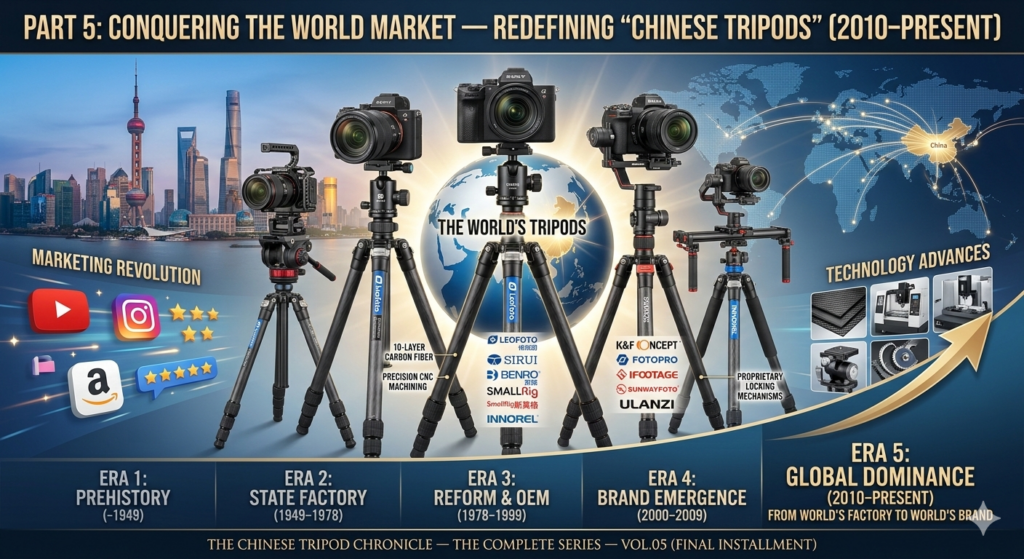
The Chinese Tripod Chronicle — THE COMPLETE SERIES — Vol.05 (Final Installment)
The 2010s. This is where the Chinese tripod industry enters another dimension entirely.
As we saw in previous installments, by the late 2000s Chinese tripod brands had already begun gaining international recognition. Benro and Sirui were known to Western photography enthusiasts as “affordable alternatives to Gitzo and Manfrotto,” and their carbon fiber tripods were shaking up the market’s price structure.
But in the 2010s, the transformation became far more dramatic.
The arrival of a new generation of brands, the mirrorless camera revolution, the democratization of marketing through social media and YouTube, and the complete dismantling of the “Chinese tripod = cheap” stigma — this fifteen-year period is the story of how China’s tripod industry evolved from “the world’s factory” into “the world’s brand.”
The Leofoto Shock: A New Generation Arrives
What Is Leofoto?
If there is one name that defines the Chinese tripod industry in the 2010s, it is Leofoto (徠図, pronounced “Leo-foto”).
Leofoto is a tripod manufacturer headquartered in Zhongshan, Guangdong Province. Its official name is Zhongshan Leofoto Photographic Equipment Co., Ltd. The company was formally established in 2014, though its parent manufacturing company had been doing OEM/ODM work for years prior.
What made Leofoto a sensation was its build quality and finish.
Where Benro and Sirui had positioned themselves as “80–90% of Gitzo quality at half the price or less,” Leofoto aimed higher: “Quality that matches — or in some respects surpasses — Gitzo, at a price somewhat below Gitzo’s.” It was a step up in ambition.
“The Tripod as Craft Object”: Leofoto’s Design Philosophy
Pick up a Leofoto tripod, and the first thing you notice is the exquisiteness of the surface finishing.
CNC-milled metal components feature finely cut knurling patterns (diamond-shaped anti-slip textures). The anodized surfaces have a deep, rich matte black tone. The torque feel of the locking mechanisms is consistent and satisfying — nothing about the product feels cheap.
This goes beyond mere “high quality.” It is a declaration of an aesthetic: the tripod as craft object. Leofoto asserts, through every product detail, that a tripod is not merely “a stand to hold a camera,” but a tool that expresses a photographer’s identity.
This philosophy resonated particularly strongly in the Japanese market. Japanese camera enthusiasts are traditionally demanding when it comes to the tactile quality and finish of equipment, and Leofoto’s craft-like quality struck a chord. Reviews of Leofoto products proliferated on Japanese photography YouTube channels and blogs, and by the late 2010s the brand had secured a firm foothold in the Japanese market.
Leofoto’s Technical Features
A summary of Leofoto’s key technical characteristics:
1. 10-Layer Carbon Construction
Leofoto’s carbon fiber tripods use multi-layered carbon tubes. The company specifies “10-layer carbon” in its flagship products, claiming rigidity and vibration damping performance comparable to Gitzo’s “6X Carbon.”
2. Precision Twist-Lock Mechanisms
Tripod leg-locking systems fall into two main categories: lever locks (the Manfrotto approach) and twist locks (the Gitzo approach). Leofoto uses twist locks, relentlessly pursuing smooth torque feel and long-term durability. All locking components are fully CNC-milled — no stamped parts.
3. Full Arca-Swiss Compatibility
Leofoto adopted the Arca-Swiss compatible quick-release system across its entire head lineup. This standard, originally developed by Switzerland’s Arca-Swiss, had become the de facto standard among professionals and advanced amateurs by the 2010s. Leofoto’s full commitment to this system was an unambiguous signal that the company was targeting the professional market.
Riding the Mirrorless Camera Revolution
The “Lighter Is Better” Wave
The single most important structural shift in the camera market during the 2010s was the rise of mirrorless cameras.
Beginning with the Sony α7 in 2013, full-frame mirrorless cameras rapidly gained market share. Mirrorless cameras are smaller and lighter than DSLRs, driving a broader trend toward lighter overall systems.
This lightening trend directly affected the tripod market.
Large DSLRs paired with heavy lenses (total weight exceeding 2–3 kg) demanded large, robust tripods (like the Gitzo Systematic). But mirrorless cameras with compact lenses (total weight 1–1.5 kg) could be adequately supported by smaller, lighter tripods.
For Chinese tripod manufacturers, this shift represented an enormous opportunity.
The Travel Tripod Boom
The combination of mirrorless camera compactness and the global expansion of travel photography culture (fueled in part by the growth of low-cost carriers) caused the travel tripod market to explode in the 2010s.
Travel tripod characteristics include:
- Folded length of approximately 40–45 cm, fitting inside a backpack
- Weight of approximately 1–1.5 kg
- Reverse-folding leg mechanism for compact storage
- Removable center column for low-angle shooting
Chinese manufacturers dominated this segment. Benro, Sirui, Leofoto, and Fotopro all expanded their travel tripod lineups aggressively.
Sirui’s T-series and Leofoto’s Ranger series, in particular, became synonymous with the travel tripod category.
Expansion into the Video Production Market
The other major market shift of the 2010s was the democratization of video production.
The trend of “DSLR video” pioneered by the Canon EOS 5D Mark II accelerated throughout the decade. 4K video became mainstream. The populations of YouTubers, vloggers, and independent filmmakers exploded.
This expansion of the video market fundamentally changed the demand structure for tripods. Beyond still-photography ball heads, demand surged for fluid video heads, gimbals, sliders, and monopods.
Chinese manufacturers responded swiftly:
| Manufacturer | Video products | Key characteristics |
|---|---|---|
| Benro | S-series video heads, monopods | Targeting the mid-price gap between Sachtler and Manfrotto |
| Sirui | VH-series video heads, monopods | Balancing compactness with precision fluid drag |
| Leofoto | BV-series video heads | Shared design language with stills tripods. Arca-Swiss compatible |
| iFootage (印迹) | Cobra monopods, Shark sliders | Video-production specialist. Acclaimed for innovative monopod designs |
| SmallRig (斯莫格) | Rigs, cages, lightweight tripods | Grew into a global leader in camera rigging |
The Marketing Revolution: Social Media and YouTube
The Rise of the “Review Economy”
In the 2010s tripod market, the most important marketing channels were YouTube and Instagram.
Traditionally, tripod purchasing decisions relied on camera magazine reviews, hands-on testing in stores, and word-of-mouth on camera forums. But in the 2010s, camera-focused YouTube channels became the primary information source for tripod reviews.
For Chinese brands, this meant direct access to overseas consumers that traditional marketing methods could never have reached.
In the English-speaking world, channels like TheCameraStoreTV, PhotographyLife, and Gerald Undone reviewed Chinese-made tripods, and the phrase “Gitzo killer” became a recurring theme.
In the Japanese-language space, camera YouTubers posted numerous reviews of “Chinese tripods,” significantly boosting the visibility of Leofoto, Sirui, and Benro in the Japanese market.
Amazon as a Sales Channel
Amazon (in its various national editions) became the single most important sales channel for Chinese tripod manufacturers.
Sales on Amazon.com and Amazon.co.jp offered Chinese manufacturers several advantages:
- Direct listing without going through traditional import agents
- Customer review accumulation that made product credibility visible and verifiable
- Rapid delivery from local warehouses via FBA (Fulfillment by Amazon)
In the Japanese market, Leofoto appointed Wide Trade Co., Ltd. as its authorized distributor, pursuing a dual strategy of Amazon.co.jp sales and placement in specialty camera stores. This “authorized distributor + e-commerce” model was subsequently adopted by other Chinese tripod brands.
The Age of Proprietary Technology
From the late 2010s into the 2020s, the R&D trajectory of Chinese tripod manufacturers shifted decisively from “imitation” to “original development.”
Proprietary Locking Mechanisms
The locking mechanism is one of the most important elements determining the feel of a tripod.
In the 2000s, Chinese tripods referenced Gitzo’s twist-lock and Manfrotto’s lever-lock designs. But by the late 2010s, each major manufacturer was developing its own proprietary mechanisms.
Sirui developed a proprietary “micro-adjustment twist lock” enabling fine-tuning of locking pressure. Leofoto adopted a unique silicone-grease-sealed construction within its precision CNC-milled twist-lock components, achieving an exceptionally smooth operating feel.
Advances in Carbon Fiber Technology
Carbon tube manufacturing technology also evolved.
Early Chinese carbon tubes were primarily made using relatively simple roll-wrapping methods. By the late 2010s, multi-directional layup (layering fibers at different angles) had become widespread, improving both bending rigidity and torsional rigidity.
Leofoto’s “10-layer carbon,” Sirui’s “10X Carbon,” and similar proprietary specifications became key marketing differentiators for each manufacturer.
Ball Head and Head Innovations
Heads are the area where the most technical differentiation is possible in the tripod industry.
In ball heads, Sirui established a strong reputation with in-house-designed products. The sphericity (how perfectly round the ball is) and surface treatment precision of Sirui’s ball heads enable smooth movement and secure locking simultaneously.
In geared heads, Leofoto brought gear-driven precision heads to market that were embraced by professionals in architectural and product photography.
Leveling bases (mechanisms for achieving a perfectly horizontal platform) became a particular strength of Chinese manufacturers. Leofoto, Sirui, and Sunwayfoto all offered precision leveling bases at accessible prices, encroaching on territory traditionally held by Gitzo and Manfrotto.
How the Incumbents Responded: Gitzo, Manfrotto, and SLIK
How did the established European and Japanese brands respond to the rise of Chinese competitors?
Gitzo (Vitec Group / France → Italian ownership)
Gitzo maintained its ultra-premium positioning throughout the 2010s.
Flagship “Systematic” series models were priced above $1,000, and prices trended upward with each new release. Gitzo’s strategy was explicit: “We will not compete on price with Chinese manufacturers. We will maintain our position as the ultimate premium brand.”
However, Leofoto’s emergence intensified the question consumers were already asking: “Is Gitzo’s quality worth the price difference?”
Manfrotto (Vitec Group / Italy)
Manfrotto was the brand most directly affected by the rise of Chinese competitors.
Manfrotto’s core price range ($200–$500) overlapped almost completely with Benro’s and Sirui’s primary segments. As Chinese manufacturers began delivering equal or superior quality at lower prices, Manfrotto found itself in an increasingly difficult competitive position.
Manfrotto’s response focused on design differentiation and brand power. The befree series, with its colorful, stylish designs, conveyed the message that “a tripod can be a fashion statement” — setting itself apart from the more conservative aesthetics of Chinese manufacturers.
SLIK and Velbon (Japan)
Japan’s venerable tripod makers, SLIK and Velbon, faced severe headwinds in the 2010s.
Velbon transferred its business operations to Hakuba Photo Industry in 2020, effectively ending its history as an independent brand. SLIK continues to operate under the Kenko Tokina umbrella, but its former market prominence has faded significantly.
The decline of Japanese tripod manufacturers was not solely caused by price competition with Chinese brands. The overall shrinking of Japan’s domestic camera market, declining interest in photography among younger demographics, and the rising quality of smartphone cameras were all contributing factors. But the competitive pressure from Chinese manufacturers was undeniably the most direct force.
The 2020s: From “Chinese Tripods” to “The World’s Tripods”
Sirui’s IPO Bid and Its Significance
Around 2020, Sirui (Guangdong Sirui Optical Co., Ltd.) filed for an initial public offering (IPO). That a dedicated Chinese tripod manufacturer sought entry into capital markets was itself a landmark event, signaling the industry’s maturation.
The prospectus submitted during the IPO process disclosed detailed information about the company’s revenue composition, R&D expenditure, and patent portfolio — making it a valuable primary source for understanding the Chinese tripod industry. However, the IPO was ultimately not completed; the application was withdrawn, reportedly due to concerns about concentrated share ownership and strategic considerations.
Sirui’s IPO bid stood as evidence that the Chinese tripod industry had grown from “a collection of small workshops” into “an industry aspiring to capital market participation.”
Diversification
In the 2020s, Chinese tripod manufacturers accelerated their diversification strategies.
Sirui’s entry into lenses is perhaps the most remarkable development. In the 2020s, Sirui launched a range of anamorphic lenses (cinema lenses producing a characteristic widescreen look), which were enthusiastically adopted by independent filmmakers worldwide. A tripod maker transforming itself into a lens maker demonstrated the breadth of the company’s engineering capabilities.
SmallRig’s explosive growth is also noteworthy. SmallRig (斯莫格) began as a camera rigging (cage and accessory) manufacturer but expanded into the tripod market in the 2020s. The company’s social media prowess is unmatched in the industry — its Instagram and YouTube-driven product promotion has rapidly expanded brand recognition.
Dominance on Amazon.co.jp
In the Japanese market of the 2020s, a glance at Amazon.co.jp’s tripod category reveals a now-familiar reality: Chinese brands routinely dominate the bestseller rankings.
Leofoto, Sirui, SmallRig, Neewer, K&F Concept — these brands have claimed the shelf space that SLIK, Velbon, and Manfrotto once occupied. The shift is unmistakable.
Major Chinese Tripod Brands Today
A summary of the major China-based tripod brands with a significant global presence as of the mid-2020s:
| Brand | Headquarters | Key characteristics | Price range |
|---|---|---|---|
| Benro (百諾) | Zhongshan, Guangdong | Widest international distribution. OEM/ODM operations continue in parallel. Broad product range | Mid to high |
| Sirui (思鋭) | Zhongshan, Guangdong | Tripods + lenses as twin pillars. Strength in precision machining | Mid to high |
| Leofoto (徠図) | Zhongshan, Guangdong | Craft-level quality. Especially strong reputation in Japan. Full Arca-Swiss commitment | Upper-mid to high |
| Fotopro (富図宝) | Zhongshan, Guangdong | Travel tripod specialist. Founded 2004 | Low to mid |
| K&F Concept | Shenzhen, Guangdong | Amazon-centric marketing. Also makes filters, lens adapters, etc. | Low to mid |
| SmallRig (斯莫格) | Shenzhen, Guangdong | Diversified from camera rigging. Unmatched social media marketing | Low to mid |
| iFootage (印迹) | Shenzhen, Guangdong | Video production specialist. Proprietary monopod and slider designs | Mid to high |
| Sunwayfoto (晟崴) | Zhongshan, Guangdong | Heads and clamps specialist. A go-to brand for Arca-Swiss compatible accessories | Mid to high |
| Innorel | Guangdong | Value-focused. Primarily sold via Amazon | Low |
| Ulanzi | Shenzhen, Guangdong | Vlog and smartphone tripods. Youthful, pop-oriented design | Low |
Looking Back: 170 Years in Five Eras
This series has traced over 170 years of history — from the mid-19th-century arrival of photography in China to the present day.
To close, let us review the journey through five eras:
| Era | Period | Keywords |
|---|---|---|
| Prehistory | –1949 | Photography arrives. Total dependence on imports. Zero domestic manufacturing |
| State Factory Era | 1949–1978 | Planned economy. Soviet-style industrialization. Tripods a low-priority accessory |
| Reform & OEM Era | 1978–1999 | Special Economic Zones. Foreign investment. Industrial cluster in Zhongshan. OEM contracts |
| Brand Emergence | 2000–2009 | Own brands born. Benro, Sirui, Fotopro. Carbon fiber price disruption |
| Global Dominance | 2010–Present | The Leofoto shock. Mirrorless synergy. Social media marketing. Premiumization and diversification |
Will “Chinese Tripod” Become an Obsolete Term?
For a long time, the phrase “Chinese tripod” (中華三脚 in Japanese) carried an implicit subtext: “cheap and of questionable quality.”
But in the 2020s, it is no longer unusual for professionals to trust a Leofoto tripod as much as a Gitzo. Independent filmmakers are shooting features with Sirui anamorphic lenses. SmallRig cages are found on film sets around the world.
Whether the term “Chinese tripod” will eventually become obsolete is hard to say. But what can be said with certainty is that the meaning behind the term changed fundamentally during the 2010s.
What was once a byword for “cheap and cheerful” has become the backbone of the world’s photography and filmmaking infrastructure. Behind this transformation lies 170 years of accumulated history — the arrival of photography, the trial and error of state factories, the industrial clustering fueled by economic reform, the skills learned through OEM work, and the leap to building brands.
If this series has managed to illuminate some of the history that lies behind the words “Chinese tripod,” it will have served its purpose.
The Chinese Tripod Chronicle — THE COMPLETE SERIES
- Series overview
- Part 1: The Arrival of Photography — When Cameras and Tripods Came to China (–1949)
- Part 2: The State Factory Era — Optical Equipment Under a Planned Economy (1949–1978)
- Part 3: Reform, Opening Up, and OEM — How Tripod Factories Gathered in Guangdong (1978–1999)
- Part 4: The Rise of Private Brands — Benro, Sirui, and Fotopro Enter the Stage (2000–2009)
- Part 5: Conquering the World Market — Redefining “Chinese Tripods” (2010–Present)
References
- Sirui (中山市思鋭光学股份有限公司) — IPO prospectus (招股説明書, c. 2020). Revenue composition, R&D expenditure, patent listings, major clients, and corporate history. The IPO was ultimately withdrawn. https://www.sirui.com/brief.html
- Leofoto (中山市徠図撮影器材有限公司) — Official website. Product specifications and technical descriptions of 10-layer carbon and CNC machining. https://www.leofoto.com/about.php
- Vitec Group plc (now Videndum plc) — Annual Reports (2015–2024). Gitzo and Manfrotto market strategies and competitive environment disclosures. https://videndum.com/investors/results-reports-and-presentations/
- Hakuba Photo Industry — Press release (2020). Official announcement of the Velbon business acquisition. https://www.hakubaphoto.jp/
- Kenko Tokina — Official information on the SLIK brand. https://www.kenko-tokina.co.jp/
- YouTube — Camera review channels. TheCameraStoreTV, Gerald Undone, PhotographyLife (English), and various Japanese channels. Numerous Chinese tripod review videos from 2015–2025. https://www.youtube.com/
- Amazon.co.jp — Tripod category bestseller rankings. Observed trends in top-ranked products across periods. https://www.amazon.co.jp/gp/bestsellers/electronics/2143230051
- CIPA (Camera & Imaging Products Association) — Digital Camera Shipment Statistics (annual editions). Mirrorless camera shipment trends and the DSLR-to-mirrorless transition. https://www.cipa.jp/stats/dc_j.html
- SmallRig — Official website. Corporate history and product line. Information on diversification from camera rigs to tripods. https://www.smallrig.com/
- Wide Trade Co., Ltd. — Leofoto’s authorized Japanese distributor. Public information on Japanese market sales strategy. https://leofoto.co.jp/
- General Administration of Customs, People’s Republic of China (中国海关总署) — Export statistics database. 2010–2024 export trends for optical instruments and tripod-related product categories. http://www.customs.gov.cn/
- Nikkei Business / Toyo Keizai / Diamond — Various reporting on Chinese manufacturers’ brand-building strategies, 2015–2025. https://business.nikkei.com/ https://toyokeizai.net/ https://diamond.jp/