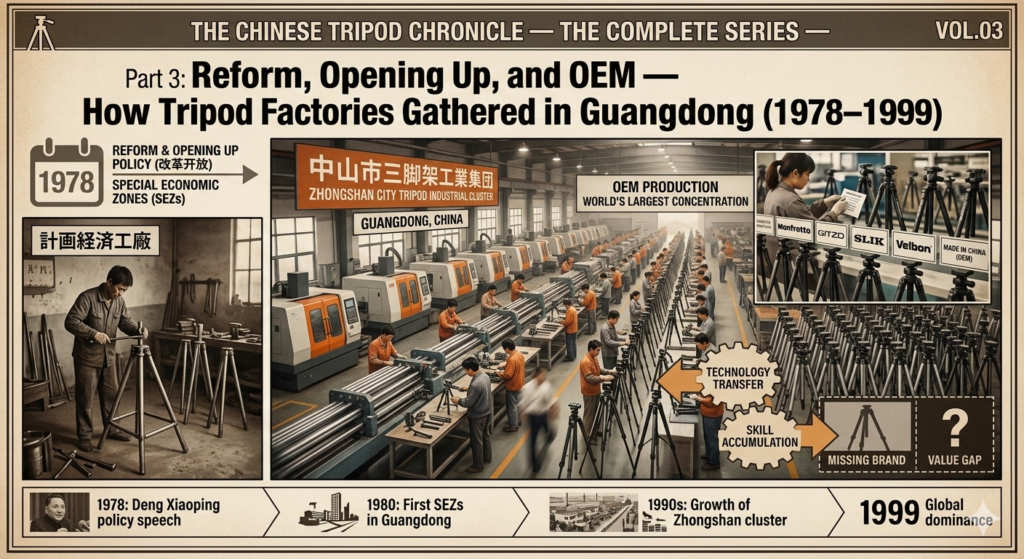
The Chinese Tripod Chronicle — THE COMPLETE SERIES — Vol.03
December 1978 marked a turning point not just for China, but for the global manufacturing landscape. Deng Xiaoping’s “Reform and Opening Up” policy (改革开放) dismantled the planned economy piece by piece and invited foreign capital into a country that had been largely closed to it for three decades.
For the tripod industry — or rather, for the industry that would become the tripod industry — this moment was year zero. What followed over the next two decades was a story of Special Economic Zones, foreign direct investment, OEM manufacturing, and the quiet accumulation of know-how that would eventually produce the world’s largest concentration of tripod factories in a single city: Zhongshan, Guangdong Province.
The Reform and Opening Up Policy: What Changed
Special Economic Zones and Foreign Capital
In 1980, China established its first Special Economic Zones (SEZs) — Shenzhen, Zhuhai, Shantou (all in Guangdong Province), and Xiamen (in Fujian Province). These zones offered foreign investors preferential tax rates, simplified customs procedures, and the ability to set up joint ventures or wholly foreign-owned enterprises.
Guangdong Province, bordering Hong Kong and with deep historical ties to overseas Chinese communities in Southeast Asia, became the epicenter of this transformation. Foreign capital — initially from Hong Kong and Taiwan, later from Japan, South Korea, and the West — poured into Guangdong’s manufacturing sector.
The types of products manufactured in these early years were typically low-tech, labor-intensive goods: textiles, toys, plastic products, and simple electronics. Photographic equipment was not yet on the radar. But the infrastructure being built — factories, logistics networks, a trained labor force — would later prove critical for the tripod industry.
The Decline of State-Owned Camera Factories
As the economy opened up, China’s state-owned camera factories faced an existential crisis.
Throughout the 1980s, Japanese cameras flooded the Chinese market. Canon, Nikon, Minolta, and Pentax offered products that were vastly superior in quality, reliability, and features. Chinese consumers — now increasingly able to purchase goods on the open market — overwhelmingly preferred Japanese products.
The state-owned camera factories (Seagull, Phoenix, Pearl River, etc.) struggled to compete. Some attempted to modernize by licensing Japanese technology or forming joint ventures, but most failed to bridge the quality gap. By the early 1990s, most of China’s state-owned camera factories had either closed, drastically downsized, or shifted to producing other products.
This collapse was painful, but it was also instructive. It demonstrated that in a market economy, manufacturing capability alone was not enough — you needed quality, innovation, and market responsiveness. This lesson would be absorbed by the next generation of Chinese manufacturers, including those who would build the tripod industry.
The Birth of the OEM Tripod Industry
What Is OEM/ODM?
Before proceeding, it is worth clarifying two terms that are central to this chapter:
- OEM (Original Equipment Manufacturer): A company that manufactures products to another company’s specifications and sells them under that company’s brand name. The OEM factory does not design the product — it builds it according to the client’s blueprint.
- ODM (Original Design Manufacturer): A company that both designs and manufactures products, which are then sold under another company’s brand. The ODM factory contributes design and engineering capabilities, not just manufacturing.
In practice, many Chinese factories operated on a spectrum between pure OEM and full ODM, depending on the client and the product.
How Tripod OEM Began in Guangdong
The origins of tripod OEM manufacturing in Guangdong Province during the late 1980s and early 1990s can be traced to several converging factors:
1. Proximity to Hong Kong
Hong Kong served as a critical intermediary between Western brands and Chinese manufacturers. Hong Kong trading companies had long-established relationships with European and American photographic equipment distributors. When these distributors began looking for lower-cost manufacturing alternatives to Italy (Manfrotto) and Japan (SLIK, Velbon), Hong Kong traders connected them with emerging factories in the Pearl River Delta.
2. Existing metalworking capabilities
Guangdong’s manufacturing base, originally built for toys, hardware, and simple metal products, provided a ready foundation for tripod production. Tripods, at their most basic, are aluminum tubes with locking mechanisms and a mounting plate — well within the capabilities of factories already producing aluminum furniture, tool handles, and similar products.
3. The Zhongshan cluster
The city of Zhongshan (中山市), located in the heart of the Pearl River Delta between Guangzhou and Zhuhai, emerged as the focal point of tripod manufacturing. Why Zhongshan specifically? The reasons include:
- Geographic advantage: Close to both Guangzhou (a major logistics hub) and the ports of Shenzhen and Hong Kong.
- Industrial tradition: Zhongshan had a strong base in metal hardware manufacturing.
- Labor supply: Abundant migrant labor from inland provinces provided a low-cost workforce.
- Cluster effects: Once a few tripod factories established themselves, suppliers of raw materials (aluminum extrusions, screws, rubber components) and specialized services (anodizing, CNC machining) followed, creating a self-reinforcing industrial cluster.
By the mid-1990s, Zhongshan had become the undisputed capital of the world’s tripod OEM industry.
Who Were the Clients?
The Italian Connection: Manfrotto and Gitzo
The most significant OEM relationships in the early tripod industry were with European brands — particularly Italian ones.
Manfrotto (part of the Vitec Group) and Gitzo (also Vitec Group) were the dominant names in the global tripod market. These companies designed their products in Italy but increasingly looked to China for lower-cost manufacturing of certain product lines — particularly their entry-level and mid-range models.
The arrangement was straightforward: Manfrotto or Gitzo would provide detailed specifications and quality requirements. Chinese factories in Zhongshan would manufacture the products to these specifications. The finished tripods would be shipped to Europe, branded with the Manfrotto or Gitzo name, and sold through established distribution channels.
This OEM relationship was a double-edged sword for the Chinese factories. On one hand, it provided steady revenue, technology transfer, and exposure to world-class quality standards. On the other hand, it left the Chinese factories entirely dependent on their clients — invisible to the end consumer, with no brand equity of their own.
Japanese Brands: SLIK and Velbon
Japanese tripod brands SLIK and Velbon also outsourced some manufacturing to China during this period, though they maintained more domestic production capacity than their European counterparts. The relationship with Chinese OEM factories helped Japanese brands keep prices competitive in the face of rising domestic labor costs.
Other Clients
Beyond the major brands, a wide range of smaller photographic equipment companies, trading houses, and private-label brands placed OEM orders with Zhongshan factories. These ranged from European camera store chains seeking house-brand tripods to American mass-market retailers looking for the cheapest possible products.
Technology Transfer and Skill Accumulation
Learning by Doing
The OEM era was, above all, a period of learning. Chinese factory owners and engineers absorbed manufacturing knowledge through every order they fulfilled.
Key areas of learning included:
1. Aluminum extrusion and processing
Tripod leg tubes are made from extruded aluminum alloy (typically 6000-series aluminum). Chinese factories learned to produce consistent-quality extrusions with precise wall thickness and surface finish. They also mastered anodizing (the electrochemical process that creates a durable, colored surface layer on aluminum) — a critical finishing step for tripod legs.
2. Precision machining
The metal fittings of a tripod — leg angle selectors, center column locks, head mounting plates — require CNC (Computer Numerical Control) machining. As OEM orders grew in volume and complexity, Zhongshan factories invested heavily in CNC equipment, initially imported from Japan and Taiwan, later from domestic Chinese manufacturers.
3. Quality control systems
Working with demanding European and Japanese clients forced Chinese factories to implement quality control systems that far exceeded what had existed in the state-owned factory era. Incoming material inspection, in-process checks, and final product testing became standard procedures — at least in factories serving major brands.
4. Assembly and finishing
Tripod assembly involves numerous hand operations: fitting leg tubes into collars, adjusting locking mechanism tension, attaching rubber feet and hooks, final lubrication. Chinese factories developed efficient assembly lines that combined manual dexterity with systematic processes.
The ODM Transition
By the late 1990s, some of the more capable Zhongshan factories had progressed from pure OEM (building to client specifications) to ODM (contributing their own designs). This was a crucial step.
An ODM factory could say to a client: “You don’t need to design the product from scratch. We already have a range of proven designs. Choose one, and we’ll customize it with your branding, your color scheme, and any minor modifications you want.”
This shift gave Chinese factories more control over the value chain. It also meant they were accumulating design capabilities — the same capabilities that would later be deployed for their own brands.
The Scale of the Industry by 1999
By the end of the 1990s, Guangdong Province — and Zhongshan in particular — had become the world’s largest producer of camera tripods by volume. Exact statistics are difficult to obtain, but industry estimates suggest that by 1999:
- Over 70% of the world’s consumer-grade tripods were manufactured in China, primarily in Guangdong.
- Dozens of factories in the Zhongshan area were producing tripods, ranging from small workshops with 20–30 workers to larger facilities with several hundred employees.
- The product range had expanded from simple aluminum tripods to include more sophisticated products with precision ball heads, quick-release plates, and multi-section carbon-fiber legs (though carbon fiber was still in its early stages).
| Category | 1978 | 1999 |
|---|---|---|
| Tripod manufacturing | Virtually nonexistent | World’s largest producer by volume |
| Geographic center | N/A | Zhongshan, Guangdong Province |
| Business model | N/A | OEM/ODM for foreign brands |
| Product range | N/A | Aluminum tripods (low to mid-range). Early carbon fiber experiments |
| Own brands | None | Virtually none (a few attempts, but no international recognition) |
| Technology level | Workshop-level | Competitive for OEM production. CNC machining, anodizing, quality control systems in place |
The Missing Piece: Brand
Despite this remarkable industrial achievement, one thing was conspicuously absent: a Chinese tripod brand that the world recognized.
Every tripod that left Zhongshan’s factories bore someone else’s name. The Chinese manufacturer was invisible. The value — the brand premium, the customer loyalty, the pricing power — accrued entirely to the foreign brand owner.
Some factory owners were content with this arrangement. OEM was predictable, low-risk, and profitable enough. But others looked at the gap between their factory-gate price and the retail price on the shelves in New York, London, and Tokyo, and asked themselves: Why shouldn’t we keep that margin for ourselves?
That question would define the next chapter of this story.
The Chinese Tripod Chronicle — THE COMPLETE SERIES
- Series overview
- Part 1: The Arrival of Photography — When Cameras and Tripods Came to China (–1949)
- Part 2: The State Factory Era — Optical Equipment Under a Planned Economy (1949–1978)
- Part 3: Reform, Opening Up, and OEM — How Tripod Factories Gathered in Guangdong (1978–1999)
- Part 4: The Rise of Private Brands — Benro, Sirui, and Fotopro Enter the Stage (2000–2009)
- Part 5: Conquering the World Market — Redefining “Chinese Tripods” (2010–Present)
References
- Vitec Group plc (now Videndum plc) — Annual Reports (various years). Information on Manfrotto and Gitzo’s manufacturing strategies and supply chain. https://videndum.com/investors/results-reports-and-presentations/
- Ezra Vogel — Deng Xiaoping and the Transformation of China (Harvard University Press, 2011). Comprehensive account of the Reform and Opening Up policy.
- Barry Naughton — The Chinese Economy: Adaptation and Growth (MIT Press, 2nd ed., 2018). Detailed analysis of the transition from planned to market economy.
- Zhongshan Municipal Government — Industrial development records and statistics on the city’s manufacturing sector.
- SLIK Corporation — Corporate history. One of Japan’s major tripod brands, with historical ties to Chinese OEM manufacturing.
- Velbon (Hakuba Photo Industry) — Corporate history and business transition records.
- China Camera Industry Association (中国照相机械行业协会) — Annual industry reports, including production and export data for photographic accessories.