The Chinese Camera Equipment Chronicle — THE COMPLETE SERIES — Vol. 02
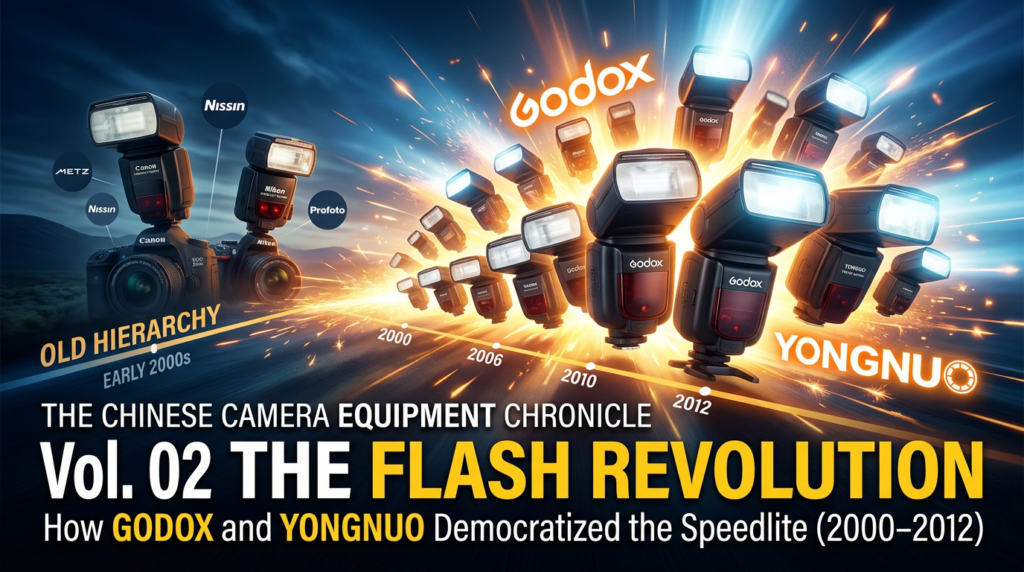
In the early 2000s, the global strobe market had a clearly defined hierarchy.
At the top sat Canon’s 580EX and Nikon’s SB-800 — the flagship speedlites from the two dominant camera manufacturers. Below them came third-party makers: Metz (Germany), Nissin (Japan), and Sunpak (Japan). In the studio flash world, Profoto (Sweden), Broncolor (Switzerland), Elinchrom (Switzerland), Bowens (UK), and Comet (Japan) held unassailable positions.
These manufacturers’ products were high-quality, reliable, and expensive.
A Canon 580EX retailed for around ¥60,000 (~$550 at the time); a Nikon SB-800 for roughly ¥50,000 (~$450). A single Profoto studio head cost over ¥300,000 (~$2,700+). “Strobe lighting” was a technique reserved for professionals with significant budgets or serious amateurs willing to invest heavily in gear.
One country shattered this entire structure from the ground up.
The Awakening of Godox — From Studio Flash to the World
Early 2000s: Establishing a Domestic Foothold
As we saw in Part 1, Godox (神牛) was founded in Shenzhen in 1993 and spent the 1990s as a small-scale manufacturer primarily producing studio flash units for the domestic market and OEM clients.
In the 2000s, Godox accelerated its product development.
In 2001, the company developed a handheld outdoor flash — the first time a Chinese manufacturer entered the market for “battery-powered, high-output flash,” a segment previously monopolized by products like the Profoto Acute and Elinchrom Ranger.
In 2007, Godox released the GD-series wireless shutter controller. This was merely a remote shutter release, but it signaled that Godox was beginning to think beyond “things that emit light” to encompass the “entire shooting system.”
2008–2009: The Technical Leap
Godox’s technical turning point came in 2008–2009.
2008: RT-series triggers and TC-series flash units
The RT series was a 2.4 GHz wireless flash trigger — evidence that Godox had begun seriously working on wireless control technology. At this stage, it was still limited to manual power adjustment, but the embryo of the future Godox ecosystem was already forming.
2009: LP750 inverter and R48 Macro LED Ring
The LP750 was an external power unit enabling studio strobes to be used outdoors without mains power. The R48 was Godox’s first LED product. Together, these two products signaled Godox’s departure from being a “studio-only manufacturer,” simultaneously approaching two growth markets: outdoor photography and LED lighting.
2010: Entering the Clip-on Speedlite Market — PB820 Power Pack
In 2010, Godox released the PB820 Power Pack, an external battery unit that supplied power to clip-on speedlites (such as Canon’s 580EX or Nikon’s SB-900), dramatically reducing recycle time.
The product itself was niche, but strategically important: the PB820 became Godox’s first point of contact with users of major-brand speedlites, introducing the Godox name to that audience.
2011: TT520, TT560, TT660 — The Dawn of Budget Clip-on Speedlites
In 2011, Godox released the TT520, TT560, and TT660 — clip-on speedlites.
All were manual-only flash units. They did not support TTL (through-the-lens automatic exposure coupling with the camera). But their prices were staggering — roughly ¥3,000–¥5,000 (~$30–$50). Given that the Canon 580EX II (the then-current successor) retailed for over ¥60,000, these were less than one-tenth the price.
“What’s the point of a speedlite that can’t do TTL?” — a fair question. But in the strobe market of the 2010s, there was an enormous latent demand that answered “Yes” to this very proposition.
Resonance with the “Strobist” Movement
In 2006, American photographer David Hobby launched the photography blog Strobist. The site systematically explained “off-camera flash” techniques — taking speedlites off the camera’s hot shoe and firing them wirelessly from a distance. It had an explosive influence on amateur photographers worldwide.
The core message of the Strobist movement was this: “You don’t need expensive TTL speedlites. Use multiple manual flash units, control them wirelessly, and you can achieve studio-quality lighting.”
Godox’s budget manual speedlites resonated perfectly with this movement. Three TT560 units at ¥3,000 each totaled under ¥10,000 — one-sixth the cost of a single Canon 580EX II. A three-light setup for less than the price of one name-brand flash. The shockwave rippled through photography communities worldwide.
Yongnuo (永诺) — On the Front Lines of the Copycat Problem
Who Is Yongnuo?
Approaching the global market from a very different angle was Yongnuo (永诺, officially Shenzhen Yongnuo Photographic Equipment Co., Ltd.).
Yongnuo was founded in Shenzhen in 2006. Where Godox started with studio flash, Yongnuo focused from the beginning on clip-on speedlites and wireless triggers.
RF-602 / RF-603 — Price Destruction in Wireless Triggers
Yongnuo first gained worldwide attention through its wireless flash triggers.
In the late 2000s, as off-camera flash surged in popularity, demand for wireless triggers skyrocketed. But reliable triggers were expensive. A PocketWizard (USA) Plus II cost over ¥20,000 (~$180) per unit — nearly ¥50,000 (~$450) for a transmitter-receiver pair.
Yongnuo’s RF-602 (circa 2008) and RF-603 (circa 2010) offered practical wireless flash triggering at less than one-tenth the price: ¥2,000–¥3,000 (~$20–$30) for a transmitter-receiver pair.
In terms of quality, they fell well short of PocketWizard. Signal stability, range, build quality — all inferior. But when faced with the choice of “¥50,000 PocketWizard or ¥3,000 Yongnuo,” the vast majority of amateur photographers — and not a few professionals — chose Yongnuo.
YN-560 — The De Facto World Standard for Manual Speedlites
Among Yongnuo’s clip-on speedlites, the most important product was the YN-560 series (2010 onward).
The YN-560 was a manual speedlite with a guide number of 58, priced at ¥5,000–¥7,000 (~$50–$70). Like Godox’s TT560, it lacked TTL, but earned respect for its build quality and flash output. It evolved through the YN-560 II, YN-560 III (with built-in RF-603 receiver), and YN-560 IV (compatible with both RF-602 and RF-603 triggers), becoming the de facto world standard for manual speedlites.
“If you’re buying a manual speedlite, start with the YN-560” — this became the mantra of strobe beginners across English-speaking and Japanese-speaking communities alike throughout the early 2010s.
The Copycat Problem — YN-568EX and Canon 580EX II
No discussion of Yongnuo’s history can avoid the copycat issue.
From around 2012, Yongnuo began developing and selling TTL-compatible clip-on speedlites in earnest. And here, controversy arrived.
The YN-568EX (for Canon) bore a striking resemblance to the Canon 580EX II in external design. The control panel layout, button placement, and even the model numbering convention (568EX → 580EX) made it unmistakable that the design was heavily influenced by Canon’s original.
The YN-685 and YN-968 similarly reflected the design language of Canon and Nikon’s OEM speedlites.
This “copycat” problem defies simplistic moral judgment.
The case against:
- Copying external design constitutes intellectual property infringement
- It confuses consumers and damages the brand equity of OEM manufacturers
- Using technology gained through OEM contracts to copy the client’s own products is a betrayal of trust
The case in favor:
- Many functional aspects are original designs, not simple copies
- The price gap (OEM: ¥60,000 vs. Yongnuo: ¥10,000–¥15,000) gives consumers real choice
- The arrival of TTL-compatible third-party speedlites expanded the base of photography enthusiasts
- Camera manufacturers’ monopoly on the speedlite market was itself arguably against consumer interests
This issue intensified further when Yongnuo later entered the market for Canon and Nikon compatible lenses, but lenses fall outside the scope of this series.
What matters is this: the copycat problem cast a shadow over the entire Chinese camera equipment industry, while simultaneously playing a decisive role in democratizing strobe lighting through price disruption — two contradictory truths that coexist.
Neewer — The “Shadow King” of Amazon
A Shenzhen-Based E-Commerce Brand
Taking a third path distinct from both Godox and Yongnuo was Neewer.
Neewer was launched in 2011 by Shenzhen Xing Ying Da Industry Co., Ltd. (深圳市星颖达实业有限公司). Neewer’s defining characteristic was its mix of in-house designed products and OEM/ODM-sourced products, sold primarily through Amazon as its core sales channel.
TT560 — The “First Speedlite” for Beginners
Neewer’s TT560 (a different product from Godox’s TT560, despite the nearly identical name and specifications — a similarity that itself suggests ODM sourcing) achieved massive sales volumes in the early 2010s as “the cheapest speedlite you can buy on Amazon.”
Priced around ¥2,000 (~$20), it was the gateway drug. For someone who wanted to “try using a speedlite,” the financial risk was negligible. This rock-bottom pricing lowered the barrier to entry for strobe lighting to its absolute minimum.
Diversification Beyond Strobes
Where Neewer differed from other strobe manufacturers was in its positioning as a comprehensive brand covering all categories of camera equipment.
Beyond speedlites, it offered LED panel lights, light stands, softboxes, backdrops, microphones, camera bags — “everything you need for a shoot” under the Neewer brand. Think of it as the “Uniqlo of camera equipment”: a strategy that brilliantly exploited Amazon’s “add-on purchase” mechanics.
Godox AD200 — Creating the “Battery Strobe” Category
2017: The Game Changer
Through the early 2010s, Godox had been steadily building market share with budget manual speedlites and studio flash. But the product that truly stunned the global photography community was the AD200 (credited as a 2016 product on Godox’s official timeline, though actual market availability began in early 2017).
The Godox AD200 was a 200 Ws battery-powered portable strobe. It packed far more output than any clip-on speedlite (typically guide number 60 or so) into a compact, battery-powered body. The flash head was interchangeable, switching between a bare-bulb head and a Fresnel head.
And the price — approximately ¥30,000 (~$300).
No other manufacturer had ever put a 200 Ws battery strobe into this price bracket. The Profoto B2 (250 Ws) cost around ¥300,000 (~$2,700); the Elinchrom ELB 400 around ¥200,000 (~$1,800). Godox was literally offering a comparable product at one-tenth the price.
What the AD200 Changed
The AD200’s impact went far beyond being “a cheap strobe.”
1. Democratizing Location Lighting
Before the AD200, using studio-level lighting on outdoor shoots required Profoto B1/B2 or Elinchrom ELB-series units costing ¥200,000–¥300,000 per light. The AD200 gave wedding photographers, portrait shooters, and event photographers access to powerful location lighting at an affordable price.
2. The De Facto Standardization of the Bowens Mount
The AD200 and Godox’s broader studio flash lineup adopted the Bowens mount — a lighting accessory connection standard developed by Bowens International of the UK.
Ironically, Bowens International itself went into liquidation in July 2017 when its parent company, German investment firm AURELIUS, decided to wind down operations, closing facilities in the UK and China. In 2019, WEX Photographic (formerly Calumet, also under AURELIUS) revived the Bowens brand, manufacturing Bowens-spec products through Godox’s factories. But Godox’s adoption of the mount across its massive product range had already established the Bowens mount as an open standard for lighting accessories worldwide.
Softboxes, beauty dishes, reflectors — these light-shaping accessories (modifiers) flooded the market as Bowens-mount compatible products from Chinese manufacturers. While Profoto’s proprietary mount locked users into Profoto-only accessories, Bowens-mount modifiers were available from dozens of manufacturers. This openness of the accessory ecosystem further solidified Godox’s competitive advantage.
3. The “X System” — A Unified Wireless Control Ecosystem
Alongside the AD200, Godox built its 2.4 GHz wireless control system, the “X System.”
Godox’s entire flash lineup — clip-on speedlites, AD200/AD400Pro/AD600Pro, studio flash heads — could all be controlled from a unified set of wireless triggers (X1T, X2T, XPro, XProII). Triggers were available for every major camera mount: Canon, Nikon, Sony, Fujifilm, Panasonic/Lumix, and Olympus/OM System — all with TTL auto-exposure and HSS (High-Speed Sync) operating wirelessly.
This ability to “control all flash units from a single trigger, regardless of camera brand” became Godox’s most powerful differentiator.
Profoto also offers a wireless control system (Profoto AirTTL), but it is a closed ecosystem limited to Profoto products, with per-unit costs 5–10 times higher than Godox.
How OEM Manufacturers and Third Parties Responded
Canon and Nikon’s Dilemma
Canon and Nikon’s response to the rise of Chinese speedlites was limited.
Prices for OEM speedlites actually trended upward from the late 2000s through the 2010s: Canon’s 600EX-RT (released 2012) retailed in the ¥60,000 range, and the Canon EL-1 (2021) reached ¥120,000+. The OEM manufacturers adopted a strategy of “differentiating on quality and maintaining a premium position against Chinese competitors.”
But as Godox’s quality improved with each generation, and TTL/HSS accuracy approached parity with OEM products, a growing number of consumers asked: “Is the 6x–10x price premium really justified by a corresponding quality gap?”
The Decline of Metz and Sunpak
The most direct casualties of Chinese speedlites were the third-party strobe manufacturers.
Germany’s Metz, long synonymous with high-quality third-party speedlites, struggled under price competition from Chinese makers and was forced to scale back operations. Japan’s Sunpak found itself in similar straits.
These “mid-price” third-party manufacturers occupied the most vulnerable position: cheaper than OEM brands but more expensive than Chinese competitors — the hardest segment to defend.
Nissin’s Strategic Response
Japan’s Nissin Digital took a different approach to differentiation. Rather than competing on price with Chinese makers, Nissin focused on domestic repair service, TTL accuracy on par with OEM products, and NAS (Nissin Air System) — its own wireless ecosystem.
Nissin’s strategy was to “match OEM brands on service quality while differentiating from Chinese competitors through reliability and after-sales support.” This approach allowed Nissin to maintain a viable market position.
2012 — An Interim Report on the Flash Revolution
By 2012, the global strobe market looked nothing like it had in 2000.
| Category | Status in 2000 | Status in 2012 |
|---|---|---|
| Clip-on Speedlites | OEM units (¥50,000–60,000 / ~$450–550) were the only practical option | Yongnuo (~¥10,000 / ~$100) and Godox (from ~¥3,000 / ~$30) achieved mass adoption |
| Wireless Triggers | PocketWizard (~¥50,000 / ~$450/pair) was virtually the only choice | Yongnuo RF-603 (~¥3,000 / ~$30/pair) became the world standard |
| Studio Flash | Profoto, Broncolor, and Elinchrom dominated | Godox rapidly eroding the low- to mid-price segments |
| Battery-Powered Strobes | Profoto AcuteB / Elinchrom Ranger etc. (¥200,000–400,000+ / $1,800–3,600+ each) — very limited options | Godox entering with AD360 (ca. 2013) and others. AD200 would arrive in 2017 |
| Copycat Concerns | Did not exist | Yongnuo’s compatible speedlites generating controversy |
In barely a decade, Chinese-made speedlites had vaulted from “nonexistent” to “major players on the world stage.” The driving forces were the Pearl River Delta’s electronic components cluster, technical expertise accumulated through OEM work, Amazon as a new sales channel, and alignment with the global trend of “democratizing strobe lighting” epitomized by the Strobist movement.
But at this point, the story was still confined to the world of flash — instantaneous light.
As the 2010s progressed, another enormous lighting market — LED continuous lighting — was rapidly emerging. And in this arena, Godox would face new rivals: Nanlite, and Aputure. The next installment tells the story of the “LED lighting war.”
Coming next: Part 3 — The LED Lighting Conquest: How Nanlite, Aputure & Godox Rewrote the Rules of Production Lighting (2012–Present)
The Chinese Camera Equipment Chronicle — THE COMPLETE SERIES (Main Series Hub)
- Prehistory — Hong Kong’s Photo Trade and the Awakening of Mainland China (–1999)
- The Flash Revolution — How Godox and Yongnuo Democratized the Speedlite (2000–2012)
- The LED Lighting Conquest — How Nanlite, Aputure & Godox Rewrote the Rules of Production Lighting (2012–Present)
- Conquering the World of Video Accessories — How Chinese Gear Transformed the Film Set (2007–Present)
- Conclusion — How “Chinese Gear” Redefined the Standards of Production
Sources and References
- Godox official site — “Why Godox” and “History” pages. Product milestones listed chronologically from 1993 onward. https://www.godox.com/why-godox/ | https://www.godox.com/history/
- Godox Netherlands — “About us: How it all started.” Background on founder Eugene Zeng and the company’s origins. https://www.godox.nl/about-us-1
- Business of Photography — “How Godox Came from ‘Nothing’ to Dominating the Photography Space” (2025). Overview of Godox’s growth trajectory and expansion into microphones. https://businessofphotography.net/how-godox-came-from-nothing-to-dominating-the-photography-space/
- Cine Gear Expo — “Godox Lighting Equipment” (2022). Official profile: founded 1993, specializing in lighting and audio equipment. https://www.cinegearexpo.com/la-expo/news-info/godoxlight/
- Wikipedia — “Yongnuo.” Founded 2006, Shenzhen. Overview of clip-on speedlites, lenses, and LED products. https://en.wikipedia.org/wiki/Yongnuo
- Strobist (David Hobby) — Photography blog launched in 2006. Systematic off-camera flash tutorials that sparked a worldwide strobe lighting movement. https://strobist.blogspot.com/
- Hypop — “A Comprehensive Master Guide to Studio Flash Strobes” (2023). Context on Godox’s studio flash lineup and market history. https://www.hypop.com.au/blogs/master-guide/studio-flash-strobes
- EC21 — “Godox Photo Equipment Co., Ltd. Company Overview.” 9,000 m² factory, 200+ employees, 16 years of manufacturing experience (at time of writing). https://godox.en.ec21.com/company_info.html
- Crunchbase — “GODOX Photo Equipment Co. Ltd.” 1,001–5,000 employees. https://www.crunchbase.com/organization/godox-photo-equipment-co-ltd