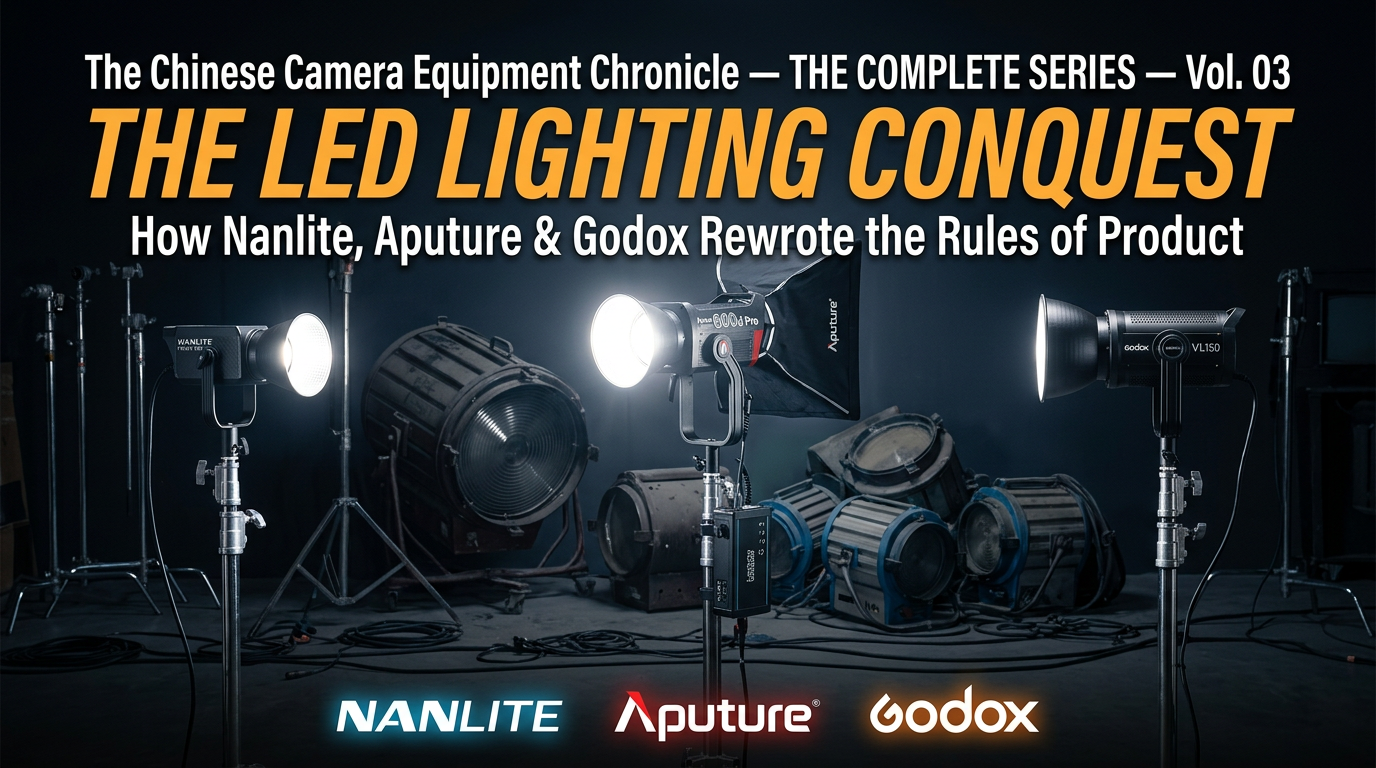
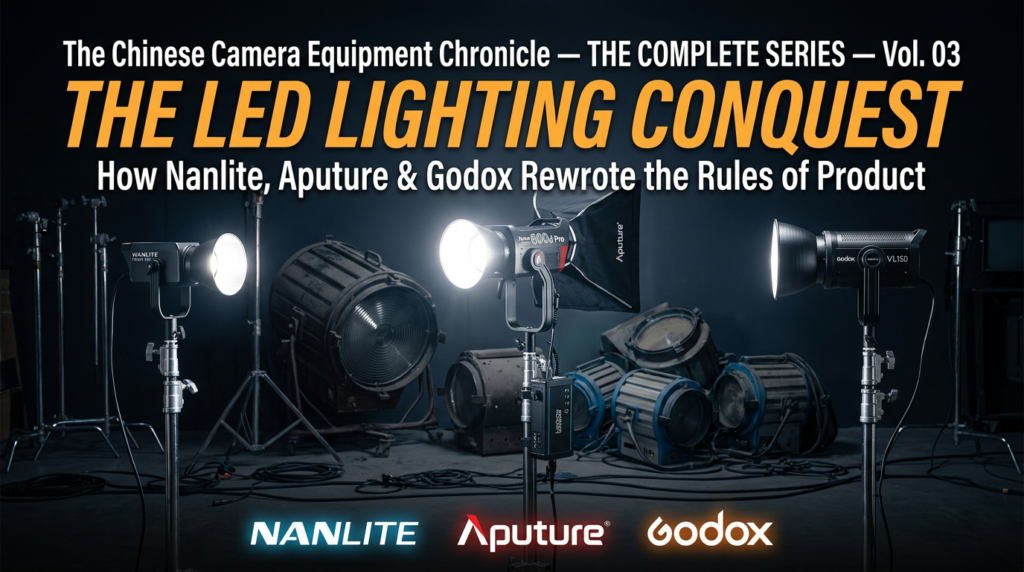
The Chinese Camera Equipment Chronicle — THE COMPLETE SERIES — Vol. 03
The flash revolution described in Part 2 was the story of “instantaneous light” — light that fires for a fraction of a second when the shutter is pressed. That is the essence of a strobe: indispensable for still photography, but useless for video.
Video requires continuous light — light that stays on the entire time the camera is rolling.
Until the 2000s, continuous lighting for video production was dominated by tungsten (halogen) and HMI (metal halide) sources. Arri’s (Germany) Fresnel spotlights, Kino Flo’s (USA) fluorescent bank lights, Mole-Richardson’s (USA) tungsten units — all high-quality, but expensive, heavy, and hot. The surface temperature of a tungsten light could reach several hundred degrees Celsius, making extended shoots in small studios impossible without air conditioning.
LED lighting solved all three problems — weight, heat, and cost — at once.
And three Chinese manufacturers — Nanlite, Aputure, and Godox — rewrote this market from the ground up.
- The DSLR Video Revolution — The Explosion of LED Lighting Demand
- Nanguang (南冠) — The Most Senior LED Lighting Maker
- Aputure — “The Godox of Video Lighting”
- The COB LED Revolution — Aputure Light Storm 120d
- Godox — The Flash King Enters the LED Arena
- Nanlite — From “Nanguang” to a Global Brand
- PavoTube — The New Category of RGB Tube Lights
- Amaran — LED Lighting “Anyone Can Afford”
- The Structure of the LED Lighting Market — A Three-Way Battle
- YouTube and Content Creators — The New “Film Set” Driving Demand
- How Western Manufacturers Responded — and Struggled
- Software Ecosystems — The Digitization of Lighting Control
- The Current Market Structure — LED Lighting Is “A Three-Player Arena of Chinese Brands”
- Sources and References
The DSLR Video Revolution — The Explosion of LED Lighting Demand
2008 — The Canon 5D Mark II Changed Everything
Before discussing the rise of the LED lighting industry, we must address the “event” that sent demand skyrocketing.
In 2008, the Canon EOS 5D Mark II was released — the first full-frame DSLR capable of 1080p video recording. It triggered what became known as the “DSLR video revolution.”
Until then, video production cameras were the exclusive domain of professional camcorders (from Sony, Panasonic, Canon, etc.), costing anywhere from several thousand to tens of thousands of dollars. The 5D Mark II, at roughly $2,700, let anyone shoot “cinematic” footage with the shallow depth of field unique to a full-frame sensor.
The impact on the lighting market was enormous.
The population of people shooting video exploded overnight. Freelance video creators, wedding videographers, YouTubers, corporate communications staff — a vast new cohort had “bought a camera but didn’t own any lights.” And what they wanted wasn’t a $3,000+ Arri Fresnel. They wanted lighting that was affordable, lightweight, and didn’t generate heat.
LED lighting was precisely the technology to answer that demand.
Early 2010s: The Era of Small LED Panels
In the early phase of the DSLR video revolution (roughly 2008–2013), the products that gained traction were small LED panel lights.
On-camera LED panels that attached to a camera’s hot shoe or accessory shoe were pioneered by Litepanels (USA, founded 2001). The Litepanels MicroPro offered high-quality light in a compact form, prized for documentary and news shooting — but it cost $300–$500+.
Chinese manufacturers entered here.
Neewer (discussed in Part 2) and countless other Shenzhen-based brands flooded Amazon with small LED panels priced at $20–$50. Quality was hit-or-miss, but for buyers who just wanted “cheap continuous light,” they were sufficient.
However, small LED panels had a fundamental limitation — insufficient output. They could serve as fill lights for interviews or accent lights for tabletop photography, but as key lights for studio or outdoor location work, they simply lacked the power.
The technology that broke through this barrier was COB (Chip on Board) LED.
Nanguang (南冠) — The Most Senior LED Lighting Maker
From a 1992 Fluorescent Lighting Manufacturer to LED
As noted in Part 1, Nanguang (南冠, later Nanlite) was founded in Shantou, Guangdong Province in 1992 — one of the oldest dedicated manufacturers of photographic and video lighting in China.
Initially focused on fluorescent and halogen lighting, Nanguang made its full-scale entry into LED from the late 2000s to early 2010s.
Nanguang’s strength lay in over 20 years of accumulated expertise as a lighting-only company. Light diffusion characteristics, color temperature precision management, thermal design — all knowledge cultivated during the fluorescent and halogen eras, and all directly applicable to LED as a new light source.
In the early 2010s, Nanguang was producing LED panels and stick-type LEDs, but had not yet made a major global impact. Nanguang’s transformation into the world-class “Nanlite” brand would come with the launch of the Forza series in 2019.
Aputure — “The Godox of Video Lighting”
Founded in 2014 — A Chinese Brand with Silicon Valley Sensibilities
The first manufacturer to truly revolutionize the LED lighting market was, surprisingly, a startup founded in 2014 — Aputure (愛圖仕).
Aputure was established by Ian Xie and Ted Sim in 2014. The company name is a portmanteau of “aperture” (a cinematography term) and “future.” The founding team included a color scientist formerly at Fujifilm and cinematographers based in Los Angeles. From the outset, Aputure’s mission was to create “professional LED lighting for filmmakers.”
What set Aputure decisively apart from other Chinese lighting makers was its brand strategy and community marketing.
Where Godox conquered markets with “high performance at low prices,” Aputure aimed from the start to become “a brand respected by professional filmmakers.” Cinematic tutorials on its official YouTube channel, prominent presence at trade shows like NAB and Cine Gear Expo, sample units supplied to Hollywood cinematographers and independent filmmakers — Aputure was building an identity not as a “Chinese manufacturer” but as a “global video lighting brand.”
The First Products — The Amaran Series
Aputure’s earliest lighting products were the Amaran series LED panels.
Amaran panels were significantly cheaper than existing competitors like Litepanels, yet earned praise for their high Color Rendering Index (CRI). Conventional Chinese LED panels frequently scored CRI in the 80s, producing the unnatural skin tones characteristic of “the LED problem.” Amaran panels achieved CRI 95+, establishing a new position: “affordable but color-accurate.”
The Amaran series was Aputure’s “warm-up.” The real breakthrough came with the Lightstorm series from 2016 onward.
The COB LED Revolution — Aputure Light Storm 120d
2017: The Turning Point for Video Lighting
In 2017, Aputure fully launched the “Light Storm” series — its first line of studio-grade COB LED fixtures, headlined by the Aputure Light Storm LS C120d.
The 120d was a 120W COB LED daylight (6000K) spotlight.
COB (Chip on Board) LED technology packs multiple LED chips at high density onto a single substrate, functioning as a single high-output light source. Unlike the “area source” of small LED panels, a COB LED behaves more like a “point source.” This allows it to be paired with light-shaping accessories (modifiers) — Fresnel lenses, reflectors, softboxes — to control light in the same way as traditional tungsten or HMI fixtures.
The 120d was revolutionary for several reasons:
1. Bowens Mount Adoption
The 120d adopted the Bowens mount — the same lighting accessory connection standard that Godox’s flash products had popularized (as discussed in Part 2). This meant that softboxes and reflectors already purchased for Godox flash units could be used directly on the 120d. This compatibility created a smooth migration path from flash to LED lighting for Godox ecosystem users.
2. Extraordinary Value
The 120d was priced at approximately $595 (around ¥70,000). A comparable Arri L7-C cost over ¥300,000; a Litepanels Astra 6X around ¥200,000. The 120d delivered professional-quality COB LED spotlighting at a fraction of the incumbents’ prices.
3. CRI 96+ Color Accuracy
“Affordable but color-accurate” — the brand image Aputure had established with its Amaran panels was reinforced further with the 120d. CRI 96+ and TLCI 97+ were figures competitive with Arri’s continuous lighting.
The Chain Reaction Triggered by the 120d
The 120d set off a cascade of changes across the production landscape.
It became the “standard light” for YouTube studios
Between 2017 and 2018, the 120d spread explosively among English-language YouTube creators. Previously, YouTubers’ lighting consisted of ring lights, cheap LED panels, or “natural light only.” The 120d gave YouTubers who wanted “professional-looking footage” studio-grade lighting at an accessible price.
Peter McKinnon, Matti Haapoja, Gerald Undone — rapidly growing video-focused YouTubers reviewed and endorsed the 120d, cementing the perception that “the 120d is the first COB LED to buy.”
It penetrated independent filmmaking
The 120d also found its way into low-budget film production. In a world where a single film light cost $3,000+, the arrival of a high-CRI LED fixture for around $600 was a major event. For film school students and independent filmmakers, the 120d was “the first professional light they could actually afford.”
2018: 120d II and 300d — Expanding the Lineup
In 2018, Aputure released the Light Storm LS C120d II — approximately 25% brighter than the original, with the color temperature shifted to 5500K (from 6000K), dimming down to 1%, and improved cooling fan noise reduction. Priced at approximately $745.
Around the same time, the Aputure LS C300d (300W) captured demand from users who needed “more than 120W but can’t justify an Arri 600W.” The 300d won “Best in Show” at industry expos including NAB, confirming that Aputure had earned recognition from the Hollywood filmmaking community.
Godox — The Flash King Enters the LED Arena
SL Series — “The Cheapest COB LED”
Godox, having established overwhelming dominance in the flash market, made its full-scale entry into LED continuous lighting with the SL series.
The Godox SL-60W was a 60W COB LED spotlight priced at an astonishing ~$120 (around ¥15,000). Less than one-fifth the price of the Aputure 120d (~$600), and incomparable to any Arri Fresnel.
The SL-60W adopted the same Bowens mount as the Aputure 120d. For anyone who wanted “the cheapest possible COB LED light,” the SL-60W was overwhelmingly popular.
However, the quality gap with Aputure was clear. The SL-60W’s biggest weakness was cooling fan noise — loud enough to be picked up by microphones. Many users resorted to swapping the cooling fan for a Noctua (Austrian silent fan manufacturer) replacement — an episode emblematic of the early days of Chinese LED lighting.
Godox subsequently released the SL-150W and SL-200W with increased output, and around 2022, the SL60IID (second generation) significantly improved noise performance.
Knowled M600D — Full-Scale Cinema Market Entry
Just as Godox’s flash strategy had been to “enter at the low end and gradually move upmarket,” the company traced the same trajectory in LED lighting.
In late 2021, Godox unveiled a new professional brand called “Knowled” and released the Knowled M600D as its inaugural product.
The M600D was a 600W daylight COB LED spotlight delivering 15,700 lux at 3 meters. Priced at $1,499 — $400 less than the Aputure LS 600d Pro ($1,890) — it replicated in LED lighting the pattern that had played out repeatedly in the flash market: “Godox quality at a lower price than Aputure.”
The launch of the Knowled brand signaled Godox’s intent to shed the image of “budget photography gear maker” and compete directly in the high-end film and television production market.
Nanlite — From “Nanguang” to a Global Brand
Brand Reinvention — The 2017 Pivot
Nanguang (南冠), founded in 1992, relaunched as a world-class brand around 2017.
Products previously sold under the “Nanguang” name were unified under the “Nanlite” brand, accompanied by a serious push into global marketing. A cinema-grade sub-brand, “Nanlux,” was also established, creating a two-tier structure: “Nanlite = prosumer/mid-range” and “Nanlux = cinema/high-end.”
By its 30th anniversary in 2022, the company had grown to over 900 employees, a factory floor exceeding 44,000 m², and more than 270 patents. Three decades of unwavering focus on lighting equipment — this depth as a “pure-play lighting manufacturer” was Nanlite’s greatest weapon.
The Forza Series — A Three-Way Battle in COB LEDs
At the 2019 NAB (National Association of Broadcasters) show, Nanlite unveiled the Forza series.
Forza 60 (60W), Forza 300 (300W), Forza 500 (500W) — these COB LED spotlights competed head-on with Aputure’s Lightstorm series and Godox’s SL/Knowled series.
Nanlite’s differentiator was its commitment to “quality of light,” honed over 30 years as a dedicated lighting manufacturer. Uniform beam distribution, low-noise cooling design, and color temperature accuracy — Nanlite competed not on Aputure’s brand cachet or Godox’s aggressive pricing, but on “lighting professionalism.”
In January 2023, Nanlite announced the Forza II series (60 II / 60B II / 300 II / 300B II / 500 II / 500B II), incorporating green/magenta correction, smaller ballasts (control boxes), and improved silent operation — refinements reflecting feedback from real production environments.
PavoTube — The New Category of RGB Tube Lights
Democratizing Creative Lighting
Another Nanlite product line that attracted worldwide attention was the PavoTube series.
PavoTubes are RGB full-color tube-shaped LED lights, offering color temperature adjustment from 2700K to 7500K plus 360° RGB color selection.
Tube-shaped LED lights had been pioneered by Astera (Germany) and Quasar Science (USA), but PavoTubes slashed the price by a factor of several. Where an Astera Titan tube cost over ¥100,000 (~$900+) per unit, Nanlite’s PavoTube 15C was available for approximately $200 (¥20,000–30,000).
The spread of PavoTubes represented the democratization of “creative lighting” in video production. Adding cyan or magenta accent colors to backgrounds, using a single tube as both practical and stylistic light — this kind of “visual storytelling through color” became possible even on shoestring budgets.
Music videos, fashion shoots, product promo films — PavoTube brought what was once the domain of Hollywood colorists (lighting designers specializing in color) within reach of YouTube creators.
Amaran — LED Lighting “Anyone Can Afford”
Aputure’s Sub-Brand Strategy
In December 2020, Aputure released the LS 600d Pro (600W, $1,890) while simultaneously announcing products at an entirely different price point.
The Amaran 100d (100W, $199) and Amaran 200d (200W, $299).
Amaran — originally the name of Aputure’s first lighting series (LED panels) — was here redefined as a sub-brand for entry- to mid-range COB LED spotlights. Bowens mount compatible, CRI 95+, compact form factor — these were Lightstorm-derived technologies optimized for cost, with a clear message: “Aputure quality at Godox prices.”
The Amaran 100d/200d represented the second wave of COB LED price disruption. The “accessible pro lighting” that began with the 120d at ~$600 in 2017 had, in just three years, reached below $200.
Amaran’s Independence — The 2024 Brand Separation
In 2024, Aputure announced that Amaran would be spun off as an independent brand. This formalized a “Aputure = cinema/professional” and “Amaran = content creator” split — a strategy mirroring the Nanlite/Nanlux two-tier structure.
Post-separation, Amaran operates under the amaran (lowercase) brand, developing lighting products for content creators.
The Structure of the LED Lighting Market — A Three-Way Battle
The 2020s Landscape
By the 2020s, the LED video lighting market had converged toward a near-oligopoly among Aputure (+Amaran), Godox (+Knowled), and Nanlite (+Nanlux).
| Manufacturer | Founded | Headquarters | Sub-Brand | Strengths | Key COB LED Products |
|---|---|---|---|---|---|
| Aputure | 2014 | Shenzhen | amaran (spun off 2024) | Brand power, deep ties to the filmmaking community, high CRI | LS 120d / 300d / 600d Pro / STORM 400x |
| Godox | 1993 | Shenzhen | Knowled | Massive user base from flash, overwhelming price competitiveness | SL60 / SL150 / SL200 / Knowled M600D |
| Nanlite | 1992 | Shantou | Nanlux | 30+ years as a pure-play lighting maker, Forza series refinement, PavoTube category creation | Forza 60 / 300 / 500 II / PavoTube series |
What is fascinating is that these three companies each have distinct origins:
- Nanlite is the veteran, with over 30 years as a “lighting-only manufacturer.” Fluorescent → halogen → LED — nothing but lights, for three decades.
- Godox started as a “flash manufacturer” and expanded into LED continuous lighting. Its distribution network and Bowens mount ecosystem, built through strobes, became weapons in the LED arena too.
- Aputure was founded as a “pure LED manufacturer” specializing in LED lighting from day one.
Unlike the flash market, where Godox reigns supreme, the LED continuous lighting market exhibits a clear three-way rivalry. This is because LED continuous light is “a market where price alone doesn’t decide winners.” Filmmakers evaluate quality of light (CRI, beam distribution), noise levels, usability, software ecosystems (app control, DMX integration), and accessory availability as a whole. Simple “cheapness” doesn’t win — and this market dynamic is what makes coexistence among the three possible.
YouTube and Content Creators — The New “Film Set” Driving Demand
The Shift in Where Production Happens
The explosive growth of the LED lighting market cannot be understood without acknowledging the content creator economy led by YouTube.
Over the five years from 2015 to 2020, the visual quality of YouTube content improved dramatically. Where early YouTubers shot with webcams and natural light, by around 2020, “cinematic visuals from a solo creator’s channel” had become commonplace.
Chinese-made LED lighting’s falling prices were a major driver of this quality upgrade.
For YouTubers, lighting was “the gear investment with the highest ROI.” A camera upgrade might improve image quality by 20%, but adding lights could improve it many times over. A 120d at ~$600 or an SL-60W at ~$120 was the lowest-cost path to “professional-looking footage.”
“Lighting Reviews” as a YouTube Content Genre
An interesting phenomenon: LED lighting reviews themselves became an established genre of YouTube content.
Gerald Undone, DSLR Video Shooter (Caleb Pike), The Slanted Lens — these channels published detailed reviews with every new product launch, racking up tens to hundreds of thousands of views. For lighting manufacturers, YouTube reviewers became the most cost-effective marketing channel available.
Aputure was particularly adept at leveraging this channel, as noted earlier, but Nanlite and Godox also aggressively supplied products to YouTube reviewers. The result: products from the three Chinese manufacturers monopolized the starring roles in “YouTube lighting reviews,” while Arri, Kino Flo, and Litepanels were overwhelmed in sheer review volume.
How Western Manufacturers Responded — and Struggled
Arri — Can the “Highest Quality” Sanctuary Hold?
Germany’s Arri, with over a century of history as the pinnacle of film lighting, maintained its position with the SkyPanel series (launched 2015). The SkyPanel remains the gold standard for LED color quality, and for Hollywood blockbusters and high-end commercials, Arri is still the first choice.
But the SkyPanel S60-C is priced at $6,820 (~¥750,000–1,000,000). That’s roughly 3.5x the Aputure LS 600d Pro ($1,890) and 4.5x the Godox Knowled M600D ($1,499).
Arri’s “sanctuary” is increasingly confined to the budget-rich world of Hollywood features and network television. The “middle tier” — independent films, documentaries, corporate videos — is being replaced by Chinese brands.
Kino Flo and Litepanels — The Squeeze on the Middle
Kino Flo and Litepanels positioned themselves as “professional quality” at mid-tier prices — not as high-end as Arri, but a step above consumer gear. This mid-tier positioning, however, proved to be the most vulnerable to Chinese competitors.
The same pattern from Part 2 — where Metz and Sunpak suffered under Godox’s low-cost speedlites — is repeating itself in the LED lighting market. “Not as high-quality as Arri, but more expensive than Chinese brands” is a position that grows harder to defend with each passing year.
Software Ecosystems — The Digitization of Lighting Control
App Control and DMX — Another Axis of Competition
In the 2020s LED lighting market, software-based lighting control has become a competitive axis as important as hardware performance.
Aputure offers Sidus Link, Godox provides the Godox Light App (and Knowled DMX App), and Nanlite has NANLINK — smartphone apps for remote lighting control.
These apps go far beyond being “remote controls.” They enable batch control of multiple lights, preset saving and recall, special effect simulation (lightning, candle flicker, police siren, etc.), and integration with professional DMX (Digital Multiplex) protocols for theater and studio lighting systems. LED lighting has evolved from “a device that emits light” into a “networked smart device.”
Aputure’s Sidus Link has further evolved into Sidus Link Pro, an advanced lighting management platform capable of unified planning and control for large-scale film sets. This is evidence of Aputure’s ambition to ascend from “LED maker for individual creators” to “lighting infrastructure company for film studios.”
The Current Market Structure — LED Lighting Is “A Three-Player Arena of Chinese Brands”
| Category | Status in 2012 | Status in 2025 |
|---|---|---|
| Small LED Panels | Litepanels ($300–500) was the only professional-quality option | Amaran, Godox, Nanlite, etc. supply high-quality panels from $20–$200 |
| COB LED Spots (Medium Output) | The product category did not exist | Aputure LS / amaran, Godox SL, Nanlite Forza — the primary battleground |
| COB LED Spots (High Output) | HMI (Arri, $2,000–5,000) was the only option | Aputure 600d Pro / Godox M600D / Nanlux Evoke ($1,500–2,500) replacing HMI |
| RGB Tube Lights | Astera ($900+/tube) pioneered the category. Limited to pros | Nanlite PavoTube ($200–500/tube) transformed the market. Amaran also entered |
| Lighting Apps & Control | DMX controllers (dedicated hardware, $1,000+) required | Smartphone apps (Sidus Link / NANLINK / Godox Light App) provide free control |
| Major Market Players | Arri, Kino Flo, Litepanels, Mole-Richardson (all Western) | Aputure, Godox, Nanlite (all Chinese) + Arri (high-end only) |
The LED video lighting market, once the exclusive domain of Western manufacturers, has by 2025 become effectively a three-player arena of Chinese brands.
Arri remains viable in the niche of “highest-quality cinema lighting,” but every other segment — from YouTube studios to corporate videos, independent films to wedding shoots — is dominated by Aputure, Godox, and Nanlite.
This structural shift is even more dramatic than what occurred in the flash market. In flash, Canon and Nikon OEM speedlites still retain a share as “premium products.” But in LED lighting, Chinese manufacturers dominate every price tier — from the premium segment (Aputure Lightstorm) to entry-level (Godox SL / Amaran).
The flash revolution of Part 2 drove down the cost of still photography lighting. The LED lighting revolution of Part 3 drove down the cost of video production lighting.
But lighting alone didn’t transform the “film set.”
Camera rigs, gimbals, wireless video transmission, on-camera monitors, microphones, and camera bags — “everything besides lighting” that video production requires was also rewritten by Chinese manufacturers. Next time, we examine the rise of SmallRig and the broader world of video production accessories.
Coming next: Part 4 — Conquering the World of Video Accessories: How Chinese Gear Transformed the Film Set (2007–Present)
The Chinese Camera Equipment Chronicle — THE COMPLETE SERIES (Main Series Hub)
- Prehistory — Hong Kong’s Photo Trade and the Awakening of Mainland China (–1999)
- The Flash Revolution — How Godox and Yongnuo Democratized the Speedlite (2000–2012)
- The LED Lighting Conquest — How Nanlite, Aputure & Godox Rewrote the Rules of Production Lighting (2012–Present)
- Conquering the World of Video Accessories — How Chinese Gear Transformed the Film Set (2007–Present)
- Conclusion — How “Chinese Gear” Redefined the Standards of Production
Sources and References
- Wikipedia — “Aputure.” Founded 2014 by Ted Sim and Ian Xie. History of Amaran and Lightstorm product lines. https://en.wikipedia.org/wiki/Aputure
- Newsshooter — “Aputure LS COB 120d II Released with Major Upgrades” (September 2018). Specifications and pricing for the 120d II. https://www.newsshooter.com/2018/09/07/aputurels-cob-120d-ii-released-major-upgrades/
- Newsshooter — “Aputure LS 600d Pro COB Light Available for Pre-order” (November 2020). Release date, pricing, and specifications. https://www.newsshooter.com/2020/11/24/aputure-ls-600d-pro-cob-light-available-for-pre-order/
- DIY Photography — “Aputure releases LS 600D Pro and announces Amaran 100D/X & 200D/X Bowens mount LED lights” (December 2020). Amaran 100d/200d announcement and pricing. https://www.diyphotography.net/aputure-releases-ls-600d-pro-and-announces-amaran-100d-x-200d-x-bowens-mount-led-lights/
- CineD — “amaran Announces Spin-off from Sister Company Aputure.” Reporting on the Amaran brand separation. https://www.cined.com/amaran-announces-spin-off-from-sister-company-aputure/
- Godox official site — “History” page. Product milestones including LED lighting from 1993 onward. https://www.godox.com/history/
- Newsshooter — “Godox Knowled M600D Daylight LED Light & FLS10 Fresnel Lens” (December 2021). M600D announcement and specifications. https://www.newsshooter.com/2021/12/13/godox-knowled-m600d-daylight-led-light-fls10-fresnel-lens/
- CineD — “Godox Knowled M600D — Powerful Daylight COB Light Announced.” Price comparison with Aputure LS 600d. https://www.cined.com/godox-knowled-m600d-powerful-daylight-cob-light-announced/
- Nanguang official site — Company profile. Founded 1992, 900+ employees, 270+ patents. https://www.nanguang.cn/introduce.html
- Newsshooter — “NANLITE Forza 60 II, 60B II, 300 II, 300B II, 500 II & 500B II Announced” (January 2023). Forza II series specifications and pricing. https://www.newsshooter.com/2023/01/10/nanlite-forza-60-ii-60b-ii-300-ii-300b-ii-500-ii-500b-ii-announced/
- CineD — “NANLITE Forza 300B II and Forza 500B II — First Look” (January 2023). Second-generation Forza improvements. https://www.cined.com/nanlite-forza-300b-ii-and-forza-500b-ii-first-look/