The Chinese Tripod Chronicle — THE COMPLETE SERIES — Vol.01
To understand the history of the Chinese tripod industry, we must first ask: when did the camera itself arrive in China?
Photography was born in Europe. In 1839, Louis-Jacques-Mandé Daguerre announced his daguerreotype process in Paris, and the world gained a new way of seeing. Yet it took barely a decade for this invention to cross oceans and reach the shores of East Asia — including China.
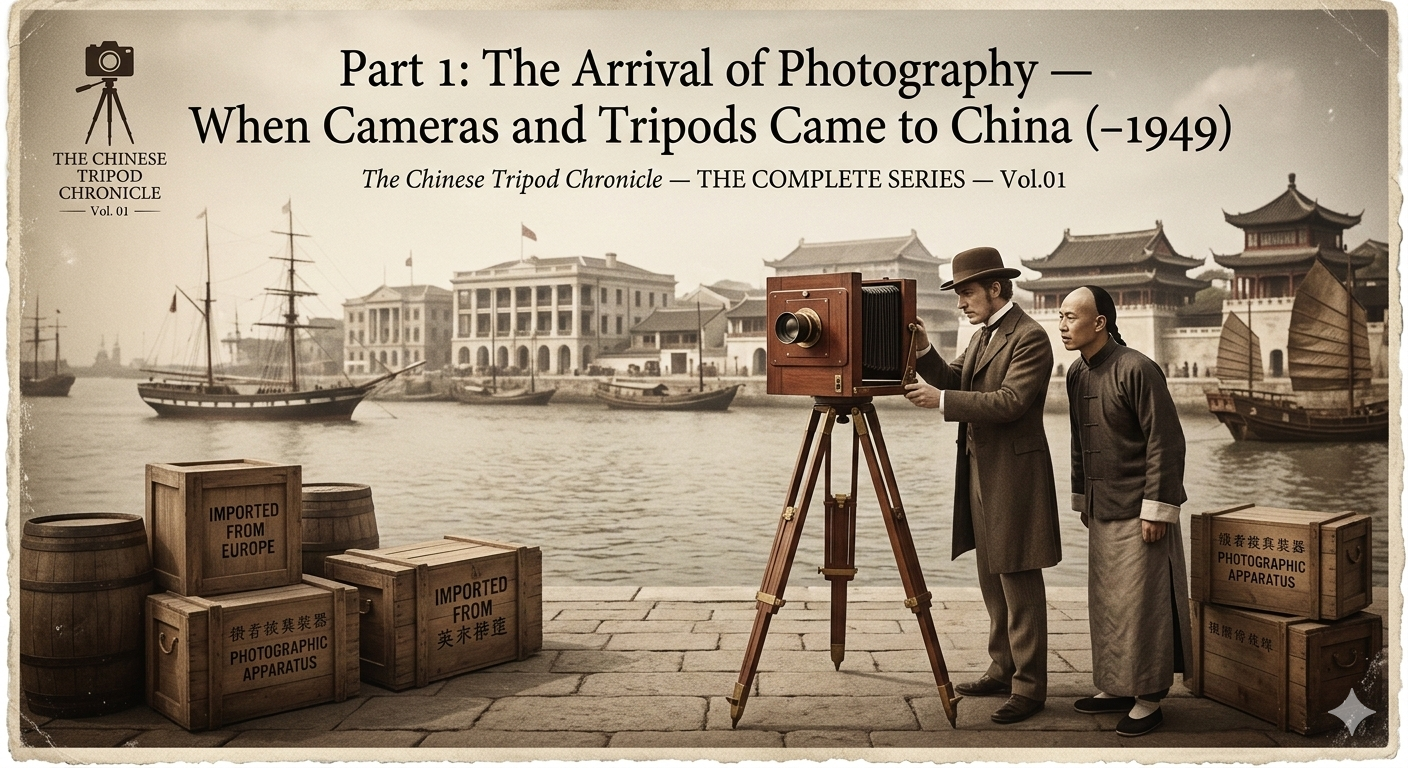
This first installment traces the earliest encounters between China and photography, from the Opium War era through the end of the Republic of China in 1949. Along the way, we will see how cameras and tripods arrived as foreign imports, how a photographic culture gradually took root, and why domestic tripod manufacturing remained virtually nonexistent during this entire period.
Photography Arrives: The Treaty Port Era (1840s–1860s)
The First Cameras in China
The precise date when the first camera entered China is difficult to pinpoint. However, most photo-historians agree that daguerreotype cameras arrived in southern China — particularly in the treaty ports of Guangzhou (Canton) and Hong Kong — during the 1840s.
Following the First Opium War (1839–1842) and the Treaty of Nanking (1842), several Chinese ports were forcibly opened to Western trade. Along with merchants, missionaries, and diplomats came the material culture of the West — including photographic equipment.
The earliest known photographs taken in China date from this period. Jules Itier, a French customs official, is credited with taking daguerreotype images in Guangzhou and Macau around 1844. These images — stiff, silvery, requiring long exposure times — were produced with bulky wooden cameras mounted on equally bulky wooden tripods.
Tripods as Foreign Objects
It is important to note that at this stage, the tripod was not a separate commercial product. It was simply part of the photographic apparatus — an essential but unremarkable component shipped alongside the camera, the lens, and the chemical supplies from Europe or America.
These early tripods were made of wood (typically mahogany or ash), with brass fittings. They were heavy, often weighing several kilograms, and designed for the cumbersome wet-plate and daguerreotype processes that required the camera to remain absolutely still during exposures of several seconds to several minutes.
No one in China was manufacturing tripods at this time. The concept of a “tripod industry” simply did not exist.
The Rise of Commercial Photography Studios (1860s–1900s)
Foreign and Chinese-Operated Studios
By the 1860s and 1870s, commercial photography studios had begun to appear in major Chinese cities — first in the treaty ports, then gradually spreading inland.
Some of these studios were operated by Westerners. Notable among them were Felice Beato (who photographed the Second Opium War in 1860) and John Thomson (whose Illustrations of China and Its People, published in 1873–1874, remains one of the most important early photographic records of China).
Chinese-operated studios also emerged during this period. Lai Afong (賴阿芳), active in Hong Kong from the 1860s, is often cited as one of the earliest and most commercially successful Chinese photographers. His studio produced portraits, landscapes, and commercial photographs that catered to both Western and Chinese clientele.
Equipment: Still Entirely Imported
All photographic equipment used in these studios — cameras, lenses, plates, chemicals, and tripods — was imported from Europe (primarily Britain, France, and Germany) or the United States.
The concept of domestically manufactured photographic equipment had not yet emerged. China’s industrial base in the late 19th century was focused on textiles, mining, and military manufacturing (through the Self-Strengthening Movement of the 1860s–1890s). Precision optical instruments and photographic supplies were far outside the scope of domestic production capabilities.
Tripods remained wooden, imported, and treated as disposable accessories — functional but unremarkable.
The Early 20th Century: Photography Expands, but Manufacturing Does Not (1900–1937)
Photography Becomes More Accessible
The early 20th century saw significant changes in Chinese society — the fall of the Qing dynasty (1912), the founding of the Republic of China, and rapid urbanization in cities like Shanghai, Beijing, and Guangzhou. Photography became more widespread during this period, driven by several factors:
- Kodak’s global expansion: The Eastman Kodak Company established a presence in China in the early 1900s, selling affordable roll-film cameras that made photography accessible beyond professional studios.
- Japanese photographic equipment: As Japan’s camera industry grew in the early 20th century, Japanese-made cameras and accessories (which were often less expensive than European equivalents) began to enter the Chinese market.
- The rise of photojournalism: Chinese newspapers and magazines increasingly used photographs, creating demand for photographic equipment among journalists and publishers.
The Shanghai Photography Scene
Shanghai, as China’s most cosmopolitan and commercially developed city, became the center of the country’s photographic culture. Photography clubs were formed, exhibitions were held, and a community of serious amateur photographers emerged.
However, even in this vibrant photographic culture, all equipment continued to be imported. Japanese brands like Canon (founded 1937), Nikon (founded as Nippon Kogaku in 1917), and Minolta were beginning to establish themselves, but their products reached China through import channels, not domestic manufacturing.
Why No Domestic Manufacturing?
The absence of domestic camera or tripod manufacturing in early 20th-century China can be attributed to several factors:
- Lack of precision manufacturing infrastructure: Cameras and lenses require precision optical glass, fine mechanical components, and quality control systems that China’s industrial base could not yet support.
- Political instability: The warlord era (1916–1928) and subsequent political upheaval made long-term industrial investment difficult.
- Small market size: Despite growth, the market for photographic equipment in China remained relatively small compared to Europe, the US, or Japan.
- Import dependency: It was easier and cheaper to import established foreign products than to develop manufacturing capabilities from scratch.
War and Upheaval (1937–1949)
The Second Sino-Japanese War and World War II
The period from 1937 to 1945 was defined by the Second Sino-Japanese War (which merged into the broader Pacific Theater of World War II). During this period, normal commercial activity — including the photography market — was severely disrupted.
Japanese occupation of major Chinese cities disrupted import channels for Western photographic equipment. Ironically, some Japanese photographic products became more available in occupied areas, though the market was heavily constrained by wartime conditions.
The Chinese Civil War (1946–1949)
Following Japan’s surrender in 1945, China was plunged into civil war between the Nationalists (Kuomintang) and the Communists. This three-year conflict further delayed any possibility of establishing domestic photographic equipment manufacturing.
The State of Affairs in 1949
When the People’s Republic of China was proclaimed on October 1, 1949, the state of China’s photographic equipment industry can be summarized in a single word: nonexistent.
- There were no domestic camera manufacturers.
- There were no domestic lens manufacturers.
- There were no domestic tripod manufacturers.
- All photographic equipment was imported — primarily from Japan, Germany, and the United States.
- The concept of a “Chinese camera equipment industry” existed only as a distant aspiration.
This was the starting point. Everything that followed — the state-owned factories, the OEM era, the rise of Benro and Sirui, the Leofoto revolution — grew from this zero point.
The Chinese Tripod Chronicle — THE COMPLETE SERIES
- Series overview
- Part 1: The Arrival of Photography — When Cameras and Tripods Came to China (–1949)
- Part 2: The State Factory Era — Optical Equipment Under a Planned Economy (1949–1978)
- Part 3: Reform, Opening Up, and OEM — How Tripod Factories Gathered in Guangdong (1978–1999)
- Part 4: The Rise of Private Brands — Benro, Sirui, and Fotopro Enter the Stage (2000–2009)
- Part 5: Conquering the World Market — Redefining “Chinese Tripods” (2010–Present)
References
- Terry Bennett — History of Photography in China 1842–1860 (Quaritch, 2009). The definitive English-language study of early photography in China, including the daguerreotype era.
- Jeffrey W. Cody and Frances Terpak (eds.) — Brush & Shutter: Early Photography in China (Getty Research Institute, 2011). Exhibition catalog covering Chinese and Western photographers in 19th-century China.
- Régine Thiriez — Barbarian Lens: Western Photographers of the Qianlong Emperor’s European Palaces (Gordon and Breach, 1998). Includes discussion of early photographic equipment used in China.
- John Thomson — Illustrations of China and Its People (1873–1874). One of the most important early photographic documents of China, providing visual evidence of photographic practice and equipment.
- Kodak (Eastman Kodak Company) — Corporate history materials relating to early 20th-century expansion in Asia.
- The Metropolitan Museum of Art / Getty Museum — Digital collections of early Chinese photography, including daguerreotypes and albumen prints from the 1840s–18