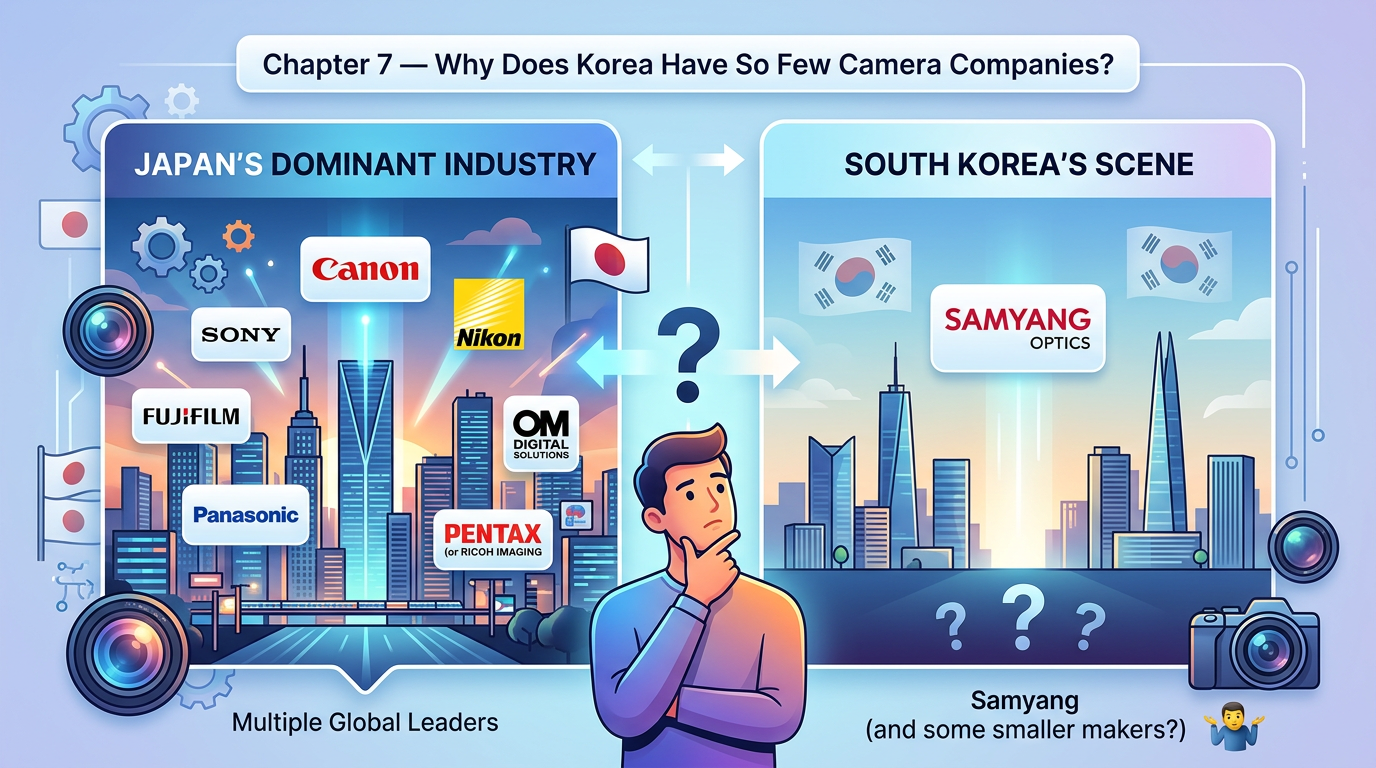
Japan has Canon, Nikon, Sony, Fujifilm, Panasonic, OM Digital Solutions (formerly Olympus), and Pentax (now Ricoh Imaging). Germany has Leica, Zeiss, and Schneider-Kreuznach. And South Korea? Samyang — just one company. Why?
Why Japan Dominates the Camera Industry
Before examining Korea’s camera industry, it’s worth understanding why Japan is so overwhelmingly dominant in this space.
From Prewar Imitation to Postwar Innovation
Japan’s camera industry traces its roots to prewar technology transfer from Germany. Before World War II, the camera market was dominated by German manufacturers — Leica, Contax, Rollei, Voigtländer — and Japanese companies initially studied (and in some cases copied) these German products. It’s well documented that Nikon’s original corporate name was “Nippon Kogaku” (Japan Optical) and that early Nikkor lenses drew on Zeiss designs.
What truly catapulted Japan’s camera industry, however, was postwar institutional design. An analysis shared on Reddit’s photography forums highlighted several key factors:
“The Japanese government did some smart things to improve and protect their camera industry. First, they banned copying. Japanese companies were forbidden from copying German cameras and lenses and had to innovate on their own.”
“Another was the naming convention for lenses. Lenses had to be defined by numbers — focal length, aperture, special specifications. Naming after inventors was forbidden. Removing egos from lenses made it easier to produce more lenses and commercialize them.”
Additionally, American quality management expert W. Edwards Deming was invited to Japan during the postwar occupation, where he introduced statistical quality control methods to Japanese manufacturers. Deming’s teachings merged with the emerging culture of kaizen (continuous improvement), driving a dramatic leap in manufacturing quality across all Japanese industries.
The Culture of Iterative Design
One Reddit user offered this observation about Japan’s camera industry strength:
“I worked at a Japanese software company for a year, and I was blown away by their mastery of iterative design. They take what came before and make it better, over and over again. All attention and dedication poured in. Very little is ‘new’; most things are simply ‘better.’ This design philosophy is probably amazingly effective in the photographic industry.”
This culture of iterative improvement was particularly well suited to precision instruments like cameras and lenses. Small, incremental refinements year after year, steadily raising quality and gradually incorporating new technology — this is essentially the same approach that drives Toyota’s production system.
Why Korea Has So Few Camera Makers
So why couldn’t Korea — or didn’t Korea — break into this industry?
1. Timing Mismatch in Industrialization
Korea’s serious industrialization didn’t begin until the late 1960s, roughly 20 years behind Japan. By the time Korean manufacturing was gaining momentum in the 1960s–70s, Japanese camera makers had already cemented their foundations during the postwar recovery and were dominating global markets.
The camera industry requires the convergence of four advanced capabilities: optical design, precision machining, electronic control, and quality management. Achieving excellence in all four takes decades of accumulated expertise. Samyang’s journey — starting with OEM lens production in the 1970s — illustrates just how long that accumulation takes.
2. Korean Industrial Policy — Betting on Heavy Industry and Semiconductors
Under President Park Chung-hee, Korea concentrated its limited resources on heavy and chemical industries (steel, shipbuilding, petrochemicals, automobiles) and later on semiconductors and electronics. The chaebols — Samsung, LG, Hyundai, SK — grew massive by following this national strategy.
The camera industry was never part of that plan. Its market size was relatively small, and Japanese manufacturers already held overwhelming share. Pouring national resources into semiconductors and displays, with their vastly larger addressable markets, was simply more rational.
3. The Supply Chain Problem
Manufacturing camera lenses requires high-quality optical glass, precision mold technology, aspherical lens processing, and advanced coating techniques. Much of this supply chain is dominated by Japanese companies — HOYA, Ohara, Sumita Optical Glass, and others.
Korea’s Maeil Business Newspaper reported in 2024 that LK Samyang is “the only interchangeable lens manufacturer in South Korea.” The paper also noted that Korean smartphone camera lens module makers “depend heavily on Japan for key materials and components” — a dependency that extends well beyond interchangeable lenses.
4. Samsung NX — The Attempt That Failed
Korea’s most serious entry into the camera market came from Samsung Electronics with the NX series (roughly 2010–2016).
The Samsung NX system used APS-C sensors in mirrorless camera bodies with a proprietary Samsung NX mount. The NX1 in particular was highly praised for its innovation and image quality. As one Reddit user noted:
“Samsung, the Korean company, their NX1 was a very innovative and highly regarded camera that takes great photos. You can never say it was ‘bad.’ Samsung was simply outmaneuvered by Sony in the mirrorless camera market. Sony was selling full-frame mirrorless cameras at the same price as Samsung’s crop-sensor mirrorless system.”
But as the overall digital camera market contracted under smartphone pressure, Samsung decided to exit the camera business around 2016. NX mount lens production ceased. The lenses had reportedly been manufactured by Korean company Optron-Tec, but after Samsung’s withdrawal, much of that technical capability dispersed.
PetaPixel reported in 2020 that Olympus had exited the Korean camera market entirely — underscoring just how small the Korean market is.
“Is It Really That Korea Has Few — Or That Japan Has Too Many?”
The answer to this question is half yes, half no.
The “Yes” Side
Japan has the highest concentration of camera manufacturers of any country in the world. By that standard, every country has “few” camera makers. Even Germany has only Leica as a body manufacturer. The United States had RED (cinema cameras), but that was acquired by Nikon in 2024. Australia has Blackmagic Design. None of these are major still camera manufacturers.
In other words, it may be more accurate to say “Japan has an abnormally high number of camera companies” rather than “Korea has too few.”
The “No” Side
Korea is one of the world’s leading electronics powers. Samsung is the world’s second-largest image sensor manufacturer (behind Sony). LG has significant imaging technology capabilities. The component technologies needed to build cameras largely exist within Korea.
Yet only Samyang remains as a lens manufacturer. This points to a structural issue: Korean conglomerates gravitate toward massive markets (semiconductors, smartphones, displays) and have little incentive to commit resources to the niche camera market. Samsung’s NX exit is the clearest illustration of this dynamic.
What It Means to Be “The Last One Standing”
After Samsung exited the camera business, Samyang became the only company in South Korea capable of designing and manufacturing interchangeable camera lenses. The “World Class 300 Enterprise” designation from the Korean government in 2017 reflected this role as the standard-bearer of Korean optical industry.
But Samyang’s position is simultaneously a source of pride and fragility. The entire Korean interchangeable lens industry rests on a single company with approximately 130 employees.
The Schneider-Kreuznach partnership, the L-Mount Alliance membership, and the “LK = Leading Korea” corporate rebrand may represent more than business strategy. They may be Samyang’s declaration that it intends to “lead” Korea’s optical industry — not just survive within it.
Conclusion — What Samyang’s Story Tells Us
Founded as “Korea WAKO” in 1972, spending decades as an anonymous OEM subcontractor, reinventing itself with the 85mm F1.4 as an own-brand lens maker, breaking into autofocus to survive the mirrorless era, and now partnering with Schneider-Kreuznach for the next chapter — Samyang’s story is a microcosm of Korean manufacturing and a mirror reflecting the evolution of the global lens market.
In an industry overwhelmingly dominated by Japanese companies, the fact that a 130-person optical manufacturer has survived for over 50 years is itself remarkable. And now that small manufacturer has partnered with a German optical institution and is developing a full lineup of AF zoom lenses.
No one can predict what Samyang’s next 50 years will look like. But one thing seems certain: there are more interesting lenses yet to come from that factory in Masan.
Sources
- Reddit r/photography — “Why are ALL major camera companies Japanese?” (https://www.reddit.com/r/photography/comments/4s5hq9/why_are_all_major_camera_companies_japanese/)
- Photo Stack Exchange — “Why do Japanese companies dominate the camera market?” (https://photo.stackexchange.com/questions/119837/why-do-japanese-companies-dominate-the-camera-market)
- Wikipedia — “Samsung NX series” (https://en.wikipedia.org/wiki/Samsung_NX_series)
- PetaPixel — “Olympus Exits Camera Market in Korea” (https://petapixel.com/2020/05/20/olympus-exits-camera-market-in-korea/)
- NamuWiki — “LK삼양” (https://en.namu.wiki/w/LK삼양)
- Maeil Business Newspaper — “Samsung Electronics, which was leading the K-optical industry, got out…” (https://www.mk.co.kr/en/business/11181079)
- The Lec — “Samsung’s South Korean lens suppliers struggling to survive” (http://www.thelec.net/news/articleView.html?idxno=3407)
- The Lec — “S.Korea relies heavily on Japan for camera lens components” (https://www.thelec.net/news/articleView.html?idxno=424)
- DPReview Forums — “Who manufactures Samsung lenses?” (https://www.dpreview.com/forums/threads/who-manufactures-samsung-lenses.3785030/)
- Camera-wiki.org — “Samsung” (https://camera-wiki.org/wiki/Samsung)
- PetaPixel — “Japanese Companies Shipped 10.6 Million Lenses in 2025” (https://petapixel.com/2026/02/03/japanese-companies-shipped-10-6-million-lenses-in-2025/)
- W. Edwards Deming — Wikipedia (https://en.wikipedia.org/wiki/W._Edwards_Deming)