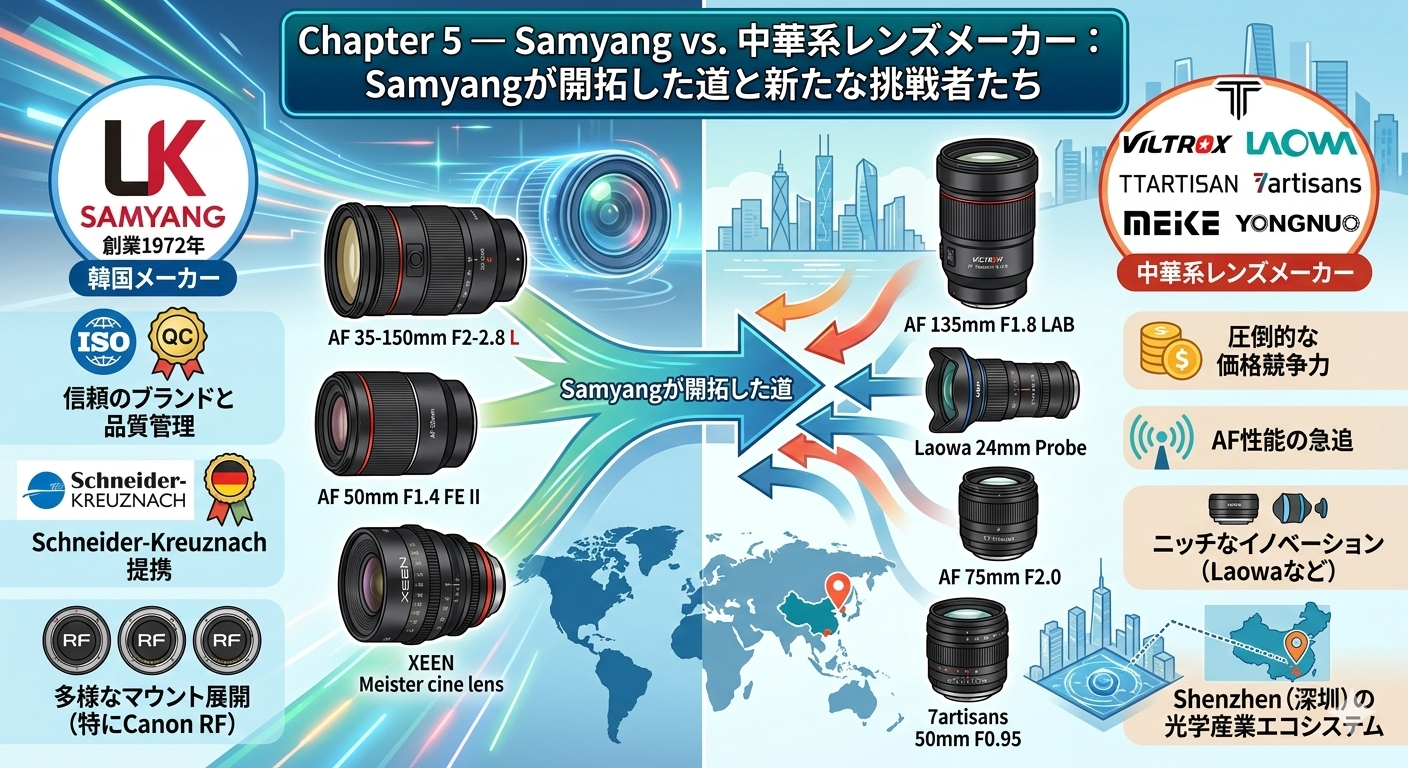
The path Samyang carved out in 2008 with the 85mm F1.4 — affordable, high-quality third-party lenses — was a trail others would follow. By the 2020s, a new generation of challengers had emerged from Shenzhen, China.
The Road Samyang Paved
PetaPixel’s guide to third-party lens brands puts it plainly:
“First, the contributions of Samyang must be addressed. Samyang is probably the best-known Asian manufacturer, but it is a Korean company, not a Chinese one. Samyang has paved the way for other Asian third-party lens brands, because the companies listed below are trying to emulate Samyang’s success.”
“Founded in 1972, Samyang has a long history in manufacturing optical components, but making low-cost lenses is a more recent endeavor. The starting point of all third-party manufacturers is entering the market at low cost and low risk. The easiest way to achieve this is to start producing simple-optics, manual-focus prime lenses. IP-free designs are readily available and require relatively simple manufacturing and assembly.”
The playbook Samyang pioneered — enter the market with MF primes, build a brand, then graduate to AF lenses and higher price points — became the roadmap for the Chinese lens makers that followed.
The Major Chinese Lens Makers
From the late 2010s onward, a wave of Chinese lens manufacturers emerged as serious players. Here are the key names.
Viltrox — The Most Direct Threat
- Founded: 2009 (Shenzhen, China)
- Profile: Started with mount adapters and teleconverters, then moved into lens manufacturing. Early investment in AF technology
- Key mounts: Sony E, Nikon Z, Fujifilm X, Leica L, Micro Four Thirds
- Notable products: AF 85mm F1.8, AF 56mm F1.4, AF 75mm F1.2 XF, AF 135mm F1.8 LAB
Viltrox is arguably Samyang’s most direct competitor among the Chinese brands. The company leveraged its mount adapter expertise — which required deep knowledge of electronic communication protocols — to become one of the first Chinese manufacturers to mass-produce AF lenses.
The 2024 AF 135mm F1.8 LAB was a wake-up call. Review site DustinAbbott.net ran a head-to-head comparison against Samyang’s AF 135mm F1.8 FE and concluded: “Viltrox brings premium build quality, excellent features, and better optical performance. Samyang’s only advantages are being significantly lighter and slightly cheaper.”
Laowa (Venus Optics) — The Niche Innovator
- Founded: 2013 (Hefei, Anhui Province, China; sales office in Hong Kong)
- Profile: MF-only specialist focusing on highly unique products — macro probe lenses, ultra-wide zero-distortion lenses, tilt-shift lenses
- Key mounts: Nearly all mounts supported
- Notable products: 24mm F14 2x Macro Probe, 9mm F5.6 FF RL
Laowa has carved out a niche by building lenses that major manufacturers simply don’t make. Direct competition with Samyang is limited, but Laowa has expanded the definition of what a “third-party lens” can be.
TTArtisan — The Fast-Growing Newcomer
- Founded: 2019
- Profile: Started with Leica M-mount compatible lenses. Rapidly expanding into AF territory
- Key mounts: Sony E, Nikon Z, Fujifilm X, Leica M & L, Hasselblad XCD
- Notable products: AF 35mm F1.8, AF 75mm F2.0
TTArtisan was founded by one of the co-founders of 7artisans. Despite being a late entrant (established 2019), the company has expanded its lineup at breakneck speed. Its AF lenses directly compete with Samyang at overlapping focal lengths, using aggressive pricing as the primary weapon.
7artisans
- Founded: 2015
- Profile: Extremely affordable MF lenses in large variety. Known for exotic specs like 50mm F0.95
- Key mounts: Nearly all mounts supported
Meike
- Founded: 1997 (lens production from around 2017)
- Profile: Originally a camera accessories maker. Now focusing on cinema lenses
- Key mounts: Various
Yongnuo
- Founded: 2006 (lens production from 2014)
- Profile: Famous for flashes and wireless triggers. Made headlines with a clone of the Canon EF 50mm F1.8
Shenzhen — Why China Keeps Producing New Lens Makers
It’s no coincidence that most of these companies are based in or around Shenzhen, often called “China’s Silicon Valley.”
Shenzhen is the world’s electronics manufacturing hub, and the mass production of smartphone camera lens modules has created a deep supply chain of optical components, precision tooling, and manufacturing know-how in the region.
PetaPixel analyzes the phenomenon:
“This is undoubtedly the confluence of several factors. It relates to China’s opening up as part of the global production chain — particularly the increased manufacturing of technology products after 2000. This happened simultaneously with the boom in digital camera and smartphone manufacturing, which raised the capacity and capability of Chinese production lines and staff.”
In short, smartphone cameras drove the commoditization of optical components and precision manufacturing. That, in turn, lowered the barrier to entry for building interchangeable mirrorless camera lenses.
Samyang vs. Chinese Makers — The Competitive Landscape
The competition between Samyang and the Chinese manufacturers can be analyzed along several axes.
1. Price Competition
Price is the Chinese makers’ strongest weapon. The TTArtisan AF 75mm F2.0 retails for around $178; the Meike 85mm F1.8 for about $200 — often less than half the price of equivalent Samyang products.
Samyang occupies a middle ground: “somewhat more expensive” than Chinese alternatives, but “significantly cheaper” than Sony, Sigma, or Tamron. This positioning is both an advantage and a vulnerability.
2. AF Performance
In the AF lens segment, the Samyang-Viltrox rivalry has intensified. Both companies target the Sony FE mount as their primary battleground, offering lenses at overlapping focal lengths and apertures. As of 2024–2025, Viltrox’s latest LAB series has closed the gap with Samyang, and in some cases surpassed it.
3. Brand Trust and Quality Control
PetaPixel flags a persistent concern about Chinese third-party lenses:
“Smaller lens manufacturers may have lower quality control standards than larger brands. Copy-to-copy variation in quality, focus accuracy issues, lack of compatibility, and — especially with very inexpensive third-party lenses — more potential for build quality and image quality issues.”
Here, Samyang’s 50-plus years of history offer a genuine advantage. The post-2013 quality control improvements, the 2016 factory rebuild, and ISO certifications all serve as differentiation from newer Chinese entrants.
4. Mount Strategy
Canon has taken a restrictive stance toward third-party RF mount lenses — PetaPixel reported that Canon asked Viltrox to cease selling RF mount lenses. Samyang, like Viltrox, is believed to have reverse-engineered the RF mount protocol. However, while Viltrox withdrew from the RF mount, Samyang’s RF lenses remain on sale, suggesting some form of arrangement with Canon. This represents a meaningful advantage over Chinese competitors.
The Schneider-Kreuznach Card — Differentiation Through Partnership
The 2024 Schneider-Kreuznach partnership takes on added significance in the context of Chinese competition.
Having the endorsement of a century-old German optical house allows Samyang to communicate a quality and reliability message that Chinese manufacturers cannot easily match. This resonates with a specific buyer segment: people who can’t justify first-party lens prices but are uncomfortable with the quality uncertainty of Chinese alternatives. That segment is Samyang’s core audience.
Samyang’s Survival Strategy — From “Cheap” to “Value”
Samyang’s path forward amid Chinese competition is becoming clear:
- Escape the price war: Rather than racing to the bottom against Chinese makers, Samyang is raising quality and brand value — through the Schneider-Kreuznach partnership, the Prima series, and premium positioning
- Zoom lens differentiation: While most Chinese makers are still focused on MF primes, Samyang has pushed into fast AF zooms (14-24mm, 24-60mm, 35-150mm, 60-180mm)
- Cinema lens strength: The XEEN brand and V-AF series give Samyang a strong presence in the filmmaking market, where most Chinese makers remain weak
- Multi-mount expansion: AF lenses across Sony E, Leica L, Canon RF, and Fujifilm X mounts
This mirrors the transformation that Tamron and Sigma underwent years ago — evolving from “cheap third-party” to “quality-competitive third-party.” Samyang is on the same trajectory.
Sources
- PetaPixel — “A Guide to Third-Party Chinese Lens Brands” (https://petapixel.com/chinese-lens-brands/)
- DustinAbbott.net — “Viltrox LAB vs Samyang AF – 135mm Battle!” (https://dustinabbott.net/2024/11/viltrox-lab-vs-samyang-af-135mm-battle/)
- phillipreeve.net — “The Best Fullframe Lenses from China” (https://phillipreeve.net/blog/the-best-fullframe-lenses-from-china/)
- DPReview Forums — “Samyang 85mm 1.4 II vs Viltrox 85mm 1.8 II vs Viltrox 85mm 1.4 Pro” (https://www.dpreview.com/forums/threads/samyang-85mm-1-4-ii-vs-viltrox-85mm-1-8-ii-vs-viltrox-85mm-1-4-pro.4816114/)
- Reddit r/Nikon — “What do you think of Viltrox and Samyang?” (https://www.reddit.com/r/Nikon/comments/1k72mol/what_do_you_think_of_viltrox_and_samyang/)
- The Phoblographer — “Some of the Best Lenses Aren’t Made in Japan Anymore” (https://www.thephoblographer.com/2022/06/17/opinion-some-of-the-best-lenses-arent-made-in-japan-anymore/)
- Camera-wiki.org — “Samyang” (https://camera-wiki.org/wiki/Samyang)